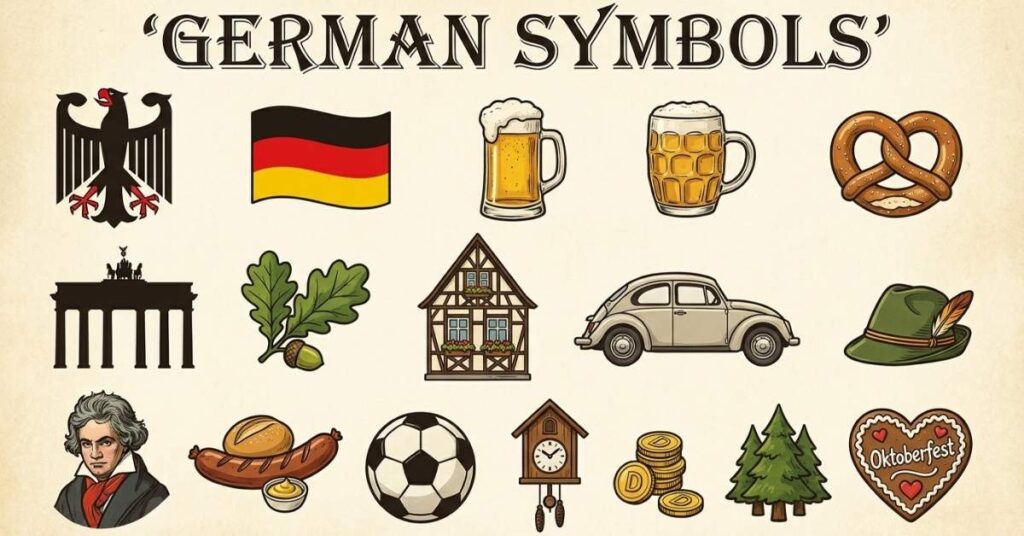
Germany’s history stretches across tribal forests, medieval empires, two world wars, and a divided nation reunited. Along the way, it produced a set of symbols so powerful that they still shape flags, tattoos, sports jerseys, and even how people search the internet today. From the black federal eagle to ancient runes carved into stone, German symbols carry centuries of meaning packed into a single image.
This guide breaks down every major German symbol, where it came from, what it means now, and why it still matters in 2026. Whether you’re researching your family heritage, planning a tattoo, or simply curious about German culture, you’ll find clear, accurate answers here.
What are German Symbols?
German symbols are visual marks, emblems, letters, or objects that represent Germany’s history, values, or identity. They include national emblems like the federal eagle and the black-red-gold flag, historic military marks like the Iron Cross, and older tribal signs such as runes used by early Germanic peoples.
Some are official, appearing on passports, coins, and government buildings. Others are cultural, showing up in folklore, festivals, and family crests, forming a visual language that explains how Germany sees itself.
Ancient German Symbols And Their Hidden Stories
Long before Germany existed as a country, the people living in its forests and river valleys used symbols to mark identity, honor gods, and protect their communities. Many of these old signs still surface in jewelry, tattoos, and folklore today.
Also Check This: Symbols of Rebirth
Ancient German Symbols
Ancient German symbols date back thousands of years, carved into stones, weapons, and jewelry by early tribal communities. Common examples include sun wheels, protective knotwork, and early rune-like markings that predate written Old German.
Germanic Tribe Symbols

Germanic tribes such as the Saxons, Franks, and Cherusci used distinct emblems on shields and banners to show clan identity in battle. These marks often featured animals like wolves, boars, and ravens, chosen for traits such as loyalty and ferocity.
Germanic Symbols
Germanic symbols broadly cover the visual traditions shared across early Central and Northern European tribes, including runes, animal totems, and nature icons like the world tree. They were rarely decorative alone; many were believed to carry protective or spiritual power, later influencing Norse mythology as well.
German Symbols And Meanings In Modern Culture
Today, German symbols carry updated meanings shaped by democracy, reunification, and modern national identity, even though many still borrow directly from ancient and medieval roots.
German Symbols And Meanings
Modern German symbols mostly represent unity, resilience, and democratic values rather than conquest or tribal power. The federal eagle stands for strength and independence, while the black-red-gold flag represents the long struggle for freedom, explaining why Germans display them with quiet pride.
German Symbolism
German symbolism blends mythology, Christianity, and political history into a layered visual system. A single symbol, like the eagle, can simultaneously reference the Roman Empire, the Holy Roman Empire, and the modern Federal Republic, making it a rich subject for historians and designers alike.
Symbols Of Germany
The most recognized symbols of Germany include the Bundesadler (federal eagle), the black-red-gold flag, the Brandenburg Gate, and the Iron Cross. Regional symbols, like the Bavarian rhombus pattern, also carry strong cultural weight, appearing on everything from government seals to football jerseys.
What Is The Symbol Of Germany?
The official national symbol of Germany is the Bundesadler, a black eagle with red beak and claws set on a gold shield. It represents power, independence, and national unity, and it appears on federal buildings, official documents, and the presidential standard.
Also Check This: Sleep Token Symbols
German Symbols Text
German symbols text refers to special characters unique to the German alphabet, most notably the umlauts (ä, ö, ü) and the sharp S (ß), called the eszett. These characters change meaning entirely, so “schon” (already) and “schön” (beautiful) are different words despite looking similar.
German Symbols Letters

German symbol letters include ä, ö, ü, ß, and occasionally the archaic long s used in older printed texts. On most keyboards, these can be typed using alt codes (Alt+0228 for ä) or by switching to a German keyboard layout.
German Symbols To Copy
For quick use, here are commonly copied German symbols and characters:
- ä, ö, ü (umlauts)
- ß (eszett or sharp S)
- € (Euro sign, used across Germany and the EU)
- † (dagger, sometimes used in German genealogy records)
- § (section sign, common in German legal documents)
These can be copied directly and pasted into documents, social media captions, or messages without needing special software.
German Symbols Tattoos
German symbol tattoos usually draw from runes, tribal marks, or the Iron Cross, chosen for their bold lines and layered meaning. Popular choices include the Algiz rune for protection and the Othala rune for heritage. Because some historic symbols were misused during the Nazi era, it’s worth researching a design’s full history first.
Iconic, Ancient And Historical German Symbols
Some German symbols have stayed instantly recognizable for centuries, while others faded and were later rediscovered by historians, artists, and tattoo enthusiasts.
Iconic German Symbols
The most iconic German symbols include the Bundesadler, the black-red-gold flag, and the Brandenburg Gate, all instantly associated with the country worldwide. Their consistency over decades has made them trusted markers of German identity.
Traditional German Symbols
Traditional German symbols often come from regional folklore rather than national politics. The oak tree represents strength, wisdom, and endurance, and appears on the German one, two, and five cent Euro coins, alongside the maypole and regional harvest wreaths.
Famous German Symbols
Famous German symbols recognized outside Germany include the Iron Cross, the federal eagle, and Oktoberfest imagery like the pretzel and beer stein. Automotive logos, like the three-pointed Mercedes-Benz star, have also become unofficial symbols of German engineering.
Ancient German Symbols Tattoos
Ancient German symbol tattoos, especially runes and tribal knotwork, remain popular because they combine deep history with striking design. The Berkano rune (growth) and the Fehu rune (prosperity) are common choices for subtle, meaningful ink. Checking a symbol’s authentic origin helps avoid accidental use of designs linked to extremist misappropriation.
Old German Symbols

Old German symbols include early guild marks, family crests, and church seals used across medieval towns to identify trade, lineage, and local governance. Many still appear on old buildings and historical documents preserved in German archives.
Meaningful German Symbols
The most meaningful German symbols represent values that outlast politics, including family loyalty, courage, and resilience. The oak leaf, the eagle, and the black-red-gold colors fall into this category, valued for what they represent rather than who governs.
German Symbols In War, Politics and Family
Germany’s turbulent 20th century left a permanent mark on how the world reads German symbols, particularly military and political emblems.
WW1 German Symbols
During World War 1, Germany used the Iron Cross, the Reichsadler (Imperial Eagle), and the black-white-red imperial flag as core military symbols. The Iron Cross, created in 1813, was widely awarded for bravery throughout the war and represented the German Empire under Kaiser Wilhelm II.
WW2 German Symbols
World War 2 symbols are historically the most sensitive, since the Nazi regime hijacked older German emblems and combined them with the swastika for propaganda. The Iron Cross itself was not a Nazi invention, but the party added a swastika to its center. After the war, West Germany legally required the swastika to be removed from any reissued medals.
Also Check This: Symbols of Virgo
WWII German Symbols
Beyond the Iron Cross, WWII symbols included the Balkenkreuz (bar cross) used on Wehrmacht vehicles and aircraft, plus various party insignia tied to Nazi organizations. It’s worth separating genuine military history, like the Balkenkreuz’s roots in the medieval Teutonic Order cross, from symbols created purely for Nazi ideology. Modern Germany strictly regulates the display of Nazi-specific symbols by law.
East German Symbols
East Germany, the former German Democratic Republic, rejected the eagle and instead used a hammer, compass, and wreath of grain, representing workers, intellectuals, and farmers under socialist ideology. This emblem disappeared after reunification in 1990, when the black-red-gold flag with the federal eagle returned as the symbol of a unified Germany.
German Symbols For Family
German family symbols often center on the family crest or Wappen, a heraldic design passed down through generations to show lineage and status. Oak leaves, keys, and animals like lions or stags commonly appear, each chosen to represent values such as protection or strength.
Popular German Symbols

The most searched German symbols in 2026 remain the federal eagle, the national flag, the Iron Cross emblem used by the Bundeswehr, and runic tattoo designs, popular thanks to national pride, historical curiosity, and strong visual design.
Deep Symbolic Meaning of German Symbols
Beyond history, German symbols carry layers of meaning that touch on spirituality, psychology, and shared cultural identity.
Spiritual Meaning
In spiritual interpretation, German symbols like runes are often associated with guidance, protection, and inner transformation. A rune might be read as a message from the subconscious, while cross-shaped symbols can represent a turning point in life or a search for identity.
Psychological Meaning
Psychologically, humans are drawn to German symbols because the brain naturally responds to clean geometry, symmetry, and repeated patterns, all common features of Germanic design. Symbols like the eagle also tap into universal associations with power and freedom.
Cultural Meaning
Culturally, German symbols reflect a nation that has rebuilt itself multiple times, from empire to division to reunification. This history gives symbols like the black-red-gold flag a meaning beyond decoration; they represent survival and hard-won national identity.
Types / Variations of German Symbols
Here are five of the most historically significant German symbols, each with a distinct origin and modern role.
1. Federal Eagle (Bundesadler)
The Bundesadler is a black eagle with a red beak, tongue, and claws set on a gold shield, and it is Germany’s official national emblem. Its roots trace back to the Roman Aquila standard, later adopted by the Holy Roman Empire and reshaped after World War 2 into a symbol of peaceful democracy.
2. Black-Red-Gold Flag
Germany’s flag consists of three horizontal bands: black, red, and gold. The colors first appeared together during the German Confederation era and became associated with liberal, democratic movements during the Revolutions of 1848. Suppressed under the Nazi regime, they were readopted by West Germany in 1949 and became the flag of reunified Germany in 1990.
3. Iron Cross (Eisernes Kreuz)
Created in 1813 by King Frederick William III of Prussia, the Iron Cross was one of the first military medals awarded based on merit rather than noble birth. In modified form without Nazi symbols, it remains the emblem of today’s Bundeswehr, the modern German armed forces.
4. Germanic Runes
Runes were the writing system used by early Germanic tribes before adopting the Latin alphabet, with each character believed to carry both a sound and a symbolic meaning. Runes like Algiz (protection), Fehu (wealth), and Othala (heritage) remain popular in jewelry and tattoos today.
5. Holy Roman Empire Eagle
The Holy Roman Empire adopted a single-headed, later double-headed, eagle as its imperial symbol starting around the 9th century, linking German rulers to the authority of ancient Rome. This eagle eventually evolved into the modern Bundesadler, one of Europe’s longest continuously referenced symbols.
German Symbols Across Cultures
German symbols didn’t develop in isolation. They absorbed influence from neighboring cultures and, in turn, shaped visual traditions across Europe and beyond.
Ancient Germanic Tribes
Early Germanic tribes used animal totems, runes, and nature symbols to represent clan identity long before centralized states existed, passed down mostly through oral storytelling rather than written record.
Roman Influence
Contact with the Roman Empire introduced the eagle standard to Germanic peoples, a symbol later absorbed into German heraldic tradition and used by early rulers to project authority.
Medieval Europe
During the medieval period, the Holy Roman Empire spread eagle imagery and cross-based symbols across Central Europe through coats of arms, city seals, and church architecture, while guild marks and family crests laid the foundation for symbols still recognized today.
Modern Europe
In modern Europe, German symbols like the black-red-gold flag are now tied to European Union values of democracy and cooperation, and Germany’s postwar rebuilding of its national symbols influenced how other nations approached emblem design after conflict.
Global Influence
Globally, German symbols show up in unexpected places, from the Iron Cross in motorcycle and heavy metal subcultures to rune-inspired designs in fantasy games and fashion, a spread that often strips symbols of their original weight, turning them into stylistic choices.
German Symbols in Art, Movies & Pop Culture
German symbols appear constantly across film, television, and design, often used to signal historical setting or cultural depth. War films frequently reference the Iron Cross and period-accurate flags to establish authenticity, while fantasy franchises borrow rune-like alphabets to create an ancient, mystical atmosphere. Automotive brands such as Mercedes-Benz, BMW, and Volkswagen use minimalist, geometric logos that echo the same precision and symmetry found in traditional German heraldry. In music, particularly metal and industrial genres, German imagery and language are used deliberately to evoke intensity, structure, and historical gravity. Video games set in medieval or wartime Europe also lean heavily on German symbols to build immersive, historically grounded worlds.
Spiritual & Dream Meaning of German Symbols
When German symbols appear in dreams, interpretation usually depends on the specific symbol and its traditional meaning. Seeing an eagle in a dream is commonly linked to ambition, vision, or a desire for freedom, while a cross-shaped image may point to a decision weighing on the dreamer’s mind. Runes appearing in dreams are sometimes interpreted as messages related to personal growth, hidden knowledge, or an unresolved connection to heritage. These interpretations are cultural and symbolic rather than scientific, so they work best as a starting point for personal reflection rather than a fixed rulebook.
Positive vs Negative Meaning
Like many powerful symbols, German symbols carry both uplifting and troubling interpretations depending entirely on historical context and who is using them.
Positive Meanings
In their positive form, German symbols represent unity, resilience, courage, freedom, and a deep connection to family and heritage. The black-red-gold flag, the federal eagle, and protective runes are widely embraced today as symbols of a modern, democratic Germany that has rebuilt itself from devastating conflict.
Negative Interpretations
Certain symbols carry negative associations because of their misuse during the Nazi era, particularly the swastika and Nazi-modified versions of older emblems like the Iron Cross. Groups tracking hate symbols note that context matters enormously; the same shape can represent centuries of legitimate military history or, in a different setting, extremist ideology. Understanding this distinction is essential before using historic German symbols in tattoos, artwork, or public display.
Why Humans Are Attracted to German Symbols
People are drawn to German symbols for reasons that go beyond aesthetics. The clean lines, symmetry, and geometric structure common in German design naturally appeal to how the human brain processes patterns and order. There’s also a strong emotional pull tied to storytelling: German symbols represent a nation that has fallen, rebuilt, and redefined itself multiple times across a single century. That narrative of resilience resonates with people seeking meaning, identity, or a visual connection to strength and endurance. For those with German heritage, these symbols also offer a tangible link to ancestry, family history, and a sense of belonging that stretches back generations.
FAQ’s
What is the most famous German symbol?
The Bundesadler, or federal eagle, is the most famous and officially recognized symbol of Germany, appearing on government buildings and documents.
Is the Iron Cross a Nazi symbol?
No. The Iron Cross predates the Nazi era by over a century and remains the emblem of Germany’s modern armed forces, though the Nazi-era version with a swastika is specifically associated with that regime.
What do the colors of the German flag mean?
Black, red, and gold represent the historic struggle for freedom, unity, and democracy, though their exact original meaning is debated by historians.
Are runes German or Norse?
Runes were used across early Germanic and Norse cultures, since both share common linguistic and cultural roots from Northern and Central Europe.
What is a good German symbol for a tattoo?
Protective runes like Algiz, or heritage-focused runes like Othala, are popular, meaningful choices, provided their history is properly researched first.
Why did East Germany not use the eagle?
East Germany rejected the eagle in favor of a hammer, compass, and grain wreath to represent its socialist, worker-focused ideology.
Conclusion
German symbols carry far more weight than simple decoration. From ancient runes carved by early tribes to the modern Bundesadler standing on government buildings, each symbol tells a chapter of a long, complicated national story. Some represent unity and democratic rebirth, while others remain permanently tied to painful history that must be understood with care and context. What makes German symbols so enduring in 2026 is exactly this depth: they are not static images, but living reminders of resilience, identity, and a nation that has continually redefined what it means to move forward.

Daniel Wilson is the admin of Meaning Lexi, a website focused on the meanings of words, names, phrases, and symbols. He is dedicated to providing clear, accurate, and easy-to-understand content for readers.