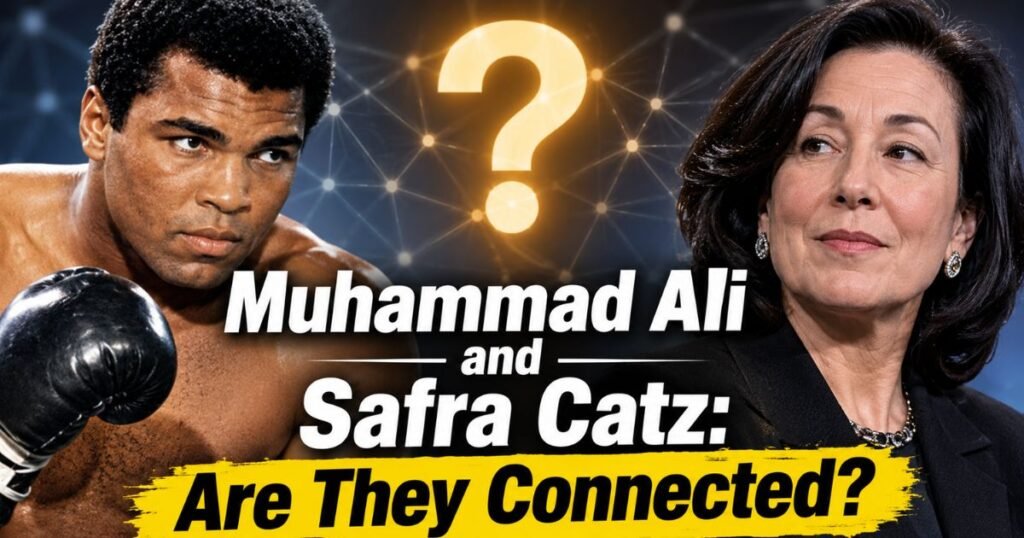
Muhammad Ali and Safra Catz are two of the most recognizable names in their fields. One built his legend in the boxing ring, the other built hers in the boardroom. So why do so many people search for Muhammad Ali and Safra Catz together?
The short answer is that no reliable public source shows a family, business, or personal link between them. This guide separates verified facts from online noise. You will learn who each person is, how their careers compare, and why the two names land in the same search results.
You will also get a simple method for checking biographical claims yourself. That way, the next time two famous names are paired online, you know exactly what to look for.
Are Muhammad Ali and Safra Catz Related?
No. There is no verified evidence that Muhammad Ali and Safra Catz are related by blood, marriage, or business. None of the biographical sources checked for this article mention the other person, including Oracle’s executive profile, Stanford’s faculty page, and the Jewish Women’s Archive entry on Catz.
Here is what the record does show:
- Muhammad Ali: born January 17, 1942, in Louisville, Kentucky, as Cassius Marcellus Clay Jr. He died on June 3, 2016, in Scottsdale, Arizona, at age 74.
- Safra Catz: born December 1, 1961, in Holon, Israel. She moved to the United States at age six and has worked at Oracle since 1999.
- Shared surname or family tree: none. Their family backgrounds, countries of birth, and careers are unrelated.
- Documented meeting or joint project: none found in the sources reviewed.
Two famous people can share a search query without sharing a history. The rest of this guide explains why that happens.
Who Was Muhammad Ali?
Muhammad Ali was an American professional boxer and activist, widely regarded as one of the most significant sports figures of the 20th century. He is the only fighter to win the lineal heavyweight championship three times. Outside the ring, he became a global symbol of conviction, faith, and resistance.
His rise to boxing fame
Ali began as Cassius Clay in Louisville. He won an Olympic gold medal in the light heavyweight division in 1960 and made his professional debut on October 29, 1960, with a six-round decision over Tunney Hunsaker. Trainer Angelo Dundee soon joined his corner.
His breakthrough came in 1964. At age 22, he upset the heavily favored Sonny Liston to claim the heavyweight title. After the fight he announced his conversion to Islam and took the name Muhammad Ali.
His career numbers show the scale of his run:
- Record: 56 wins, 5 losses, and 37 knockouts in 61 professional fights.
- Titles: lineal heavyweight champion in 1964, 1974, and 1978.
- Signature fight: the 1974 “Rumble in the Jungle” against George Foreman.
His stand against the Vietnam War
In 1964, Ali failed the military qualifying test. When the standards were revised in 1966, he became eligible for the draft. On April 28, 1967, in Houston, he refused three times to step forward for induction, citing his religious beliefs and his opposition to the war.
The consequences were severe:
- He was convicted of draft evasion in June 1967 and sentenced to five years, though he stayed free while appealing.
- Boxing authorities stripped his titles and his license.
- His passport was taken, which blocked fights abroad.
- He lost more than three years of his athletic prime.
On June 28, 1971, the U.S. Supreme Court unanimously overturned his conviction. By then, public opinion on the war had shifted, and Ali had become an icon for a generation that opposed it.
His lasting legacy
Ali retired in 1981. Doctors diagnosed him with Parkinson’s syndrome in 1984, and he made fewer public appearances as the illness progressed. He devoted his later years to religious and charitable work.
In 1996, he lit the cauldron at the Atlanta Olympics. In 1997, he received the Arthur Ashe Award for Courage. He and his wife, Lonnie, founded the Muhammad Ali Center in Louisville, which promotes his values of respect and understanding. He died in 2016, and his reputation as an athlete who risked everything on principle has only grown since.
Who Is Safra Catz?
Safra Catz is an Israeli-American business executive and one of the most influential leaders in enterprise technology. Oracle’s own profile lists her as executive vice chair of its board of directors. She served as the company’s chief executive officer until September 2025.
Education and early career
Catz was born in Holon, Israel, and moved to the United States at age six. She earned a bachelor’s degree from the Wharton School of the University of Pennsylvania in 1983 and a law degree from Penn Law in 1986.
She then joined the investment bank Donaldson, Lufkin & Jenrette, where she rose to managing director in investment banking. Over roughly 14 years on Wall Street, she covered the software industry and built deep experience in mergers and acquisitions.
A quick accuracy note: several low-quality biography sites list an MBA or a degree from another university. Her documented credentials are the Wharton undergraduate degree and the Penn law degree.
Her leadership at Oracle
Catz joined Oracle in April 1999 as a senior vice president. Her path at the company looks like this:
- 1999: joins Oracle and later becomes executive vice president.
- 2001: joins the board of directors.
- 2004: named president.
- 2005 to 2008: serves as chief financial officer.
- 2014: becomes co-CEO with Mark Hurd when Larry Ellison steps down as CEO.
- 2019: becomes sole CEO after Hurd’s death on October 18.
- 2025: moves from CEO to executive vice chair.
She is closely tied to Oracle’s acquisition strategy. Stanford’s faculty profile credits her with more than 85 acquisitions over a five-year period. Under her leadership, Oracle also grew into a major player in cloud computing.
Her professional influence
Catz’s influence extends beyond Oracle. Her verified roles include:
- HSBC Holdings: board member from 2008 to 2015.
- The Walt Disney Company: director, beginning in 2018.
- Paramount Skydance: current board member.
- In-Q-Tel: board of trustees.
- Homeland Security Advisory Council: member since 2022.
- Oracle Education Foundation: chair since 2004.
- Stanford Graduate School of Business: lecturer in accounting, teaching a course on mergers and acquisitions.
This mix of finance, law, and operations reflects a career built more on execution than on public visibility.
Muhammad Ali and Safra Catz: A Comparison
Placing the two side by side shows how different their paths were. The table below uses only facts confirmed by the sources reviewed.
| Category | Muhammad Ali | Safra Catz |
| Field | Professional boxing and activism | Investment banking and enterprise software |
| Born | January 17, 1942, Louisville, Kentucky | December 1, 1961, Holon, Israel |
| Best known for | Three-time lineal heavyweight champion | Longtime Oracle leader, CEO from 2014 to 2025 |
| Public stance | Refused Vietnam War induction in 1967 | Corporate and board leadership, public service councils |
| Education | Central High School, Louisville | Wharton (1983) and Penn Law (1986) |
| Era of peak influence | 1960s to 1980s | Late 1990s to present |
| Status | Died June 3, 2016 | Executive vice chair of Oracle |
| Documented link to the other | None found | None found |
The differences are clear:
- Arena: public combat versus private negotiation.
- Source of influence: personal charisma versus operational and financial skill.
- Visibility: Ali was a global celebrity by his early twenties, while Catz built her reputation largely behind the scenes.
Why Do People Search for Muhammad Ali and Safra Catz Together?
Public search data is not available for this question, so any explanation is informed reasoning rather than proof. Still, several patterns commonly pair unrelated famous names.
- Name matching: search engines connect pages that contain similar name tokens, even when the people are different.
- Shared directories: one page can list many notable people with no relationship among them.
- Content mirroring: low-quality biography sites copy and rewrite each other, which spreads the same errors.
- Curiosity: people often test whether two high-profile figures have a hidden link.
One example shows how this can happen. The Michael J. Fox Foundation’s Founders Council page lists Lonnie and Muhammad Ali alongside Lily Safra. Lily Safra is a different person, and nothing on that page connects her to Safra Catz. A search that blends “Ali” and “Safra” could still surface it. This is one plausible explanation, not a confirmed cause.
Online mentions are not proof of a relationship
Two names on the same web page prove only that the page contains both names. They do not show a family tie, a friendship, or a partnership.
A real connection leaves a trail: a named biography, a company filing, a court record, or a direct interview. When that trail is missing, the claim has no foundation, however often it is repeated.
Similar prominence does not mean shared history
Both Ali and Catz reached the top of highly competitive fields. That similarity in stature can make search tools group them under broad topics such as famous leaders or influential figures.
But stature is not history. Ali’s career peaked decades before Catz became Oracle’s president, and the two worked in worlds with almost no overlap.
Uncertainty should remain visible
This article reports that no link was found, not that a link is impossible. Proving a negative is hard, and honest writing says so.
If a credible primary source ever documents a connection, the conclusion should change. Until then, the most accurate answer is that no verified relationship exists in the public record.
What Their Stories Teach Us About Influence
Ali and Catz used very different tools, but their stories point to a few shared lessons about lasting influence.
- Preparation beats noise. Ali’s confidence was backed by an Olympic gold medal and years of training. Catz’s authority comes from decades of financial and legal discipline.
- Principle has a price. Ali gave up his titles and years of income over his convictions. Catz has navigated high-stakes corporate decisions where every choice carries risk.
- Institutions outlast individuals. The Muhammad Ali Center and the Oracle Education Foundation both aim to carry values forward beyond one career.
- Influence takes many forms. Public courage and quiet competence can both change an industry or a culture.
These lessons apply to both people without implying that they ever crossed paths.
The Importance of Accurate Biographical Research
Fame attracts mistakes. While reviewing sources on Catz, several lower-quality pages gave conflicting birth dates and incorrect degrees. Some Ali pages repeat famous stories that his own friends and biographers later disputed, such as the tale of his Olympic medal being thrown into a river.
Accurate research protects readers and the people being written about. Use this checklist before you trust or share a claim about a connection:
- Find the primary source. Look for an official biography, a filing, a court record, or a direct interview.
- Confirm with two independent sources. Pages that copy each other count as one source, not two.
- Check the date. Roles change. Catz moved from CEO to executive vice chair in 2025, and older pages still call her CEO.
- Read what the source actually says. A page that lists two names is not a page that links them.
- State uncertainty openly. If the evidence is thin, say so.
This approach follows the principles of experience, expertise, authoritativeness, and trustworthiness. Readers, and the AI tools that summarize the web for them, reward content that is specific, dated, and honest about its limits.
FAQ’s
Are Muhammad Ali and Safra Catz related?
No. No reliable source documents any family, marriage, or business relationship between them.
Did Muhammad Ali ever work with Safra Catz or Oracle?
No such work appears in the sources reviewed. Ali’s career centered on boxing, activism, and charity.
Who is Safra Catz?
She is an Israeli-American executive who joined Oracle in 1999 and became its CEO in 2014. She now serves as executive vice chair.
Is Safra Catz still the CEO of Oracle?
No. She served as CEO until September 2025 and now holds the executive vice chair role.
What was Muhammad Ali’s boxing record?
He won 56 of 61 professional fights, with 37 knockouts and 5 losses.
Why did Muhammad Ali refuse the draft?
He cited his religious beliefs and his opposition to the Vietnam War. The Supreme Court overturned his conviction in 1971.
How can I verify whether two famous people are connected?
Look for a primary source that names both people and states the link. Co-mentions on one web page are not proof.
Conclusion
Muhammad Ali was a boxing champion who risked his career for his beliefs. Safra Catz is a finance and technology leader who helped shape Oracle for more than two decades. Their achievements are remarkable, but the public record shows no connection between them.
The pairing in search results most likely reflects name matching, shared directories, and recycled web content rather than real history. The best response is curiosity paired with careful sourcing.
If you find a credible primary source that links them, treat it as new evidence and update the conclusion. Until then, keep the two stories separate and let the verified facts lead.

Daniel Wilson is the admin of Meaning Lexi, a website focused on the meanings of words, names, phrases, and symbols. He is dedicated to providing clear, accurate, and easy-to-understand content for readers.