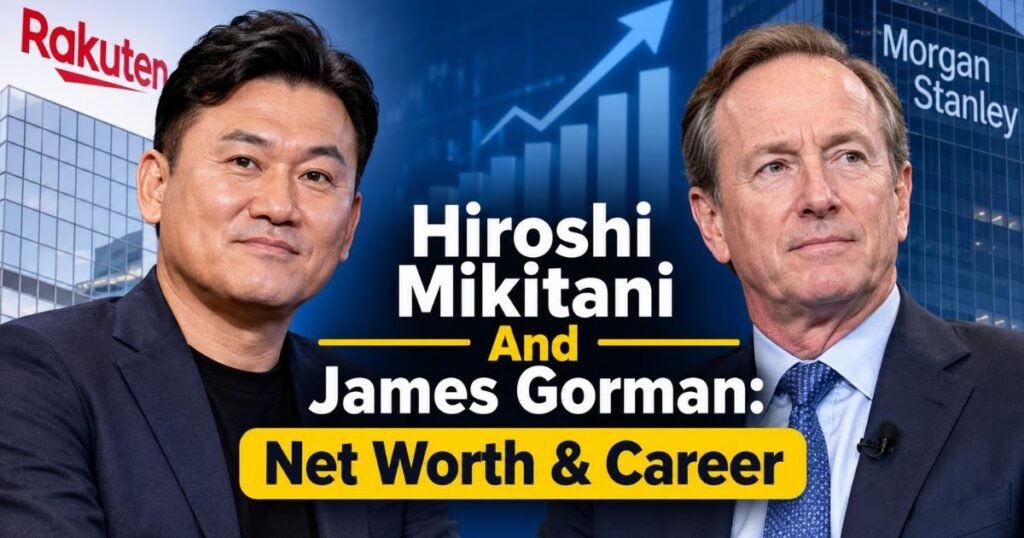
Hiroshi Mikitani and James Gorman lead very different kinds of organizations, yet more and more readers search for their names together. One built a Japanese internet empire from a single online mall. The other reshaped a Wall Street bank and now chairs one of the world’s best-known entertainment companies.
This guide puts Hiroshi Mikitani and James Gorman side by side, using current 2026 data. You will get their career timelines, the latest Rakuten and Disney developments, honest net worth ranges, and a clear answer to the question most pages skip: is there actually a connection between them?
Who Are James Gorman and Hiroshi Mikitani?
James Gorman is the Australian-born former CEO of Morgan Stanley and the current chairman of The Walt Disney Company. Hiroshi Mikitani is the Japanese founder, chairman and CEO of Rakuten Group.
| James Gorman | Hiroshi Mikitani | |
| Born | July 14, 1958, Melbourne | March 11, 1965, Kobe |
| Education | University of Melbourne (BA, LLB), Columbia MBA | Hitotsubashi University, Harvard MBA |
| Early career | McKinsey, then Merrill Lynch | Industrial Bank of Japan |
| Signature company | Morgan Stanley | Rakuten |
| Current role | Chairman, The Walt Disney Company | Founder, Chairman and CEO, Rakuten Group |
Both men started in finance or consulting. Both later moved into building or steering large platforms. That shared starting point explains part of why people compare them.
What Is the Connection Between James Gorman and Hiroshi Mikitani?
No direct business partnership or personal relationship between James Gorman and Hiroshi Mikitani appears in public records, company filings or major news coverage. The link people draw is thematic, not transactional.
A few recent blog posts, published in October 2026, frame the two as a pair. Those pieces compare their careers rather than document a shared deal. We found no joint venture, shared board seat or co-investment connecting them.
So what do they genuinely share?
- Both began in finance-adjacent careers before becoming operators.
- Both run or have run large, multi-business groups.
- Both are frequent names on global executive speaker lists.
- Both became known for how they handled leadership and change.
Treat any page that claims a secret partnership with suspicion. The honest answer is that this is a comparison of two leadership styles, not the story of a relationship.
James Gorman Career and Morgan Stanley Transformation
Gorman left Merrill Lynch in February 2006 to join Morgan Stanley as president and chief operating officer of its global wealth management group. He became co-president in December 2007. In 2009 he led the merger of Morgan Stanley’s wealth business with Citi’s Smith Barney, creating one of the largest wealth platforms in the world.
He became CEO in January 2010 and added the chairman title in 2012. At the time, Morgan Stanley leaned heavily on volatile trading revenue. Gorman’s long project was to make it steadier.
Key results of the Gorman era
- Smith Barney merger (2009): Built the base of the modern wealth franchise.
- E*TRADE (closed October 2, 2020): An all-stock deal valued at about $13 billion. It added roughly 5.2 million accounts and more than $360 billion in retail client assets.
- Eaton Vance (closed March 1, 2021): A roughly $7 billion purchase that created a much larger asset management arm.
- Client assets: Wealth management reached nearly $5 trillion by the end of 2021, according to the firm’s own earnings commentary.
- Ambition: Gorman publicly floated a $10 trillion client asset target.
The pattern is simple. He chose fee-based, recurring revenue over trading swings.
Expansion of Wealth Management
Gorman often described the wealth push as a long game. By his own account in 2021, the business had grown from about $500 billion in client assets a dozen years earlier to about $4 trillion.
Three moves explain the shift:
- Scale through acquisition. Smith Barney, E*TRADE and Eaton Vance each filled a different gap: advisors, self-directed investors and asset management.
- Workplace channel. Stock plan participants from E*TRADE became a pipeline for future wealth clients.
- Integration focus. After the deals, Gorman said the firm was done bulking up and needed to absorb what it bought.
Integration was not painless. Reports note that technology work took longer than first planned. Still, most analysts view the pivot as a success.
Gorman’s Succession at Morgan Stanley
Gorman announced his retirement plans in May 2023. Ted Pick took over as CEO at the start of 2024. Gorman stayed on as executive chairman until December 31, 2024, and Pick was later named his successor as chairman.
What made the handoff unusual was the aftermath. The two other leading candidates, Andy Saperstein and Dan Simkowitz, stayed at the firm. On Wall Street, losing candidates often leave. Business press coverage treated the retention as a rare feat of continuity.
James Gorman’s Role at Disney
James Gorman has been chairman of The Walt Disney Company since January 2, 2025. He succeeded Mark Parker, who left the board after nine years.
Gorman joined the board in 2024 and took over the succession planning committee in August of that year. That committee, which also included Mary Barra and Calvin McDonald, had one big job: find the next CEO after Bob Iger.
The outcome is now public. On February 3, 2026, Disney named Josh D’Amaro, previously chairman of Disney Experiences, as its next CEO, effective March 18. Dana Walden was named president and chief creative officer as part of the transition.
Why did Disney want Gorman? Its earlier succession attempt, which ended with the exit of Bob Chapek in November 2022, drew sharp criticism. Gorman arrived with a record of running an orderly handoff at Morgan Stanley.
Outside his two big roles, he also serves as a director of the Council on Foreign Relations and chairs the board of overseers of Columbia Business School.
James Gorman Net Worth: What the Numbers Show
There is no single verified figure for James Gorman’s net worth. Public estimates range from about $48 million to nearly $300 million, depending on the method.
Here is how the estimates compare:
| Source type | Estimate | Date | Notes |
| MarketScreener | About $48 million | January 2026 | Holdings-based |
| GuruFocus | Over $73 million | May 2024 | Based on about 767,000 MS shares |
| Quiver Quantitative | At least $222.8 million | July 2026 | SEC filing data, about 556,000 MS shares, plus past sales |
| Benzinga | About $296 million | Recent | Includes holdings across several companies |
Why such a wide gap? Most trackers use SEC Form 4 filings. Those capture stock holdings and trades, not cash, real estate, art or private investments. They also treat shares sold over time very differently.
Gorman’s pay came largely from Morgan Stanley stock awards, so his wealth moved with the share price. Some trackers say he sold about 1 million Morgan Stanley shares since 2021 for an estimated $95 million.
A fair reading: his fortune is likely in the tens to low hundreds of millions of dollars. Be careful with sites that give one confident number with no method. We could not confirm a figure from a major wealth ranking publisher.
Who Is Hiroshi Mikitani?
Hiroshi Mikitani is the founder, chairman and CEO of Rakuten Group, Japan’s best-known e-commerce and fintech company.
He grew up in Kobe and studied at Hitotsubashi University. He started at the Industrial Bank of Japan, then earned an MBA at Harvard Business School in 1993.
The 1995 Kobe earthquake changed his path. He has said the disaster made him want to help revive Japan’s economy. He left the bank in 1996 and started his own consulting company, Crimson Group.
On February 7, 1997, he founded the company that became Rakuten. The online mall, Rakuten Ichiba, launched on May 1, 1997. The name means optimism in Japanese.
Beyond business, Mikitani owns the Tohoku Rakuten Golden Eagles baseball team and chairs the football club Vissel Kobe. He also chairs the Tokyo Philharmonic Orchestra. His honors include the Harvard Business School Alumni Achievement Award and France’s Legion of Honour.
How Mikitani Built the Rakuten Ecosystem
Rakuten did not stay a marketplace. Mikitani turned it into an ecosystem where each service feeds the next.
The core idea: one loyalty currency, Rakuten Points, ties shopping, banking, travel and mobile together. Spending in one place earns rewards that can be used in another.
Key steps in the build:
- 1997: Launch of Rakuten Ichiba with a merchant-first model.
- 2005: Entry into credit cards, and ownership of the Golden Eagles baseball team.
- 2010: Global expansion, including the purchase of Buy.com in the US, plus the Englishnization policy that made English the company’s main language within two years.
- 2011: The Englishnization effort became a Harvard Business Review case study.
- 2020: Launch of Rakuten Mobile as Japan’s fourth national carrier.
- 2021: More than $2 billion in new capital from Japan Post (about 8.3%), Tencent (about 3.6%) and Walmart (about 0.9%).
Mikitani calls mobile the strongest pillar of the ecosystem. Rakuten has said mobile customers spend meaningfully more on its marketplace. By October 2024 the carrier had passed 8 million subscribers.
The bet was costly. The network buildout drove years of losses and pushed Rakuten to sell about 15% of its credit card arm to Mizuho.
Rakuten’s Current Financial Position
Rakuten has turned a corner in 2026, but its balance sheet still deserves attention.
The latest data points:
- Full year 2025: Record revenue of about 2.5 trillion yen, up 9.5%. It was the 29th straight year of record revenue, yet the group still posted a net loss attributable to owners of about 177.9 billion yen.
- Q1 2026: Revenue of 643.6 billion yen, up 14.4%. EBITDA reached 108.8 billion yen, up 36.2%. Rakuten called it the highest quarterly revenue in its history.
- Q2 2026 (reported August 10): Net income of 27.2 billion yen, the first quarterly profit in six years. Fintech revenue rose 27% year on year.
- Funding: Rakuten raised about 200 billion yen in the second quarter through asset sales and completed major bond redemptions.
- Fintech reorganization: A restructuring of the fintech business was planned for October 2026.
The Q3 results will be the next test. Check Rakuten’s investor relations page for the release date.
Hiroshi Mikitani Net Worth and Ownership Position
Most credible estimates place Hiroshi Mikitani’s net worth at roughly $3 billion to $4 billion in 2026. A Forbes-based figure from April 2024 put it near $3.3 billion, and several 2026 lists show figures in the high $3 billion range.
Other numbers you will see deserve caution:
- Some older pages still say $9 billion.
- A few recent lists claim over $17 billion, which does not fit his disclosed holdings.
- SEC-based trackers show at least $2.4 to $2.6 billion in the AST SpaceMobile stake alone, which makes him a 10%-plus owner of that company. He sold shares in April 2026.
His Rakuten ownership matters too. As of December 31, 2025, he held about 8.14% directly, and his investment vehicle Crimson Group held about 10.43%. Family members and holding companies add more, bringing the founder bloc to roughly a quarter of the company.
Unlike many founders, Mikitani has no dual-class share structure protecting him. His control rests on that family stake and on his standing as chairman and CEO.
Hiroshi Mikitani And James Gorman: Two Leadership Models
The comparison is useful because the two men solved different problems.
James Gorman: Institutional Transformation
Gorman took an existing, century-old institution and changed its mix. He did it by acquisition, discipline and careful governance.
His playbook:
- Shift from volatile trading toward steady wealth fees.
- Buy scale in a few large, well-chosen deals.
- Plan succession early and keep the runners-up.
- Carry that governance skill to a second boardroom at Disney.
Mikitani: Founder-Led Expansion
Mikitani started with nothing and grew a conglomerate from one website. He did it through new business lines, global ambition and bold bets.
His playbook:
- Link every service through one points system.
- Enter capital-heavy markets such as mobile to deepen the ecosystem.
- Use culture change, such as Englishnization, to go global.
- Accept years of losses for long-term position.
What Hiroshi Mikitani And James Gorman Have in Common
Despite the different routes, several themes overlap:
- Finance roots. Both began in banking, consulting or investment circles.
- Platform thinking. Each tried to make separate businesses work as one system.
- Big, public bets. Gorman bought E*TRADE and Eaton Vance. Mikitani launched Rakuten Mobile.
- Patience for payoff. Both accepted long timelines before results showed.
- Succession as a theme. Gorman’s handoff at Morgan Stanley and Disney work stands out. Rakuten’s future leadership plan remains a fair question.
Major Differences Between Gorman and Mikitani
| Factor | James Gorman | Hiroshi Mikitani |
| Role type | Professional CEO, then chairman | Founder-CEO |
| Growth method | Large acquisitions | Organic ecosystem building plus partnerships |
| Wealth source | Salary and stock awards | Founder equity |
| Estimated wealth | Tens to low hundreds of millions | Roughly $3 to $4 billion |
| Home market | United States | Japan |
| Main risk | Integration and cycle exposure | Debt and mobile capital needs |
| Succession | Completed at Morgan Stanley | Still ahead |
The wealth gap is the most striking difference. A founder with a large equity stake can build much more personal wealth than a professional executive, even one who runs a bank worth many times more.
Why the Hiroshi Mikitani And James Gorman Comparison Matters
This pairing teaches practical lessons for readers who follow business, investing or leadership.
- For students and managers: It shows that scale can come from buying or building.
- For investors: It shows how leadership style shapes risk. Gorman’s era reduced earnings swings. Rakuten’s story still carries leverage and execution risk.
- For researchers: It shows why net worth numbers need method notes, since tracker estimates can differ by several times.
- For readers of AI search results: It is a reminder to verify claims about connections between public figures. Absence of a documented link is itself a finding.
Frequently Asked Questions
Are James Gorman and Hiroshi Mikitani connected?
No direct partnership between them appears in public records. The link people make is a comparison of their leadership careers.
What is James Gorman’s current role?
He is chairman of The Walt Disney Company, a role he has held since January 2, 2025. He is also chairman emeritus of Morgan Stanley.
Who succeeded James Gorman at Morgan Stanley?
Ted Pick became CEO in January 2024 and later took the chairman role as well.
Who is Disney’s new CEO?
Josh D’Amaro was named Disney’s CEO in February 2026, effective March 18, succeeding Bob Iger.
What is James Gorman’s net worth?
Public estimates range from about $48 million to nearly $300 million. No figure is verified by a major wealth ranking.
What is Hiroshi Mikitani’s net worth?
Most credible 2026 estimates fall between roughly $3 billion and $4 billion. Some outliers claim far more and look unreliable.
How much of Rakuten does Hiroshi Mikitani own?
As of the end of 2025, he held about 8.14% directly and about 10.43% through Crimson Group. Family holdings bring the total bloc to about a quarter.
Is Rakuten profitable in 2026?
Rakuten posted its first quarterly net income in six years in Q2 2026, at 27.2 billion yen. Its full-year 2025 result was still a net loss.
What is Englishnization?
It is Mikitani’s policy of making English Rakuten’s main working language, launched in 2010 to support global expansion.
Conclusion
Hiroshi Mikitani and James Gorman are not business partners, but they make a smart pair to study. Gorman rebuilt Morgan Stanley around wealth management and then took his succession skills to Disney’s boardroom. Mikitani turned a single online mall into the Rakuten ecosystem and is now seeing the first signs of profit from his mobile bet.
The numbers tell a clear story. Gorman’s wealth is likely in the tens to low hundreds of millions, while Mikitani’s sits in the billions thanks to his founder equity. Treat every net worth figure as an estimate, and check the method behind it.
Want to keep following the story? Watch Rakuten’s Q3 2026 results and Disney’s first full year under its new CEO. Both will show how these two leadership models perform under pressure.

Daniel Wilson is the admin of Meaning Lexi, a website focused on the meanings of words, names, phrases, and symbols. He is dedicated to providing clear, accurate, and easy-to-understand content for readers.