Every island has a language beyond words. Puerto Rico speaks through symbols: carved into ancient stone, stitched onto flags, inked into skin, and echoed in the night chorus of a tiny frog. These images carry centuries of struggle, pride, spiritual belief, and cultural fusion into a single glance.
Whether you are researching Taíno petroglyphs, considering a Puerto Rican tattoo, or simply trying to understand what makes Boricua identity so uniquely powerful, this guide walks you through each symbol with the depth it deserves. These are not just pictures. They are a living culture.
What Are Puerto Rican Symbols?
Puerto Rican symbols are visual expressions that represent the island’s history, spirituality, identity, and natural environment. They draw from three foundational cultural streams: the Taíno indigenous people who lived on the island for thousands of years before European contact, the Spanish colonial influence that arrived in 1493, and the African heritage brought through the brutal history of the slave trade.
Together, these three roots created a unique symbolic vocabulary that no other culture in the world shares. Some symbols are official and government-recognized. Others live in folk tradition, tattoo parlors, and the walls of community murals. All of them carry meaning that goes far deeper than decoration.
Also Check This: Symbols of Virgo
Puerto Rican Symbols And Their Cultural Meanings
Puerto Rican Symbols And Meanings
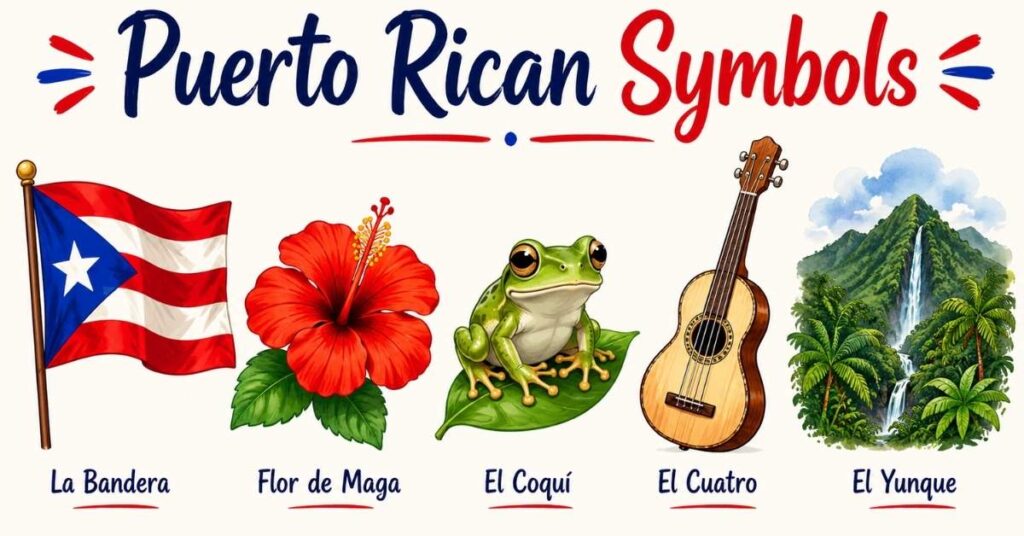
Puerto Rican symbols carry layered meanings shaped by geography, ancestry, and lived experience. The coquí frog represents belonging and resilience. The Taíno sun speaks to cosmic energy and indigenous heritage. The flag carries centuries of political struggle and national pride. Even the hibiscus flower, with its vivid red petals, communicates beauty rooted specifically in this island’s soil.
What makes these symbols remarkable is how they bridge time. Ancient petroglyphs carved by Taíno hands over a thousand years ago now appear on modern tattoos, jewelry, and street murals. The past and present exist in the same image.
Puerto Rican Symbols Tattoos

Tattoos have become one of the most powerful ways Puerto Ricans carry their heritage on their bodies. Popular Puerto Rican tattoo symbols include:
- The coquí frog, representing pride and connection to the homeland
- The Taíno sun (Sol de Jayuya), representing ancient indigenous identity
- The Puerto Rican flag, often incorporated into intricate sleeve designs
- Taíno petroglyphs, especially the goddess Atabey and the cemi figure
- The Maga hibiscus, representing the natural beauty of the island
For Puerto Ricans living in New York, Chicago, Orlando, or elsewhere in the diaspora, these tattoos carry deeply personal weight. A coquí on the wrist says, “No matter where I am, I am still from here.”
Taino Symbols And Meanings
Taíno symbols, known as petroglyphs, were carved or painted onto cave walls, rocks, and river boulders throughout Puerto Rico and the wider Caribbean. They served as spiritual records, territorial markers, ceremonial guides, and mythological narratives. Key Taíno symbols and their meanings include:
- The Coquí: Resilience, the arrival of rain, and the spirit of guardianship
- Atabey: The mother goddess of fertility and fresh water, depicted with the body of a woman and the legs of a frog
- The Sun (Guey): Cosmic balance, divine energy, and the cycle of life and death
- The Spiral: Cosmic energy, the flow of water, and spiritual continuity
- The Turtle: The origin of life, motherhood, and connection to the earth
- The Zemi: Ancestral spirits that governed protection, healing, and guidance
- The Great Seal: A badge of tribal authority, etched in 900 BCE, depicting 24 leaves of the sacred Cojobana tree
Taino Symbols Copy And Paste
Many people search for Taíno and Puerto Rican symbols to use in digital spaces. Common icons used online include the Puerto Rican flag emoji 🇵🇷, sun symbols ☀️, frog icons 🐸, and stylized tribal patterns used in social media posts, messages, and profile bios. While these simplified icons are widely used, they only hint at the richness of the original symbolic tradition.
Puerto Rico Taino Symbols

Puerto Rico remains the heartland of Taíno symbolic culture. Physical evidence of this legacy can be found at several key sites across the island:
- Cagüana Indigenous Ceremonial Park, Utuado: One of the most important Taíno archaeological sites in the Caribbean, featuring large stone ceremonial plazas lined with petroglyphs
- La Piedra Escrita, Jayuya: Carvings set into boulders beside a river, where you can stand where the Taíno people once stood
- Cueva del Indio, Arecibo: A sea cave filled with ancient petroglyphs carved above the crashing Atlantic waves
- Mona Island: A spiritual hub where thousands of cave paintings have been documented and, in 2022, dated for the first time using modern archaeological techniques
Also Check This: Sanskrit Symbols
Puerto Rico Taino Symbols Tattoos
Taíno-inspired tattoos in Puerto Rico and across the diaspora have surged in popularity as a form of cultural reclamation. These designs often feature the sun face, the coquí Taíno drawing, the spiral, the Atabey figure, and abstract geometric patterns drawn from petroglyph motifs. For many wearers, getting a Taíno tattoo is not a fashion choice. It is a statement of indigenous identity and a tribute to ancestors whose civilization was nearly erased by colonization.
Famous Symbols That Represent Puerto Rico
Taino Sun Symbol Meaning
The Taíno sun, sometimes called the Sol de Jayuya or the Guey, is one of the most recognized indigenous symbols in all of Puerto Rico. It depicts a circular face surrounded by radiating geometric rays. For the Taíno, both the sun and the moon were believed to have been born in the same sacred cave, the cave of Mautiatibuel, the “Lord of the Dawn.” The sun rose from this cave each morning and retreated when the moon emerged at dusk.
Spiritually, the sun symbol represents cosmic balance, the divine order of nature, and the eternal cycle of day and night, life and death. Today it is the most tattooed Puerto Rican symbol in the diaspora community.
Puerto Rico Symbol Frog
The coquí frog is arguably the most beloved symbol Puerto Rico has ever produced. This tiny endemic tree frog, measuring at most 1.3 inches in length, produces a two-note call “ko-KEE” that fills the island’s nights with sound. Only the males in Puerto Rico sing, and their calls have been measured between 90 and 100 decibels, making them the loudest amphibians on earth.
The coquí cannot survive outside Puerto Rico’s native climate. This biological reality became a powerful metaphor: “Soy de aquí como el coquí,” meaning “I am from here like the coquí.” The frog became the living embodiment of belonging, rootedness, and identity.
Puerto Rican Symbols Toa
The Toa symbol carries one of the most poignant stories in Taíno mythology. According to legend, the god Guahoyona abducted all the women of the island, leaving men to care for their children alone. The word “toa” means mother in the Taíno language. As the children cried out “toa, toa” in hunger and longing, the men who could not console them were transformed into frogs. This myth binds the symbol of the coquí directly to maternal love, loss, and the voice of the voiceless.
Taino Puerto Rican Symbols
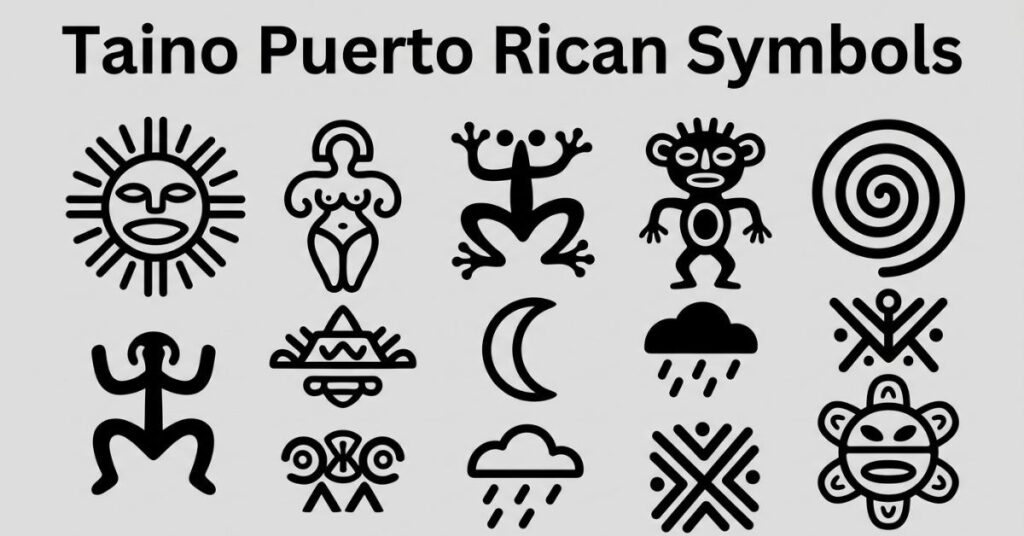
All Taíno symbols found in Puerto Rico share common visual languages: spiraling forms, geometric faces, nature figures, and spiritual beings. These symbols were not merely decorative. They governed rituals, recorded community histories, marked sacred landscapes, and communicated cosmological truths across generations without a written alphabet. Their placement near rivers and in caves suggests that water and the earth itself were considered sacred partners in symbolic communication.
Puerto Rican Tattoos
Puerto Rican tattoos span a wide artistic range. Some celebrate national pride through flag imagery and iconic landscapes. Others go deeper into indigenous symbolism and spiritual motifs. The most meaningful Puerto Rican tattoos tend to combine personal story with cultural symbol. A grandmother’s garden becomes a hibiscus. A childhood memory of summer nights becomes a coquí. A reclaimed indigenous identity becomes the Taíno sun spread across a shoulder blade.
Also Check This: Leadership Symbols
Puerto Rican Taino Symbols
The bond between Puerto Rican identity and Taíno symbolism is reinforced by genetics and culture alike. DNA studies have found that more than 60% of Puerto Ricans carry mitochondrial DNA from Native American ancestors. This biological inheritance, combined with the cultural legacy of Taíno words, myths, foods, and symbols, makes Taíno iconography a living part of modern Puerto Rican expression rather than a historical relic.
Puerto Rico Symbols
The most widely recognized Puerto Rico symbols include:
- The coquí frog
- The Puerto Rican flag
- The Taíno sun (Sol de Jayuya)
- The Flor de Maga (national flower)
- The royal palm tree
- The coat of arms
- The Paso Fino horse
- The Puerto Rican Parrot (Cotorra)
Symbols Of Puerto Rico
Each symbol of Puerto Rico tells a different chapter of the same story: a small island with an enormous, multi-layered identity built from indigenous wisdom, colonial history, African resilience, and the fierce pride of a people who have refused, repeatedly, to be erased.
Puerto Rican Protection Symbols
Protection symbols in Puerto Rican tradition are drawn primarily from Taíno spiritual belief. The Zemi figure, representing an ancestral spirit, was historically kept in the home to ward off illness and misfortune. The cemi figures were three-pointed stone objects believed to hold supernatural power. In the tradition of Espiritismo, Puerto Rico’s indigenous folk spiritualism, symbols are used in altar arrangements, cleansing ceremonies called limpiezas, and healing rituals that blend Taíno, African, and Catholic elements together into a distinctly Boricua spiritual practice.
Traditional Puerto Rico Symbols And National Identity
Things That Represent Puerto Rico
Puerto Rico is represented by a remarkable diversity of symbols spanning nature, history, art, and spirit. Key representatives include the melodic coquí, the radiant Taíno sun, the resilient flag, the crimson Maga flower, the majestic ceiba tree sacred to indigenous people, and the bold murals of the Santurce neighborhood in San Juan where street art meets cultural memory.
Puerto Rico Symbols And Meanings
Puerto Rico’s official and traditional symbols carry specific meanings:
- The Flag: Five horizontal stripes alternating red and white, a white five-pointed star set inside a blue equilateral triangle. The red represents the blood of brave warriors, the white stripes stand for peace and victory, and the blue triangle symbolizes liberty. The star represents the island itself.
- The Coat of Arms: Granted by the Spanish Crown in 1511, it is the oldest coat of arms still in use in the Americas.
- The Flor de Maga: The national flower, a striking crimson hibiscus endemic to Puerto Rico.
- The Coquí: The unofficial national animal and perhaps the most emotionally resonant symbol in Puerto Rican life.
Puerto Rico National Symbols
Puerto Rico’s officially recognized national symbols include:
- National bird: The Reinita (Puerto Rican Spindalis) and the Pitirre (Gray Kingbird)
- National tree: The Ceiba (Silk Cotton Tree)
- National flower: The Flor de Maga (Hibiscus elatus)
- National animal (unofficial): The Coquí frog
- National anthem: “La Borinqueña”
Puerto Rico Symbol
If a single image had to carry all of Puerto Rico’s identity, most Boricuas would point to the coquí. Not the flag, not the sun, not the coat of arms. The little frog that sings through every island night, that cannot survive anywhere else in the world, that was there before the Taíno arrived, before Columbus arrived, before history as most people know it even began. The coquí has been around for an estimated 29 million years. It is older than the idea of Puerto Rico itself, and somehow it is still the truest symbol of what Puerto Rico is.
Deep Symbolic Meaning
Puerto Rican symbols operate on multiple levels simultaneously. On the surface they are visual images, beautiful or striking. One level deeper they carry historical narrative, recording what happened to a people and a place. Deeper still they hold spiritual power, connecting individuals to ancestors, to natural forces, and to the cosmos.
The spiral, for instance, is not just a decorative curve. For the Taíno it represented the unending flow of cosmic energy and the movement of fresh water through the land. The turtle was not merely an animal. It was the origin of life itself, the maternal force from which humanity emerged. When Puerto Ricans place these symbols on their skin, in their homes, or on their altars, they are not making aesthetic choices. They are making declarations about who they are and where they come from.
Types and Variations of Puerto Rican Symbols
The Coquí Frog
The scientific name of the coquí is Eleutherodactylus coqui, meaning “free toes.” There are 17 species native to Puerto Rico, ranging from common tree frogs to rarer mountain species. In Taíno art, the coquí appears in petroglyphs and pottery, always associated with water, rain, and the cycles of nature.
The Sun Symbol (Taíno Sun)
The Guey or Sol de Jayuya appears as a circular face with geometric rays. It is found carved into stone at ceremonial sites and painted in Taíno pictographs. It represents divine light, ancestral wisdom, and the eternal cycle shared by all living things.
The Puerto Rican Flag
Designed in 1895 by Puerto Rican revolutionaries in New York City, the flag was actually banned under American administration from 1948 to 1957. Its reclamation became an act of resistance, and today it flies from apartment windows in the Bronx as powerfully as it waves on the beaches of Rincón.
The Coquí Taíno Symbol
The Coquí Taíno drawing specifically refers to the stylized representation of the coquí in indigenous petroglyph art. This differs slightly from the naturalistic image of the frog used in modern iconography. The Taíno version is more geometric and abstract, connecting the animal to spiritual forces rather than biological observation.
The Hibiscus Flower
The Flor de Maga (Hibiscus elatus) is endemic to Puerto Rico and Cuba. Its vivid crimson petals represent the island’s natural beauty, its fragility, and the fierce life that flourishes in Caribbean soil. It appears in art, jewelry, textiles, and as a symbol of cultural femininity rooted in place.
The Taíno Spiral
Found in petroglyphs across Puerto Rico, the spiral represents cosmic energy, the flow of water, and spiritual continuity across time. It is one of the most universal human symbols and one of the most ancient marks left by Taíno hands on the landscape of Borikén.
Puerto Rican Symbols Across Cultures
Puerto Rican symbols have traveled far beyond the island’s shores. In cities with large Puerto Rican diaspora communities, including New York, Chicago, Philadelphia, and Orlando, these symbols appear on street murals, business logos, community center walls, and the skin of second and third generation Boricuas reclaiming an identity they grew up hearing about but never directly lived.
The Taíno sun and coquí have crossed into broader Latino cultural consciousness as well, appearing at cultural festivals throughout Latin America and among Caribbean communities worldwide. This spread reflects not cultural appropriation but cultural resilience: symbols strong enough to travel and survive.
Puerto Rican Symbols in Art, Movies and Pop Culture
Puerto Rican symbols have entered mainstream popular culture in powerful ways. After Hurricane Maria struck in 2017, the neighborhoods of Santurce and Old San Juan saw an explosion of mural art that used Taíno symbols, coquí imagery, and Afro-Puerto Rican iconography as tools of collective healing and political expression. These murals transformed ancient symbols into modern declarations of survival.
In film and television, Puerto Rican characters are frequently identified visually through flag imagery, coquí references, and Taíno-inspired jewelry. In music, artists like Bad Bunny have incorporated Puerto Rican pride imagery, including the flag and indigenous symbols, into music videos, merchandise, and stage design, bringing these cultural markers to global audiences.
Spiritual and Dream Meaning of Puerto Rican Symbols
In Puerto Rico’s tradition of Espiritismo, a spiritual practice blending Taíno, African, and Catholic beliefs, symbols carry active spiritual power. Specific meanings associated with these symbols in dreams and spiritual practice include:
- Hearing the coquí in a dream: Longing for home, a call to reconnect with your roots and identity
- Seeing the Taíno sun: Spiritual awakening, mental clarity, and the arrival of truth
- The spiral in a dream: Personal transformation and growth unfolding in your life
- The turtle: Protection, a slow and steady journey toward something important
- Atabey (the mother goddess): Fertility, healing, and the power of feminine creative force
Positive vs Negative Meaning
Most Puerto Rican symbols carry overwhelmingly positive associations: pride, resilience, beauty, protection, and spiritual power. However, a few carry complex dual meanings.
The hurricane symbol connected to the Taíno deity Juracán represents both destruction and the natural power that shaped Caribbean life. The coquí’s potential extinction due to deforestation and climate change carries a troubling shadow over its celebratory meaning. As one Puerto Rican interviewed in a cultural study said, “If the coquí disappeared, we would be like orphans, without identification.” The symbol’s positive power is matched by the grief its loss would bring.
The flag itself carries complexity. Banned for nearly a decade under American colonial administration, it was an act of resistance to display it. This history makes its celebration today carry both joy and a memory of suppression.
Why Humans Are Attracted to Puerto Rican Symbols
Human beings are drawn to symbols because symbols do what language often cannot: they compress enormous meaning into a single image that can be understood across language barriers and generations. Puerto Rican symbols carry this power with unusual intensity because they sit at the intersection of so many dramatic human stories: survival of indigenous genocide, centuries of colonial rule, the African diaspora, fierce national pride under political uncertainty, and the stubborn persistence of beauty in a small island that the world frequently underestimates.
The coquí, in particular, draws people because it is the perfect metaphor: small, seemingly fragile, but producing a sound that fills the entire night. It is impossible not to see in that tiny frog something universal about the human desire to be heard.
FAQ’s
What is the most famous Puerto Rican symbol?
The coquí frog is the most iconic Puerto Rican symbol, representing identity, pride, and an unbreakable connection to the island.
What do Taíno symbols mean?
Taíno symbols represent deities, natural forces, spiritual beliefs, and daily life, carved into stone as a form of communication since the Taíno had no written alphabet.
What does the Puerto Rican flag symbolize?
The flag’s red stripes represent warrior blood, the white stripes represent peace, the blue triangle represents liberty, and the white star represents the island of Puerto Rico.
What is the Taíno sun symbol?
The Taíno sun, or Sol de Jayuya, is a circular face with radiating rays representing divine cosmic energy, the cycle of life, and indigenous ancestral wisdom.
Are Puerto Rican tattoo symbols culturally respectful?
Yes, when chosen with knowledge and genuine connection, Puerto Rican symbol tattoos are a powerful and respected form of cultural expression and identity.
What does the coquí frog represent?
The coquí represents home, belonging, resilience, and the uniquely Puerto Rican spirit of being small but undeniably present and heard.
What is the Toa symbol in Puerto Rican culture?
The Toa symbol is connected to the Taíno word for mother and relates to the mythological story of children crying for their lost mothers, which ultimately gave rise to the coquí frog symbol.
Where can I see Taíno petroglyphs in Puerto Rico?
Major petroglyph sites include Cagüana Indigenous Ceremonial Park in Utuado, La Piedra Escrita in Jayuya, and Cueva del Indio in Arecibo.
Conclusion
Puerto Rican symbols are not artifacts of a finished past. They are living voices in an ongoing conversation about identity, resilience, beauty, and belonging. From the ancient Taíno petroglyphs carved at Cagüana to the coquí tattooed on the wrist of a Puerto Rican nurse working in Chicago, these symbols carry the same essential message across centuries: we are still here, and we will be heard.
Understanding Puerto Rican symbols means understanding a people who have survived indigenous erasure, colonial suppression, natural disaster, and displacement, and who have, at every turn, reached for beauty and meaning as tools of survival. The tiny frog that sings louder than any other amphibian in the world might be the best teacher any of us could ask for.

Daniel Wilson is the admin of Meaning Lexi, a website focused on the meanings of words, names, phrases, and symbols. He is dedicated to providing clear, accurate, and easy-to-understand content for readers.