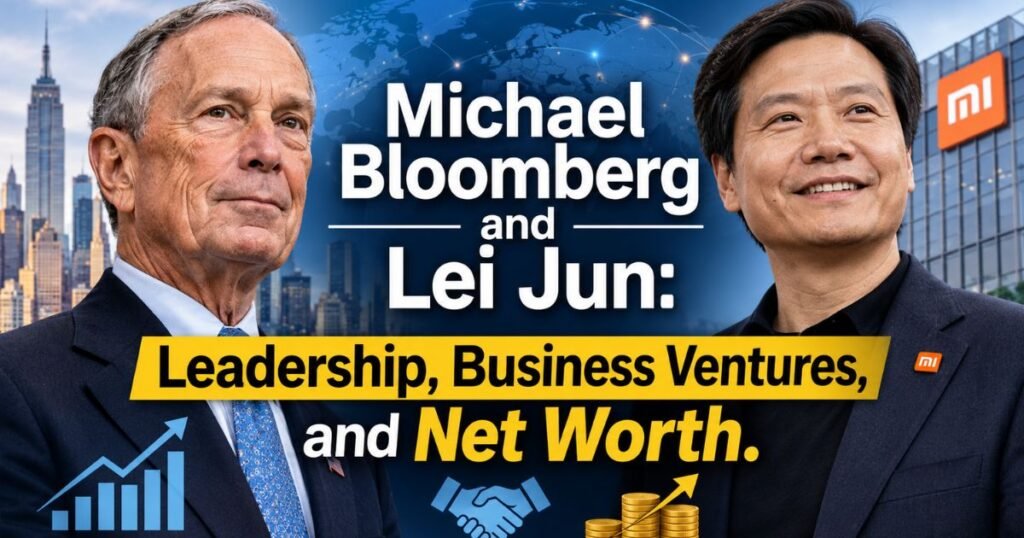
Two founders, two continents, one shared habit: they both built companies around products people refused to give up. Michael Bloomberg and Lei Jun came from very different worlds, a Wall Street trading floor and a university computer lab in central China, yet their careers rhyme in surprising ways. This guide explains how each man built his business, what he is worth in 2026, how he thinks about technology, and what he gives away.
If you want a clear, current comparison of Michael Bloomberg and Lei Jun, start with the table below, then jump to whichever section you need.
Michael Bloomberg and Lei Jun at a Glance
| Detail | Michael Bloomberg | Lei Jun |
| Born | February 14, 1942, Boston, USA | December 16, 1969, Xiantao, Hubei, China |
| Education | Johns Hopkins University, Harvard Business School | Wuhan University, computer science (1991) |
| Main company | Bloomberg L.P. (founded 1981) | Xiaomi (founded April 2010) |
| Flagship product | Bloomberg Terminal | Xiaomi smartphones, smart home devices, SU7 and YU7 cars |
| Ownership | About 88% of a private company | About 23.5% of a listed company |
| Net worth, 2026 | About $95 billion to $109 billion | About $21 billion to $24 billion |
| Giving | $4.3 billion in 2025, $25.4 billion lifetime | $2.2 billion in shares (2021), RMB 1.3 billion to Wuhan University (2023) |
Net worth estimates change daily. Figures here come from Forbes, Bloomberg and other trackers, and they are explained in detail below.
Michael Bloomberg: From Wall Street to Bloomberg L.P.
Early life and education
Michael Bloomberg grew up in Medford, Massachusetts, in a modest household. His father worked as a bookkeeper and never earned more than about $6,000 a year. His father died suddenly while Bloomberg was in college.
He graduated from Johns Hopkins University and then earned an MBA at Harvard Business School. That mix of engineering discipline and business training shaped everything that followed.
Salomon Brothers: the fast climb and the sudden exit
In 1966, Bloomberg took an entry level job at Salomon Brothers. He climbed quickly. He ran equity trading and sales, and later took charge of the firm’s information systems.
Then it ended abruptly. In 1981, Salomon was acquired and Bloomberg lost his job. He walked away with a $10 million partnership payout and no severance package.
Most people would have taken that check and rested. Bloomberg used it as seed money.
Building the Bloomberg Terminal
With three partners (Thomas Secunda, Duncan MacMillan and Charles Zegar), Bloomberg founded Innovative Market Systems. The idea was simple: traders needed fast, accurate data and a way to analyze it on one screen.
Key milestones:
- 1981: The company is founded with the Salomon payout.
- 1982: The Market Master terminal reaches the market. It is later renamed the Bloomberg Terminal.
- 1984: Merrill Lynch buys 20 terminals and a 30% stake for $30 million, with a five year restriction on selling to its rivals.
- 1986: The firm becomes Bloomberg L.P.
- 1990: Bloomberg News launches under editor Matthew Winkler.
- 2008: Bloomberg Inc. buys back Merrill Lynch’s remaining stake.
By 2022, roughly 325,000 people subscribed to the Terminal worldwide. Subscriptions run about $24,000 to $30,000 per user per year, and the Terminal has long supplied most of the company’s revenue. Bloomberg L.P. brought in around $10 billion in annual revenue by 2019.
Case study: the terminal that sold itself
Why did the Terminal succeed when so many data products failed?
Bloomberg did not sell a feature list. He sold a result: a trader who saw a price, an analytics tool and a messaging service in one place could act faster than a rival. Merrill Lynch’s early order gave the product a credible first customer and gave the startup cash to grow.
The lesson is practical. A first customer who truly needs your product is worth more than a hundred polite compliments. Bloomberg also accepted a trade off many founders refuse: he gave up a large equity stake early, then spent years buying it back.
Mayor, candidate, and CEO again
Bloomberg served as mayor of New York City from 2002 to 2013, winning three terms. He ran as a Republican and later as an independent. In 2020, he ran in the Democratic primary for president.
His business role changed too. He was CEO of Bloomberg L.P. from 1981 to 2001 and again from 2014 to 2023.
Michael Bloomberg net worth in 2026
Here is where the numbers get confusing, so let us separate them.
- Forbes annual list (March 2026): about $109 billion, ranked 18th in the world.
- Forbes real time estimate (autumn 2026): roughly $95 billion, after market moves.
- Five year change: about $48 billion in 2020 to roughly $109 billion in January 2026.
Nearly all of this wealth sits in Bloomberg L.P., where he owns about 88%. One quirk worth knowing: the Bloomberg Billionaires Index does not rank him, because the publication’s own editorial policy excludes its founder.
The takeaway: his fortune is real and enormous, but the exact figure depends on which tracker and which date you use.
Lei Jun: The Technology Entrepreneur Behind Xiaomi
Early life and the two-year degree
Lei Jun was born in 1969 in Xiantao, in Hubei province. He enrolled at Wuhan University in 1987 and graduated in 1991 with a computer science degree. He has often told the story of finishing his coursework in about two years, fuelled by a book he found in the university library that pushed him toward entrepreneurship.
He also received a 2,000 yuan scholarship as a student. That small gift matters later in his story.
Kingsoft, Joyo.com, and the angel years
Lei joined the software company Kingsoft in 1992 and became its CEO in 1998. He then co-founded the online retailer Joyo.com, which Amazon bought in 2004.
He stepped down as Kingsoft CEO in 2007. Over the following years he worked as an angel investor, backing technology companies including UCWeb and YY. He also chairs Shunwei Capital, his investment firm.
This period gave him two assets that money alone cannot buy: capital and pattern recognition.
Founding Xiaomi
Lei founded Xiaomi on April 6, 2010, with a team of co-founders that included veterans of Google, Microsoft and Motorola. The first Xiaomi smartphone arrived in 2011.
The pitch was blunt: flagship level specifications at prices ordinary buyers could afford. Xiaomi grew fast, reached the Fortune Global 500 in 2019, and at the time was the youngest company on that list.
Case study: Xiaomi’s IPO and the 5% promise
In April 2018, just before its Hong Kong listing, Xiaomi made an unusual public pledge: its overall hardware net profit margin would never exceed 5% per year. If it did, the company said it would return the excess to users. Lei repeated the promise in his open letter inside the IPO filing.
The listing followed on July 9, 2018. Xiaomi sold shares at HK$17, the low end of its range, and raised about $4.72 billion.
Why make such a promise? It told investors that Xiaomi’s real money would come from internet services and scale, not from squeezing buyers on hardware. It also gave customers a reason to trust the brand. The cap applies to consumer hardware only, and chips and some other investments sit outside it.
For readers studying strategy, the case shows how a clear, public constraint can work as marketing, governance and positioning at once.
Lei Jun net worth in 2026
Lei Jun’s wealth moves with Xiaomi’s share price. Estimates in autumn 2026 range widely:
- Forbes (September and October 2026): about $21 billion.
- Stake based estimate: about $21.4 billion, using a 23.49% Xiaomi stake from Hong Kong exchange filings and Xiaomi’s October market value.
- Bloomberg Billionaires Index (reported mid October 2026): about $24 billion.
- Peak in the past year: about $36 billion in late October 2025, according to one tracker.
A fair summary: between $21 billion and $24 billion in 2026, down sharply from his 2025 high. Remember that Xiaomi’s total market value is not his personal fortune. His wealth is the portion of shares he owns.
Michael Bloomberg and Lei Jun Compared
What they have in common
- Founder control. Each shaped his company’s direction for decades.
- A product people depend on. The Terminal for traders, the phone and the ecosystem for Xiaomi fans.
- Subscription or ecosystem thinking. Both made money from relationships, not one off sales.
- Public service. Bloomberg was a mayor. Lei has served as a delegate to China’s National People’s Congress.
- Large scale giving. Both have gifted major sums to education.
Where they differ
| Area | Bloomberg | Lei Jun |
| Ownership model | Private, about 88% owned | Public since 2018, about 23.5% owned |
| Customers | Professionals paying premium prices | Mass market buyers, thin hardware margins |
| Market | Global finance | Consumer electronics and electric vehicles |
| Net worth | Roughly four to five times larger | Heavily tied to one share price |
| Age and stage | Eighties, now a philanthropist first | Fifties, still building |
Bloomberg’s Business Philosophy
Sell information people can’t live without
Bloomberg’s core insight was that professionals will pay a lot for speed and accuracy. The Terminal charges premium prices because the cost of a wrong decision is higher than the subscription. The company also adds news, data and analytics, which keeps customers inside one system.
Stay private and stay in control
Bloomberg L.P. has never gone public. That choice kept ownership with Bloomberg, protected long term planning from quarterly pressure and kept financial details private. The trade off is less outside capital and less public scrutiny.
Build a culture around transparency
Bloomberg is known for open plan offices where executives sit among staff. The idea is that information should travel fast and problems should be visible. It mirrors the product: a company that sells transparency practises some of it.
Lei Jun Technology Strategy
The Iron Triangle model
Lei often describes Xiaomi’s approach with an “Iron Triangle” of three parts: great hardware, an efficient supply chain and internet services. Low margins on hardware bring users in. Services and ecosystem purchases create lasting value. The 5% pledge is the visible proof of this model.
Fans as co-creators
Xiaomi built early momentum by treating users as testers and advocates. Feedback from its community shaped software updates and product choices. That fan base remains a sales engine, though a car analyst quoted by CarNewsChina warned that Xiaomi Auto will need a more mature sales system beyond “Lei Jun’s endorsement and Mi Fan purchases.”
The EV bet in numbers
In March 2021, Lei announced Xiaomi’s entry into electric vehicles, with a planned investment of $10 billion over ten years. The numbers since then:
| Milestone | Figure |
| First SU7 deliveries | April 2024 |
| YU7 SUV launch | mid 2025 |
| 2025 deliveries | about 411,837 (initial target was 300,000) |
| 2026 delivery target | 550,000 |
| Cumulative deliveries | more than 800,000 by September 7, 2026 |
| Planned R&D spending | at least RMB 200 billion over five years |
Progress has not been smooth. The YU7 made up roughly 97% of January 2026 deliveries, which exposed a dependence on a single model. The first generation SU7 ended production in early February, and the new generation SU7 began deliveries on March 23, 2026, with more than 40,000 locked orders reported in early April. Early 2026 monthly volumes of roughly 20,000 units sat well below the pace needed for 550,000, so the full year target is a stretch worth watching.
Chips, AI and robots
Lei has said Xiaomi will invest more in large AI models and in a “Human x Car x Home” ecosystem that links phones, cars and household devices. Xiaomi has also invested in its own chipsets, which fall outside the 5% cap. Robotics is a logical extension of a car packed with sensors and software, but I found no major robot revenue to report, so treat that part as direction, not results.
Their Approach to Technology
Both men treat technology as a way to remove friction for a specific customer.
- Bloomberg: put data, news and messaging on one screen so a professional never has to leave it.
- Lei Jun: put a phone, a car and a home on one ecosystem so a fan never has to leave it.
The difference is price. Bloomberg charges high prices to a narrow audience. Lei accepts thin hardware margins to reach a wide one. Both approaches lock in loyalty, and both depend on trust that the product will keep working.
Entrepreneurship and Long-Term Expansion
Bloomberg’s growth path
Bloomberg grew in layers: Terminal first, then news (1990), television and radio, then acquisitions. The company bought BusinessWeek in 2009, New Energy Finance in 2009 and the Bureau of National Affairs in 2011 for $990 million. Each addition fed the Terminal rather than replacing it.
Lei Jun’s growth path
Lei grew sideways and then up: smartphones first, then smart home and lifestyle products, then internet services, then a Hong Kong listing in 2018, then electric cars. Each step reused the brand, the supply chain and the fan base.
Setbacks that shaped them
- Bloomberg: being fired from Salomon in 1981 forced him to build his own firm.
- Bloomberg: giving Merrill Lynch a 30% stake early meant years of buyback deals, finishing in 2008.
- Lei Jun: Xiaomi’s handset shipments fell in 2016 before recovering in 2017, from 55.4 million to 91.4 million devices.
- Lei Jun: a 2021 US government blacklisting of Xiaomi was blocked by a federal court and later removed.
Lessons for founders
- Use a setback as seed money. Bloomberg’s firing became his company’s funding.
- Win one real customer first. Merrill Lynch did that for the Terminal.
- Make a public promise you can keep. Xiaomi’s 5% cap shaped its brand.
- Avoid single product dependence. Xiaomi’s YU7 reliance is a live example.
- Plan for ownership trade offs. Bloomberg sold equity early and bought it back later.
Philanthropy and Social Impact
Bloomberg Philanthropies
Bloomberg Philanthropies, founded in 2006, works on public health, education, the environment, the arts and city government. Bloomberg has signed the Giving Pledge.
Recent numbers:
- 2025: $4.3 billion donated, topping the Chronicle of Philanthropy’s Philanthropy 50 for the third year running.
- Lifetime: about $25.4 billion given through personal gifts and Bloomberg Philanthropies.
- 2024: a $1 billion grant to Johns Hopkins University to make medical school free and support nursing and public health students.
- Medical education: $600 million to the endowments of four historically Black medical schools.
Lei Jun’s giving
Lei’s giving traces back to 1997, when he donated 140,000 yuan to Wuhan University. By 2017 he had given about $1 billion in total. In July 2021, he moved about $2.2 billion in Xiaomi shares to two charitable foundations he co-founded.
In 2023, on Wuhan University’s 130th anniversary, he donated RMB 1.3 billion (about $183 million). It was the largest individual cash donation to a Chinese university at the time. He has said he wanted to repay the 2,000 yuan scholarship he once received. By March 2025, he had given more than RMB 15 billion (about $2.07 billion) to education.
Comparing their impact
Bloomberg gives at a far greater scale and treats philanthropy as a full time operation with data driven programs. Lei’s giving is smaller in dollars but is concentrated on education and personal roots, with shares used as the main tool. Both reinvest wealth in the places that shaped them.
Are Michael Bloomberg and Lei Jun Connected?
I found no business partnership, joint venture or shared ownership between the two men. The connection is indirect:
- Bloomberg’s media arm has covered Xiaomi’s IPO and Lei’s fortune.
- The Bloomberg Billionaires Index publishes a profile of Lei Jun and tracks his net worth, though it excludes its own founder.
- Both appear in global wealth rankings and in conversations about founder led companies.
So this is a comparison of two parallel careers, not a story of two allies.
Frequently Asked Questions
What is Michael Bloomberg’s net worth in 2026?
Forbes put it at about $109 billion in March 2026, and real time estimates were near $95 billion by autumn 2026.
What is Lei Jun’s net worth in 2026?
Estimates sit between roughly $21 billion and $24 billion, depending on the tracker and Xiaomi’s share price.
How did Michael Bloomberg make his money?
He founded Bloomberg L.P. in 1981 and built the Bloomberg Terminal, and he still owns about 88% of the company.
How did Lei Jun become a billionaire?
He founded Xiaomi in 2010 and owns roughly 23.5% of it, after earlier success at Kingsoft, Joyo.com and angel investing.
Why is Michael Bloomberg not on the Bloomberg Billionaires Index?
The index’s editorial policy excludes the founder and majority owner of Bloomberg L.P.
What is Xiaomi’s 5% promise?
Xiaomi pledged that its overall hardware net profit margin would never exceed 5% per year, returning any excess to users.
How many EVs has Xiaomi delivered?
More than 800,000 vehicles as of September 7, 2026, since deliveries began in April 2024.
How much has Bloomberg given to charity?
About $25.4 billion over his lifetime, including $4.3 billion in 2025.
Are Michael Bloomberg and Lei Jun business partners?
No public partnership exists between them.
Conclusion
Michael Bloomberg and Lei Jun show two ways to build something durable. Bloomberg turned a layoff into a premium data empire and now gives away billions each year. Lei turned a low margin promise into a global electronics brand and is now betting heavily on cars and AI.
For founders, the shared lesson is straightforward: solve a real problem for a defined customer, keep your promises visible, and be ready to rebuild after a setback. For readers tracking wealth, remember that net worth figures move daily, so check the date before you quote one.

Daniel Wilson is the admin of Meaning Lexi, a website focused on the meanings of words, names, phrases, and symbols. He is dedicated to providing clear, accurate, and easy-to-understand content for readers.