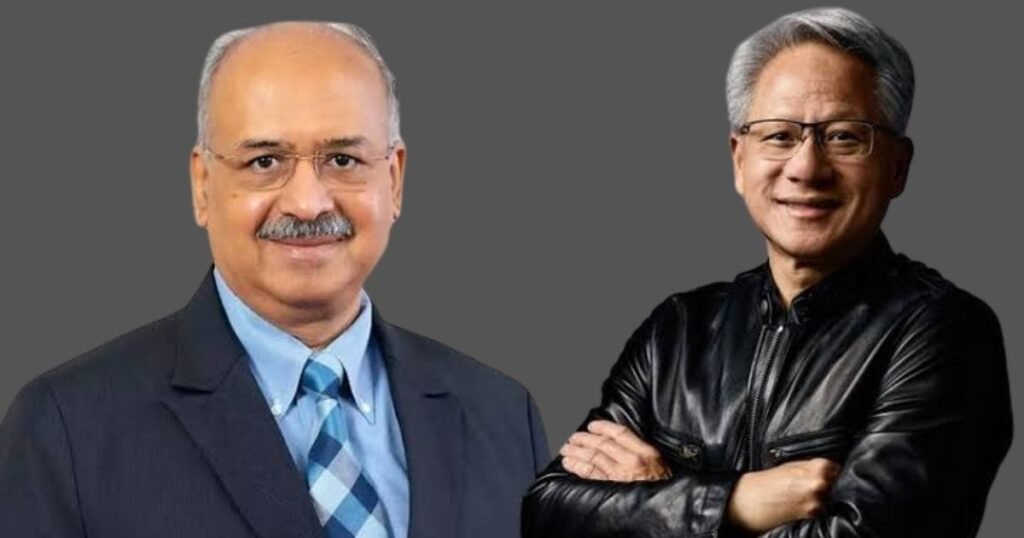
Few pairings capture the contrast between old-economy resilience and new-economy speed quite like Dilip Shanghvi and Jensen Huang. One built India’s largest pharmaceutical company quietly, brick by brick, over four decades. The other turned a graphics chip startup into the engine room of the global AI boom. This comparison of Dilip Shanghvi and Jensen Huang looks at their early lives, career milestones, net worth trajectories, and what their very different journeys teach us about long-term wealth creation.
Fast Facts: Dilip Shanghvi vs. Jensen Huang
| Attribute | Dilip Shanghvi | Jensen Huang |
| Full Name | Dilip Shantilal Shanghvi | Jen Hsun Huang |
| Born | October 1, 1955, Amreli, Gujarat, India | February 17, 1963, Taipei, Taiwan |
| Company | Sun Pharmaceutical Industries | NVIDIA Corporation |
| Founded | 1983 | 1993 |
| Role | Founder and Managing Director | Co-founder, President and CEO |
| Net Worth (2026) | Around $24 to $29 billion | Around $190 to $199 billion |
| Industry | Pharmaceuticals and Generics | Semiconductors and AI Computing |
| Marital Status | Married to Vibha Shanghvi | Married to Lori Huang |
| Key Milestone | $4 billion Ranbaxy acquisition (2014) | AI chip dominance and $5 trillion market cap |
Dilip Shanghvi Biography
Early Life, Family and Education
Dilip Shanghvi was born in 1955 into a modest trading family from Gujarat. His father ran a small wholesale business distributing generic medicines, and the family later moved to Kolkata, where young Dilip grew up watching the day-to-day mechanics of the pharmaceutical trade. He completed his schooling locally and went on to earn a bachelor’s degree in commerce from the University of Calcutta.
Rather than chasing a conventional corporate job, Shanghvi spent his early years helping run the family drug distribution business. That hands-on exposure to supply chains, pricing, and patient needs shaped the practical, no-frills approach he would later bring to building his own company.
Founding Sun Pharma
In 1983, at the age of 27, Shanghvi started Sun Pharmaceutical Industries with a modest loan of around ₹10,000 from his father. The company began in a single facility in Vapi, Gujarat, producing just five psychiatric drugs. It was a narrow, almost unfashionable niche at the time, but it gave Sun Pharma room to grow without direct competition from India’s pharma giants.
Through the late 1980s and 1990s, Shanghvi expanded steadily. Sun Pharma entered the United States market in 1998 through a stake in Caraco Pharmaceutical Laboratories, and later acquired Israel’s Taro Pharmaceutical Industries in 2007. Each acquisition added manufacturing capacity, regulatory expertise, and access to new markets.
The Ranbaxy Turning Point
The single most defining moment of Shanghvi’s career came in 2014, when Sun Pharma acquired Ranbaxy Laboratories in a deal valued at roughly $4 billion. The acquisition instantly made Sun Pharma India’s largest pharmaceutical company and pushed it into the top tier of global generic drug makers.
The years following the deal were not easy. Sun Pharma faced regulatory scrutiny from the US Food and Drug Administration and a dip in profitability between 2014 and 2018 as it worked to integrate Ranbaxy’s operations and resolve compliance issues. Shanghvi’s response was to double down on research and specialty medicines rather than retreat, and by 2023 Sun Pharma’s profits had crossed ₹8,000 crore, with its specialty portfolio becoming a key growth driver.
Awards and Public Recognition
Shanghvi’s contributions to Indian industry have earned him some of the country’s highest civilian and business honors, including:
- The Padma Shri, one of India’s top civilian awards, in 2016
- The EY Entrepreneur of the Year Award in India
- Repeated recognition on Forbes’ and Bloomberg’s global billionaire rankings
- Leadership roles at the Shantilal Shanghvi Foundation, which supports healthcare and disaster relief initiatives
Current Role and Sun Pharma’s Next Chapter
Shanghvi now serves as Executive Chairman of Sun Pharma, having gradually shifted day-to-day operational responsibilities to a professional management team. Under his continued guidance, Sun Pharma has kept pursuing bold, transformative deals. In 2026, the company agreed to acquire Organon & Co., a US-listed healthcare firm, in a transaction valued at approximately $11.8 billion. The deal is expected to more than double Sun Pharma’s annual revenue to around $12.4 billion once completed, positioning it among the world’s top 25 drugmakers. It marks one of the largest outbound acquisitions ever made by an Indian pharmaceutical company.
Jensen Huang Biography
Birth, Childhood and Education
Jensen Huang was born on February 17, 1963, in Taipei, Taiwan. At the age of nine, he and his older brother were sent to live with relatives in the United States. Due to a misunderstanding about the American school system, the boys ended up enrolled at a rural boarding school in Kentucky rather than a mainstream academic institution, a rough early chapter that Huang has spoken about candidly in later interviews.
He eventually settled with his family in Oregon, where he excelled academically and competitively, including as a nationally ranked table tennis player. Huang went on to earn a bachelor’s degree in electrical engineering from Oregon State University and later a master’s degree in electrical engineering from Stanford University.
Founding NVIDIA in 1993
Before starting his own company, Huang worked as a microprocessor designer at LSI Logic and later at Advanced Micro Devices (AMD). In 1993, at the age of 30, he co-founded NVIDIA along with Chris Malachowsky and Curtis Priem. According to company lore, the trio sketched out their early plans during meetings at a Denny’s diner in San Jose, California.
NVIDIA’s original focus was building specialized chips for 3D graphics rendering, aimed primarily at the video game industry. The company went public in 1999, and its GPU technology quickly became a standard in gaming hardware.
From Graphics Chips to the AI Era
The real transformation came when Huang recognized that the parallel processing architecture used in gaming GPUs was also ideal for the kind of massive computation required by artificial intelligence and machine learning. NVIDIA invested early in CUDA, a software platform that let developers harness GPUs for general-purpose computing, well before AI became a mainstream business priority.
That bet paid off dramatically once the AI boom accelerated. NVIDIA’s chips became the backbone of data centers training large language models worldwide, and demand from cloud providers and AI labs sent the company’s revenue and market value soaring. NVIDIA has since become one of the most valuable publicly traded companies on the planet, with a market capitalization that has crossed the $5 trillion mark.
2026 Recognition and Influence
Through 2026, Huang has remained one of the most closely watched executives in global business. He has taken part in high-level trade discussions involving US and international technology policy, and NVIDIA has continued expanding its footprint through strategic acquisitions, including its purchase of the AI model hub Hugging Face for roughly $12.9 billion. Huang’s public talks, keynote presentations, and leather-jacket persona have made him one of the most recognizable figures in modern technology, often compared to earlier generations of visionary founders.
Personal Life, Marriage and Family
Is Dilip Shanghvi Married?
Yes. Dilip Shanghvi is married to Vibha Shanghvi, and the couple has two children. His son, Aalok Shanghvi, holds a senior operational role within Sun Pharma, while his daughter has also been involved in family philanthropic activities. Shanghvi is known for maintaining a low public profile despite his wealth and business stature.
Is Jensen Huang Married?
Yes. Jensen Huang is married to Lori Huang (formerly Lori Mills), whom he met while they were both engineering students at Oregon State University. The couple has two adult children. Unlike many tech billionaires who court media attention, Huang keeps his family life largely private, choosing to let his public persona center almost entirely on NVIDIA and its technology.
Net Worth and Financial Breakdown
Dilip Shanghvi Net Worth
Estimates of Dilip Shanghvi’s net worth have varied across trackers depending on Sun Pharma’s stock performance, generally ranging between $23 billion and $29 billion through 2025 and 2026. As of Forbes’ real-time tracking in April 2026, his net worth stood at approximately $24.8 billion, making him one of India’s top ten richest individuals. His fortune is almost entirely tied to his roughly 54 percent family ownership stake in Sun Pharma, with a smaller portion attributed to other investments and philanthropic holdings.
Jensen Huang Net Worth
Jensen Huang’s wealth has grown at an extraordinary pace alongside NVIDIA’s stock price. From an estimated $3 billion in 2019, his fortune crossed $100 billion in mid-2024 and continued climbing through 2025 and 2026. By late August 2026, Forbes placed his real-time net worth at approximately $197.6 billion, and by early September 2026 it had approached the $199 billion mark following NVIDIA’s Hugging Face acquisition announcement. Nearly all of this wealth comes from his roughly 3 to 3.5 percent ownership stake in NVIDIA, held directly and through family trusts and partnerships.
Selected Verified Wealth Snapshots
- Dilip Shanghvi: approximately $24.8 billion (Forbes, April 2026)
- Jensen Huang: approximately $197.6 billion (Forbes, August 2026)
- Sun Pharma market capitalization: over $44 billion
- NVIDIA market capitalization: over $5 trillion
Career Timeline Comparison
- 1955: Dilip Shanghvi is born in Gujarat, India.
- 1963: Jensen Huang is born in Taipei, Taiwan.
- 1983: Shanghvi founds Sun Pharma with a small loan from his father.
- 1993: Huang co-founds NVIDIA with two colleagues.
- 1998: Sun Pharma enters the US market via Caraco.
- 1999: NVIDIA goes public on the Nasdaq.
- 2007: Sun Pharma acquires Taro Pharmaceutical Industries.
- 2014: Sun Pharma completes its landmark Ranbaxy acquisition.
- 2016: Shanghvi receives India’s Padma Shri award.
- 2020s: NVIDIA becomes central to the global AI computing boom.
- 2026: Sun Pharma agrees to acquire Organon for $11.8 billion; NVIDIA’s market cap surpasses $5 trillion.
Dilip Shanghvi vs. Jensen Huang: What Makes Their Stories Different?
While both men are self-made billionaires who built category-defining companies, their paths diverge in important ways.
- Industry cycle speed: Pharmaceuticals rewards patience, regulatory compliance, and decade-long product pipelines. Semiconductors and AI move in much faster cycles, where a single earnings report can add or erase tens of billions in personal wealth within hours.
- Wealth growth pattern: Shanghvi’s fortune grew gradually over 40 years through steady acquisitions and compounding revenue. Huang’s wealth exploded in a compressed multi-year window, driven by the sudden global demand for AI infrastructure.
- Public visibility: Shanghvi is known for a deliberately low-profile, data-driven leadership style. Huang has become a globally recognizable tech personality, closely associated with NVIDIA’s brand identity.
- Growth strategy: Sun Pharma expanded primarily through targeted acquisitions of existing pharmaceutical companies. NVIDIA expanded primarily through internal innovation, particularly its early investment in CUDA and parallel computing architecture.
- Geographic base: Shanghvi built and still runs his empire from India, serving global markets from an emerging-economy base. Huang built NVIDIA from Silicon Valley, at the heart of the US technology ecosystem.
FAQ’s
How old is Dilip Shanghvi in 2026?
Dilip Shanghvi was born in October 1955, making him 70 years old in 2026.
How old is Jensen Huang in 2026?
Jensen Huang was born in February 1963, making him 63 years old in 2026.
Who is richer, Dilip Shanghvi or Jensen Huang?
Jensen Huang is significantly wealthier, with a net worth near $197 to $199 billion compared to Shanghvi’s roughly $24 to $29 billion.
What company did Dilip Shanghvi found?
He founded Sun Pharmaceutical Industries in 1983, now India’s largest pharmaceutical company.
What company did Jensen Huang found?
He co-founded NVIDIA in 1993, now a leading semiconductor and AI computing company.
Is Dilip Shanghvi self-made?
Yes, he started Sun Pharma with a small loan from his father and built it into a global pharma giant.
Is Jensen Huang self-made?
Yes, he co-founded NVIDIA from scratch and grew his stake through the company’s long-term success.
Conclusion
The stories of Dilip Shanghvi and Jensen Huang show two very different but equally compelling routes to extraordinary success. Shanghvi’s journey reflects the power of patience, disciplined expansion, and deep industry knowledge in a heavily regulated sector. Huang’s journey reflects the explosive potential of being early to a transformative technology shift and staying focused on it for over three decades. Together, their careers offer valuable lessons for entrepreneurs across industries: build for the long term, adapt when the market shifts, and never stop reinvesting in what made you successful in the first place.

Daniel Wilson is the admin of Meaning Lexi, a website focused on the meanings of words, names, phrases, and symbols. He is dedicated to providing clear, accurate, and easy-to-understand content for readers.