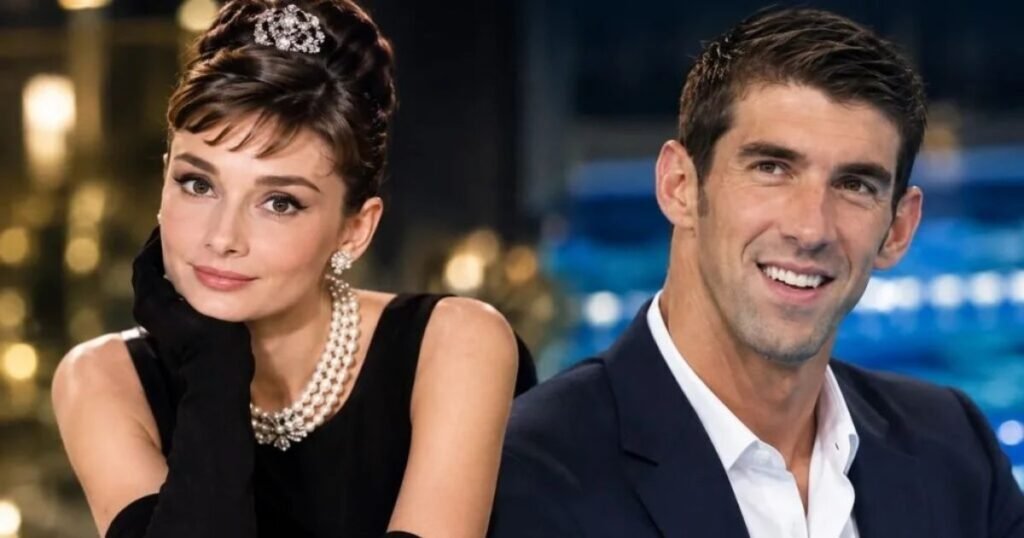
Few names carry the same lasting cultural weight as Audrey Hepburn and Michael Phelps. One redefined elegance and humanitarian work on the world stage, while the other rewrote the record books of competitive swimming forever. Audrey Hepburn and Michael Phelps may belong to completely different eras and fields, yet both became symbols of excellence, resilience, and purpose beyond fame. This article breaks down their early lives, career milestones, personal struggles, and lasting legacies in one clear, easy-to-follow guide.
Who Were Audrey Hepburn and Michael Phelps?
Audrey Hepburn was a screen legend, style icon, and humanitarian whose work with UNICEF touched millions of children worldwide. Michael Phelps is a retired competitive swimmer widely regarded as the greatest Olympian in history, with a medal count no athlete has ever matched.
Though they never crossed paths professionally, both figures shaped how the public views success. Hepburn proved that grace and generosity could outlast box office numbers, and Phelps proved that raw discipline in the pool could translate into a global platform for mental health awareness.
Here’s a simple way to understand their impact:
- Hepburn built her legacy through film, fashion, and philanthropy.
- Phelps built his legacy through athletic dominance and public honesty about mental health.
- Both became household names recognized far outside their original fields.
Audrey Hepburn and Michael Phelps Quick Bio Table
| Detail | Audrey Hepburn | Michael Phelps |
| Full Name | Audrey Kathleen Hepburn-Ruston | Michael Fred Phelps II |
| Born | May 4, 1929, Brussels, Belgium | June 30, 1985, Baltimore, Maryland, USA |
| Died | January 20, 1993, Tolochenaz, Switzerland | Still living |
| Profession | Actress, humanitarian | Competitive swimmer |
| Known For | Roman Holiday, Breakfast at Tiffany’s, UNICEF work | 28 Olympic medals, 23 gold |
| Spouse(s) | Mel Ferrer, Andrea Dotti | Nicole Johnson |
| Children | 2 sons | 3 sons |
| Notable Cause | UNICEF Goodwill Ambassador | Mental health advocacy |
Audrey Hepburn: Early Life and Background
Audrey Hepburn was born in Brussels in 1929 to a Dutch baroness and a British-Austrian businessman. Her childhood was far from glamorous. She spent part of her early years in the Netherlands during World War II, where food shortages and the trauma of occupation left a permanent mark on her outlook toward life.
Ballet was her first love. Hepburn trained seriously as a dancer in her teenage years, hoping to become a professional ballerina. She eventually shifted toward modeling and small stage roles in London, which opened the door to her eventual film career.
How Did Audrey Hepburn Become Famous?
Hepburn’s breakout role came in 1953 with Roman Holiday, a film that won her an Academy Award for Best Actress in her very first major Hollywood role. The performance instantly established her as a fresh, distinctive presence in cinema.
She followed this with a string of defining performances, including:
- Sabrina (1954)
- Funny Face (1957)
- Breakfast at Tiffany’s (1961)
- My Fair Lady (1964)
Her collaboration with designer Hubert de Givenchy also turned her into a permanent fixture in fashion history. The little black dress from Breakfast at Tiffany’s remains one of the most referenced pieces of costume design in film history.
Audrey Hepburn’s Family and Personal Life
Hepburn’s personal life involved two marriages and a long-term partnership. She married actor Mel Ferrer in 1954, and the couple had a son, Sean, before divorcing in 1968. Her second marriage was to Italian psychiatrist Andrea Dotti, with whom she had her second son, Luca.
Later in life, Hepburn found stability with actor Robert Wolders, her partner until her death. Friends and family often described her as reserved and family focused, someone who preferred quiet evenings at her Swiss farmhouse over the spotlight of Hollywood parties.
What Did Audrey Hepburn Do for UNICEF?
Hepburn’s most enduring legacy may not be a film role at all. In 1988, she became a UNICEF Goodwill Ambassador and dedicated the final years of her life to humanitarian work.
Her contributions included:
- Traveling to more than 20 countries, including Ethiopia, Somalia, Bangladesh, and Vietnam
- Drawing global media attention to famine and childhood malnutrition
- Advocating for immunization programs and clean water access
- Testifying before the U.S. Congress on behalf of children in crisis regions
Hepburn often said her own experience with wartime hunger as a child gave her genuine empathy for the families she visited, which made her advocacy feel authentic rather than performative.
How Did Audrey Hepburn Die?
Audrey Hepburn died on January 20, 1993, at her home in Tolochenaz, Switzerland, at the age of 63. She was diagnosed with appendiceal cancer earlier that year, a rare and aggressive form of the disease that had already spread by the time it was detected. She passed away peacefully surrounded by her family just months after receiving her diagnosis.
Michael Phelps: Early Life and Background
Michael Phelps was born in Baltimore, Maryland, in 1985. He began swimming at age seven, partly to burn off energy and partly because his older sisters were already competitive swimmers. Phelps was later diagnosed with ADHD as a child, and swimming became an outlet that helped him channel his focus.
By age 10, he had already set his first national age-group record. His talent caught the attention of coach Bob Bowman at the North Baltimore Aquatic Club, a partnership that would define the next two decades of his career.
How Did Michael Phelps Become the Greatest Olympian Ever?
Phelps qualified for his first Olympic team at just 15 years old, becoming the youngest male swimmer to make a U.S. Olympic team in 68 years. He did not medal at the 2000 Sydney Games, but that early exposure set the stage for one of the most dominant careers in sports history.
His Olympic timeline includes:
- 2004 Athens: 6 gold, 2 bronze medals
- 2008 Beijing: 8 gold medals, a single-Games record that still stands
- 2012 London: 4 gold, 2 silver medals
- 2016 Rio de Janeiro: 5 gold, 1 silver medal
Across four Olympic Games, Phelps collected 28 total medals, including 23 gold, making him the most decorated Olympian in history by a wide margin. He retired from competitive swimming after the 2016 Rio Olympics.
Michael Phelps’s Family Life
Phelps married Nicole Johnson, a former Miss California USA, in 2016. The couple has three sons together. Phelps has often spoken about how fatherhood shifted his priorities away from competition and toward a slower, more grounded lifestyle in Arizona.
Family life also played a central role in his recovery from personal struggles. He has credited his wife and children with giving him a reason to seek consistent treatment for his mental health rather than hiding it, as he had done for much of his competitive career.
Why Is Michael Phelps a Mental Health Advocate?
After his swimming career, Phelps became one of the most visible mental health advocates in professional sports. He has openly discussed struggling with depression and anxiety following major competitions, describing periods where he isolated himself for days and experienced suicidal thoughts, particularly after the 2012 Olympics.
Key moments in his advocacy journey include:
- Partnering with the online therapy platform Talkspace to promote accessible mental health care
- Speaking publicly about his 2014 rehabilitation stay following a second DUI arrest
- Co-founding the Michael Phelps Foundation, which promotes water safety and healthy living for children
- Receiving the Morton E. Ruderman Award in Inclusion for his openness about mental illness
Phelps has said that helping even one person through his story matters more to him than any gold medal, a statement that has become central to his post-swimming identity.
How Much Is Michael Phelps Worth?
Michael Phelps has an estimated net worth of around 80 million dollars. His wealth comes from a combination of sources:
- Endorsement deals with brands like Speedo, Under Armour, Omega, and Visa
- Prize money and bonuses from his Olympic and World Championship career
- Business ventures, including ownership stakes in swim-related companies
- Public speaking engagements focused on mental health and performance
At the peak of his competitive career, Phelps reportedly earned close to 10 to 12 million dollars annually, primarily through sponsorships rather than swimming purses.
Audrey Hepburn and Michael Phelps: What Do They Actually Have in Common?
At first glance, a mid-century film star and a modern Olympic swimmer seem to have nothing in common. Look closer, and several clear parallels emerge.
- Both overcame early hardship. Hepburn survived wartime scarcity in occupied Netherlands, while Phelps navigated a challenging childhood shaped by ADHD and his parents’ divorce.
- Both used their fame for causes bigger than themselves. Hepburn dedicated her final years to UNICEF, while Phelps has spent his retirement pushing for open conversations about mental health.
- Both reached the absolute top of intensely competitive industries. Hepburn became one of the few EGOT-adjacent legends of classic Hollywood, and Phelps became the most decorated Olympian ever.
- Both turned personal vulnerability into public value. Hepburn’s advocacy stemmed from her own childhood suffering, and Phelps’s mental health work stemmed directly from his private struggles.
- Both remain reference points decades into or after their careers. Hepburn is still cited as a style and humanitarian benchmark more than 30 years after her death, and Phelps’s medal record remains untouched years after retirement.
In short, Audrey Hepburn and Michael Phelps represent two different definitions of American icon status: one built on grace under public scrutiny, and the other built on relentless performance followed by public honesty.
Conclusion
Audrey Hepburn and Michael Phelps proved that lasting influence rarely comes from talent alone. Hepburn turned her wartime childhood into decades of humanitarian service through UNICEF, while Phelps turned his swimming dominance into a platform for destigmatizing mental illness. Their fields could not be more different, yet their stories share a common thread: using a global spotlight to give something back. Whether remembered for a little black dress or a record-breaking medal haul, both remain enduring symbols of what it means to matter beyond a single achievement.
FAQ’s
Was Audrey Hepburn actually American?
No, she was born in Brussels to a Dutch mother and British father, though her Hollywood career made her a defining figure in American cinema.
How many children did Audrey Hepburn have?
She had two sons, Sean Hepburn Ferrer and Luca Dotti, from her two marriages.
What is Michael Phelps’s most famous Olympic achievement?
Winning eight gold medals at the 2008 Beijing Olympics, a record for the most gold medals won at a single Games.
Does Michael Phelps still swim competitively?
No, he retired from competitive swimming after the 2016 Rio Olympics.
What disease did Audrey Hepburn die from?
She died from appendiceal cancer in January 1993, months after her diagnosis.
Is Michael Phelps involved in any charity work today?
Yes, he runs the Michael Phelps Foundation, focused on water safety and mental health awareness.

Daniel Wilson is the admin of Meaning Lexi, a website focused on the meanings of words, names, phrases, and symbols. He is dedicated to providing clear, accurate, and easy-to-understand content for readers.