Most people encounter voodoo symbols in horror movies or Halloween decorations and walk away with completely the wrong idea. These sacred signs are not props for dark magic. They are one of humanity’s oldest and richest spiritual languages, carrying prayers, ancestral wisdom, and divine energy across centuries and continents.
Whether you are exploring Haitian Vodou, Louisiana Voodoo, or African spiritual traditions for the first time, this guide will walk you through everything you need to know. You will discover what these symbols mean, how they are used, and why millions of people around the world still draw them with deep reverence today.
What Are Voodoo Symbols?
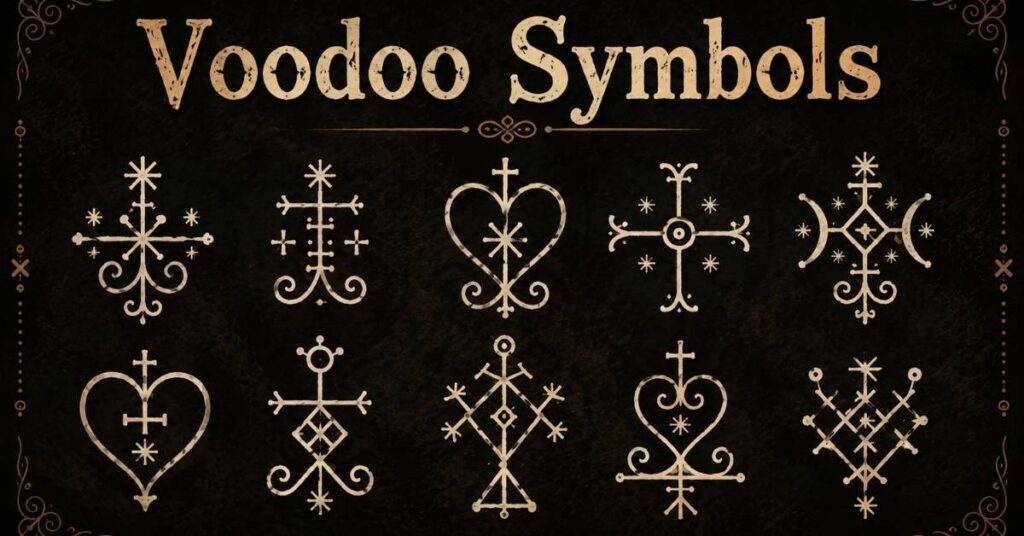
Voodoo symbols, most accurately called veves (also spelled vèvè), are sacred ritual drawings central to the religion of Haitian Vodou and related African diaspora traditions. These intricate geometric designs act as spiritual gateways between the human world and the realm of spirits known as the Lwa (also spelled Loa).
Practitioners traditionally draw veves on the ground using cornmeal, ash, flour, or powder during sacred ceremonies. Each design is not random. It serves as a precise spiritual signature for a specific Lwa, calling that spirit into the ceremonial space to offer guidance, healing, love, or protection.
The word “voodoo” itself traces back to the Fon word vodun, meaning spirit or deity. The religion developed primarily in Haiti during the colonial era, when enslaved West Africans preserved their faith by weaving together traditional spiritual systems with elements of Catholicism. This blending created one of the most resilient and misunderstood spiritual traditions in the world.
Read This: 45+ Legendary Leadership Symbols From History That Still Guide Leaders Today
Voodoo Symbols | Meanings, Uses and Types
Understanding voodoo symbols requires knowing that every single line, curve, and shape in a veve carries deliberate meaning. Each symbol is inseparable from the Lwa it represents.
Voodoo Symbols for Death

Death-related voodoo symbols do not represent fear or darkness in the way Western culture often imagines. The most prominent is the Baron Samedi veve, which features crosses and skeletal imagery connected to the cemetery. Baron Samedi governs the transition between life and the afterlife. His symbol represents transformation, healing from illness, and the wisdom that comes from accepting mortality. In Vodou theology, death is not an ending but a passage into another form of existence.
Voodoo Symbols PDF
A voodoo symbols PDF is a popular educational resource among spiritual practitioners and students of African diaspora religions. These documents typically compile clear drawings of veves alongside their historical context, associated Lwa, ritual uses, and meanings. They serve as quick-reference guides during ceremonies and personal study. Many practitioners keep printed copies on altars or in spiritual journals.
Voodoo Symbols for Good Luck
Good luck voodoo symbols focus on attracting positive energy, removing obstacles, and opening pathways to abundance. These are especially common in New Orleans Voodoo and Hoodoo-influenced practices. They are frequently incorporated into gris-gris bags (small cloth pouches filled with herbs, stones, and sacred items), altar cloths, and home altars. The Erzulie Freda veve is often associated with prosperity and good fortune alongside love.
Voodoo Symbols Meaning
The meaning of any voodoo symbol is entirely tied to the Lwa it represents. Using a symbol without understanding its meaning is considered spiritually risky by most practitioners. A practitioner who draws a veve incorrectly or without intention may fail to invite the correct spirit or attract unintended energies. Meaning, precision, and knowledge are inseparable in authentic Vodou practice.
Voodoo Symbols Images
Visual representations of voodoo symbols range from simple to extraordinarily complex. Authentic veve images show intricate geometric line drawings with symmetrical patterns, spirals, crosses, hearts, serpents, and other motifs. These images help practitioners learn to identify and draw each symbol correctly during ceremonies.
Voodoo Symbols Alastor
Alastor is a name that appears in various occult and demonological traditions. While not native to Haitian Vodou, Alastor-related voodoo symbols appear in newer occult systems that have borrowed and adapted imagery from Vodou aesthetics. These modern interpretations blend traditional veve design styles with ceremonial magic traditions.
Voodoo Symbols for Love

The Erzulie Freda veve is the most recognized voodoo symbol for love. It features hearts, flowers, mirrors, and other symbols of beauty and desire. Erzulie Freda is the Lwa of love, beauty, and luxury. Practitioners draw her veve to attract romantic relationships, strengthen existing bonds, and invite emotional healing. Offerings to Erzulie Freda typically include pink candles, perfume, jewelry, and sweet foods.
Voodoo Symbols for Protection
Protection is one of the most common uses of voodoo symbols worldwide. The Papa Legba veve, Ogou veve, and Maman Brigitte veve are all frequently employed for protective purposes. These symbols are placed in homes, worn as amulets, and drawn at doorways to guard against negative energy, evil spirits, and harm.
Understanding Voodoo Symbols and Their Meanings
Voodoo Symbols and Meanings
Every voodoo symbol carries layered meaning. On the surface, a veve is a beautiful geometric drawing. Beneath that surface lies a complete system of spiritual theology, ancestral knowledge, and ritual power.
Vodou Symbols
The term “Vodou symbols” (using the Haitian Creole spelling) refers specifically to symbols within the Haitian Vodou religious tradition. This spelling is preferred by scholars and practitioners to distinguish the genuine religious tradition from sensationalized pop culture versions of “voodoo.”
Symbols of Voodoo
The symbols of voodoo span a rich vocabulary of sacred imagery including:
- Crosses representing crossroads and spiritual gateways
- Serpents symbolizing healing, creation, and transformation
- Hearts connected to love and emotional power
- Anchors and boats representing oceanic spirits
- Swords and iron tools linked to warrior spirits
Voodoo Religion Symbols

Voodoo religion symbols are not decorative. They are functional spiritual tools. Drawing a veve with precision and intention is itself an act of devotion and communication. The religion of Vodou recognizes one supreme creator called Bondye, and the Lwa serve as intermediaries between Bondye and humanity. Each veve opens a channel to one of these divine intermediaries.
Voodoo Religion Symbol
A single voodoo religion symbol can carry enormous spiritual weight. One correctly drawn veve, offered with the right prayers and offerings, is believed capable of invoking powerful spiritual assistance across love, healing, protection, and guidance.
Voodoo Symbolism Religion Symbols
Voodoo symbolism weaves together African cosmology, Catholic iconography, and indigenous Caribbean spiritual elements. The result is a unique visual and spiritual language that has survived centuries of oppression and continues to thrive globally.
Read This: 60+ Mysterious Filipino Symbols and Their Hidden Meanings You’ve Never Noticed
Voodoo Symbols and Their Meanings
Each voodoo symbol and its meaning are completely inseparable. A symbol drawn without knowledge of its meaning is considered empty of spiritual power. The symbol is the invitation. The meaning is what the spirit responds to.
Voodoo Symbols and Meaning
When you search for voodoo symbols and meaning, you are searching for the deeper spiritual story each sign carries. Every curve, every line, and every repeated pattern tells part of a centuries-old conversation between humanity and the divine.
Types of Voodoo Symbols Around the World
Haitian Voodoo Symbols
Haitian voodoo symbols, known as veves, are the most globally recognized form of Vodou sacred imagery. They are drawn during ceremonies called sevis Lwa (service to the spirits) and represent the heart of Haitian Vodou practice. Haiti is the birthplace of the most structured and recognizable form of Vodou.
Haitian Voodoo Symbols and Meanings
In Haitian tradition, each veve corresponds to a specific Lwa with defined powers, preferences, and personality. Understanding these pairings is foundational to any serious study of Vodou.
African Voodoo Symbols

African voodoo symbols from regions like Benin, Togo, and Nigeria form the ancestral roots of all Vodou traditions in the Americas. The Fon and Ewe peoples developed the original Vodun spiritual system, which later evolved into Haitian Vodou, Louisiana Voodoo, and Candomblé in Brazil. These older symbols tend to be simpler in design but carry tremendous ancient authority.
Louisiana Voodoo Symbols
Louisiana Voodoo developed uniquely in the American South, blending West African spiritual traditions with French Catholicism, Native American herbalism, and Appalachian folk magic. The legendary Marie Laveau, known as the Voodoo Queen of New Orleans, shaped this tradition profoundly during the 19th century. Louisiana symbols often incorporate personal objects, coins, bones, and natural materials alongside traditional veve imagery.
New Orleans Voodoo Symbols
New Orleans voodoo symbols are vibrant in modern culture. They appear in tattoos, spiritual shops called botanicas, street art, and temple altars throughout the city. The city of New Orleans preserves an authentic living tradition of Voodoo that attracts spiritual seekers from around the world.
Veve Voodoo Symbols

Veve voodoo symbols function as spiritual signatures for each Lwa. Drawing a veve correctly and with genuine intention is believed to open a channel to that spirit’s energy and guidance. These symbols are never drawn carelessly in authentic practice.
Voodoo Veve Symbols and Meanings
Voodoo veve symbols and meanings reveal a complete spiritual language developed over centuries. Each design is a visual prayer, a spiritual blueprint, and an invitation all at once.
Protection, Signs and Special Voodoo Symbols
Voodoo Protection Symbols
Voodoo protection symbols are among the most widely used in the tradition. They guard against:
- Negative energy and psychic attacks
- Evil spirits and malicious intentions
- Bad luck and harmful influences
- Illness and misfortune
Voodoo Symbols of Protection
Voodoo symbols of protection are often placed at doorways, above beds, and on altar spaces. They may also be worn as jewelry or carried in protective pouches. The most common protective veves include those of Ogou, Baron Samedi, and Maman Brigitte.
Voodoo Symbol for Death
The voodoo symbol for death, most commonly associated with Baron Samedi, represents transformation rather than tragedy. It symbolizes the transition between life and the spirit world, the acceptance of endings, and the promise of continuation beyond physical death.
Voodoo Hand Signs
Voodoo hand signs are gestures used during rituals to channel spiritual energy and communicate with the Lwa. These gestures accompany drumming, chanting, and the drawing of veves during sacred ceremonies. They are specific to initiated practitioners and ceremonial contexts.
Voodoo Signs
Voodoo signs encompass a broader category of spiritual indicators used by practitioners to identify spiritual presence, interpret omens, and guide ritual practice. These include both physical symbols drawn on surfaces and signs observed in nature.
Voodoo Signs and Symbols
Together, voodoo signs and symbols form a complete spiritual communication system. Signs are observed in the world (natural omens, unusual occurrences), while symbols are deliberately created during ritual practice to invite specific spiritual energies.
Unique and Modern Voodoo Symbol Uses
Voodoovoodoo Symbols
The search term “voodoovoodoo symbols” typically reflects modern digital interest in voodoo-related imagery across design, tattoo culture, and spiritual exploration. These symbols have found new audiences online while retaining their original sacred significance for practicing communities.
Voodoo Symbols PNG
Voodoo symbols in PNG format are widely searched for use in digital art, tattoo design, journaling, and educational materials. These transparent-background image files allow creators to incorporate veve imagery into various projects. It is worth noting that many practitioners encourage respectful educational use while discouraging casual commercialization of sacred symbols.
Alastor Voodoo Symbols
Alastor voodoo symbols blend traditional Vodou aesthetics with occult demonological frameworks. In modern pop culture and certain ceremonial magic systems, Alastor is depicted as a powerful spirit with imagery borrowing from Vodou visual traditions. This represents a modern fusion rather than traditional Vodou practice.
Deep Symbolic Meaning
On a Spiritual Level
On a spiritual level, voodoo symbols serve as living connections to divine energies. They are not passive images but active spiritual tools. When drawn with intention, knowledge, and proper ceremony, veves are believed to literally invite Lwa into sacred space, enabling healing, guidance, protection, and transformation.
On a Psychological Level
On a psychological level, voodoo symbols engage the human capacity for symbolic thinking. The act of drawing a veve focused on healing creates a powerful psychological framework for healing intention. Ritual action changes the mental and emotional state of participants, making symbolic work a genuine form of psychological transformation even outside strictly spiritual interpretations.
On a Cultural Level
On a cultural level, voodoo symbols represent the extraordinary resilience of African diaspora communities. Enslaved Africans preserved their entire spiritual worldview through symbols, stories, and ceremonies despite centuries of oppression. Every veve is a testament to cultural survival.
Types and Variations of Voodoo Symbols
1. Papa Legba Veve
Papa Legba is the first Lwa invoked in any Vodou ceremony. He stands at the crossroads between the human world and the spirit world. His veve features two perpendicular axes forming a cross, often accompanied by a walking cane. Without Papa Legba’s permission, no other Lwa can be accessed. He governs communication, pathways, and beginnings.
2. Erzulie Freda Veve
Erzulie Freda is the Lwa of love, beauty, and luxury. Her veve incorporates hearts, mirrors, stars, and ornate floral designs. She is depicted as a beautiful woman who loves fine things. Her symbol is used in rituals for romantic love, self-love, emotional healing, and prosperity.
3. Baron Samedi Veve
Baron Samedi rules over death, cemeteries, and the transition between life and the afterlife. His veve features crosses, coffins, and skeletal motifs. He is known for a sharp wit and irreverent personality. Practitioners call on Baron Samedi for protection against illness, ancestral guidance, and help during major life transitions.
4. Damballa Veve
Damballa is one of the oldest and most revered Lwa in Vodou. He takes the form of a great white serpent and is considered the creator of all life. His veve features serpentine coils and is associated with wisdom, purity, creation, and cosmic balance. White is his sacred color.
5. Ogou Veve
Ogou is the Lwa of war, strength, and iron. His veve incorporates swords, fire imagery, and iron tools. He governs courage, justice, and the power to overcome obstacles. Practitioners call on Ogou when facing conflict, injustice, or situations requiring extraordinary strength.
Voodoo Symbols Across Cultures
West Africa
The roots of all voodoo symbols trace to West African spiritual systems, particularly among the Fon and Ewe peoples of present-day Benin and Togo. The Vodun religion these cultures developed was one of the most sophisticated spiritual systems in the ancient world, complete with a detailed pantheon of divine spirits and a rich visual symbolic language.
Haiti
Haiti is where West African Vodun transformed into Haitian Vodou, blending with French Catholicism under the unique pressures of colonial slavery. The Haitian Revolution of 1791 to 1804, the only successful slave revolution in history, was partly inspired and spiritually sustained by Vodou ceremonies. Veves became more elaborate and specifically defined in the Haitian context.
Louisiana
In Louisiana, particularly New Orleans, voodoo symbols merged with Creole culture, French and Spanish Catholicism, Native American herbalism, and African spiritual traditions. This produced a distinctly American form of Voodoo with its own symbol vocabulary, most famously shaped by Marie Laveau.
Caribbean and Brazil
Throughout the Caribbean and Brazil, similar African diaspora religions emerged including Santeria (Lukumi) in Cuba and Puerto Rico, Candomblé and Umbanda in Brazil, and Obeah in Jamaica. Each tradition developed its own symbol vocabulary rooted in the same West African spiritual source.
Modern Global Spirituality
Today, voodoo symbols appear in spiritual communities worldwide. Interest in African diaspora religions has grown significantly in the 21st century as people seek spiritual systems outside Western religious frameworks. Veves are studied, tattooed, drawn in journals, and incorporated into eclectic spiritual practices across every continent.
Voodoo Symbols in Art, Movies and Pop Culture
Voodoo symbols have had a complicated relationship with popular culture. In legitimate artistic contexts, veves appear in Haitian sequin flags called drapo Vodou, paintings, sculptures, and contemporary fine art exhibitions. These artistic expressions celebrate the beauty and complexity of Vodou culture.
In Hollywood, however, voodoo symbols have frequently been misrepresented as tools of dark magic, curse-casting, and horror. Films and television shows have sensationalized these sacred symbols in ways that damage understanding and perpetuate harmful stereotypes about African diaspora religions.
The authentic artistic tradition of veve is best seen in Haitian visual art, where masters create intricate sequined flags depicting complete veves with extraordinary detail and beauty. These works are recognized internationally as significant contributions to world art heritage.
Spiritual and Dream Meaning of Voodoo Symbols
Seeing voodoo symbols in dreams carries significant meaning within Vodou interpretation:
- A crossroads symbol suggests a major decision or life transition approaching
- A serpent veve points toward healing, personal transformation, or ancestral connection
- Erzulie Freda imagery in dreams may signal incoming love or emotional healing
- A coffin or Baron Samedi symbol represents an ending making space for new beginnings
- Drawing symbols in a dream often represents spiritual development and awakening
- Distorted or broken veves may suggest spiritual imbalance requiring attention
- Feeling called toward a specific symbol may indicate that the associated Lwa is reaching out
Positive vs Negative Meaning
Positive Meaning
Voodoo symbols carry overwhelmingly positive meanings within their authentic tradition. They represent:
- Divine connection and spiritual communication
- Protection for individuals, families, and communities
- Healing of physical, emotional, and spiritual ailments
- Guidance through difficult life transitions
- Celebration of ancestral wisdom and cultural heritage
- Love, beauty, prosperity, and abundance
Negative Interpretation
The negative reputation of voodoo symbols comes almost entirely from outside the tradition. Misrepresentation in Western media, colonial religious suppression, and genuine cultural misunderstanding created a false image of these symbols as tools of harm. Within authentic Vodou practice, the ethical framework emphasizes healing, balance, and community wellbeing. Harmful magic, while acknowledged to exist in folk traditions, is not the purpose of veves.
Why Humans Are Attracted to Voodoo Symbols
The attraction to voodoo symbols runs deep in human psychology and culture. Several factors explain this enduring fascination:
Ancient Origins: These symbols feel genuinely old because they are. Generations poured real faith into every line, and that accumulated spiritual energy creates a tangible sense of power that modern people instinctively recognize.
Sacred Geometry: Veves engage the human brain’s deep appreciation for geometric patterns. The intricate symmetry and repeating motifs create a visual experience that naturally induces focused, meditative attention.
Mystery and Hidden Knowledge: Humans are wired to seek hidden patterns and deeper meaning. Voodoo symbols promise access to knowledge beyond ordinary experience, tapping into a universal hunger for the transcendent.
Cultural Resilience: The story of how these symbols survived centuries of oppression resonates with universal human themes of resistance, survival, and the endurance of spirit.
Spiritual Connection: In an increasingly secular world, voodoo symbols offer a visual, tactile, participatory form of spiritual practice that engages both the mind and body simultaneously.
Frequently Asked Questions
What are voodoo symbols called?
Voodoo symbols are called veves (or vèvè in Haitian Creole). Each veve represents a specific Lwa or spirit in Vodou tradition.
What is the most powerful voodoo symbol?
Papa Legba’s veve is considered foundational since no other Lwa can be accessed without his permission. Baron Samedi’s symbol is also widely regarded as extremely powerful.
Are voodoo symbols dangerous?
No. Voodoo symbols are sacred spiritual tools used for healing, protection, and divine communication. Their dangerous reputation comes from Hollywood misrepresentation, not authentic practice.
What is a veve used for?
A veve is drawn during ceremonies to invite a specific Lwa into the ritual space to offer blessings, guidance, healing, or protection.
Can anyone use voodoo symbols?
Respectful study and appreciation are generally welcomed. However, using veves in active ritual contexts is ideally done with proper knowledge and, in many traditions, formal initiation.
What materials are used to draw veves?
Traditionally, veves are drawn using cornmeal, ash, flour, or powder on the ground during ceremonies.
What is the voodoo symbol for protection?
Several veves serve protective purposes including Ogou’s veve for warrior protection, Maman Brigitte’s for protection from injustice, and Baron Samedi’s for protection from illness and spiritual harm.
Are Haitian Vodou and Louisiana Voodoo the same?
They share West African roots but developed differently. Haitian Vodou has a more structured theology, while Louisiana Voodoo blends more heavily with Hoodoo folk magic and Creole culture.
Conclusion
Voodoo symbols are among the most profound, misunderstood, and genuinely powerful sacred traditions in human spiritual history. Far from the Hollywood caricature of dark magic and horror, these sacred veves represent centuries of ancestral wisdom, cultural survival, and genuine spiritual connection.
From the crossroads-guardian Papa Legba to the love-goddess Erzulie Freda, from the warrior strength of Ogou to the transformative wisdom of Baron Samedi, every voodoo symbol tells a story of human beings reaching across the boundary between the visible and invisible worlds.
Whether you are drawn to these symbols for spiritual practice, cultural understanding, artistic appreciation, or pure curiosity, approaching them with respect and genuine curiosity opens a doorway to one of humanity’s richest spiritual vocabularies. These are not ancient relics. They are living symbols still drawn with devotion today, still connecting people to forces that have guided human communities for thousands of years.
The more you learn, the more you realize: the invisible world has always spoken through signs. And these signs, drawn in cornmeal on sacred ground, are among the most beautiful and enduring messages it has ever sent.

Daniel Wilson is the admin of Meaning Lexi, a website focused on the meanings of words, names, phrases, and symbols. He is dedicated to providing clear, accurate, and easy-to-understand content for readers.