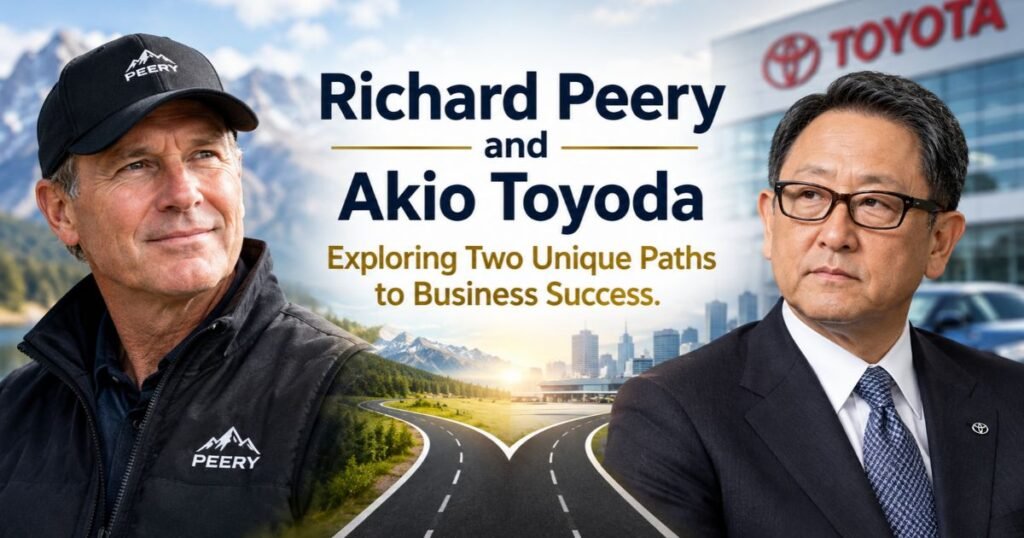
One built office parks on old orchards. The other steered the world’s best-known carmaker through recalls, a tsunami and a major shift in technology. This guide looks at Richard Peery and Akio Toyoda side by side, using public records, company biographies and trusted business reporting.
To be clear from the start: there is no public record of a joint venture between these two men. They work in different industries and on different continents. Still, studying Richard Peery and Akio Toyoda together shows how very different careers can rest on the same habits, such as patience, people and trust.
Quick facts at a glance:
| Richard Peery | Akio Toyoda | |
| Known for | Co-building Silicon Valley office space through Peery Arrillaga | Leading Toyota Motor Corporation |
| Industry | Commercial real estate | Automotive |
| Education | BYU bachelor’s degree, left Stanford MBA program | Keio University (law), Babson College (MBA) |
| Current role | Private investor, family office, philanthropy | Chairman of Toyota’s board |
| Key milestone | Sold more than 5 million sq ft for $1.1 billion in 2006 | Became Toyota president in 2009 |
Who Is Richard Peery?
Richard “Dick” Peery is an American real estate developer based in Palo Alto, California. He is best known as the longtime partner of John Arrillaga. Together they turned fruit orchards into the office campuses that now house some of the biggest names in technology.
Peery rarely gives interviews. That quiet style is part of why many people outside the Bay Area have never heard his name, even though his buildings shaped the region’s skyline.
Richard Peery’s Early Background
Peery was born around 1938 or 1939. His father, Taylor Peery, graduated from Stanford University in 1927 and from Stanford Business School in 1929. He then spent a long career at Bank of America before starting his own real estate company, Peery & Co., in 1957.
Richard earned a bachelor’s degree at Brigham Young University and later started, but did not finish, the MBA program at Stanford. In his twenties, he took over management of his father’s property portfolio. That hands-on start taught him how to judge land, tenants and timing.
Forbes has also noted that his entrepreneurial streak showed up early. In middle school he reportedly owned the gumball machines on the Stanford campus.
Richard Peery’s Impact on Silicon Valley
In the early 1960s, Peery met John Arrillaga through a family connection. The two began buying farmland in what was then called the Valley of Heart’s Delight. Their firm, Peery Arrillaga, built low-rise office parks for a young technology industry that needed room to grow.
Here is what makes their record stand out:
- They built more than 12 million square feet of office space over the decades.
- Their buildings have housed companies such as Intel, HP, Apple and Google.
- In 2007, they became the first inductees into the NAIOP Silicon Valley Developer Hall of Fame.
- Arrillaga died in January 2022 at age 84, after a business partnership with Peery that lasted about 55 years.
Peery described his late partner as a principled man and a loyal business partner. That kind of public praise says a lot about how the partnership lasted so long.
Real Estate and Long-Term Investment
Peery’s strategy was simple to describe and hard to copy. He bought land early, built for tenants who needed space and held assets for years instead of chasing quick flips.
In 2006, the partners sold less than half of their portfolio, more than 5 million square feet, for about $1.1 billion. They kept the rest. In 2019, they also sold a group of Mountain View buildings to Google for $250 million.
According to Forbes, Peery still owns roughly 3.3 million square feet of office space. Forbes has also listed his net worth among the Forbes 400, and published estimates have changed from year to year. Treat any single figure as an estimate.
A few lessons stand out from his real estate approach:
- Buy where growth is likely, not where it already happened.
- Build for the tenant, not for the headline.
- Sell part of the portfolio, but keep a core for the long run.
Who Is Akio Toyoda?
Akio Toyoda was born on May 3, 1956, in Japan. He is the grandson of Kiichiro Toyoda, who founded Toyota Motor Corporation, and the son of Shoichiro Toyoda, who served as Toyota’s chairman from 1992 to 1999.
Family name opens doors, but it also raises the bar. Toyoda has often spoken about carrying that responsibility. He is also a serious driving enthusiast and races under the name Morizo.
Education and Entry Into Toyota
Toyoda graduated from Keio University with a law degree in 1979. He then earned an MBA from Babson College in the United States in 1982. He joined Toyota in April 1984.
His early career covered nearly every part of the business, including production, marketing and product development. From 1998, he worked in California as an executive vice president and board member at NUMMI, the joint venture between Toyota and General Motors. That time in the United States gave him a close view of American customers and workers.
He joined Toyota’s board in June 2000. He also oversaw the creation of gazoo.com, an early online platform for car information and consumer services. He became an executive vice president in 2005.
Akio Toyoda’s Leadership at Toyota
Toyoda’s leadership is often described as personal and hands-on. He talks about cars, drivers and workers, not only numbers. He also has a record of public accountability, which was tested almost right away.
Becoming Toyota’s President
Toyoda became president in June 2009, in the middle of a global financial crisis. Soon after, Toyota faced a large recall involving millions of vehicles worldwide.
On February 24, 2010, he testified before a U.S. House committee. He said that he and Toyota were not perfect, apologized for accidents involving Toyota drivers and promised changes to how recalls were decided. He also said Toyota had grown faster than it could develop its people and organization.
That was a turning point. Instead of defending the company’s image, he focused on rebuilding trust. Toyota then set up a global quality committee chaired by the president and reworked how safety concerns reach senior leaders.
Other key moments in his tenure include:
- 2011 and 2012: After the Tohoku earthquake and tsunami, Toyota combined three affiliates in the region into Toyota Motor East Japan.
- Revenue growth: One corporate data tracker shows Toyota’s annual revenue rising by roughly 80 percent between fiscal 2009 and fiscal 2023.
- April 2023: He stepped down as president and became chairman of the board.
- June 2026: Shareholders again approved him as chairman, and he led the annual meeting in person for the first time in three years.
- September 2026: He was inducted into the Automotive Hall of Fame in Detroit. He is the third generation of his family to receive the honor.
Many older web pages still call him Toyota’s president or CEO. That is outdated. His current title is chairman of the board.
Richard Peery and Akio Toyoda: Different Industries, Similar Lessons
Real estate and car making do not look alike. One sells space. The other sells machines. Yet both men built careers on the same quiet principles.
Here are the parallels worth noting:
- Both grew up around a family business and learned its values early.
- Both stayed with one core mission for decades instead of chasing every trend.
- Both leaned on trusted partners and teams.
- Both treated reputation as an asset that takes years to build and moments to lose.
Long-Term Thinking
Peery bought farmland when the idea of a “Silicon Valley” was still forming. He waited while the industry grew around him. His patience turned open land into some of the most valuable office real estate in the country.
Toyoda’s version of long-term thinking looks different. During the recall crisis, he said that Toyota’s traditional order of priorities was safety first, quality second and volume third. Putting growth last was a choice that cost short-term sales but protected the brand’s future.
Both leaders show that long-term thinking is not passive. It means making unpopular decisions today so the business is stronger ten years from now.
Their Influence Beyond Business
Money and market share are only part of a legacy. Both men have also shaped communities, learning and public life.
Education, Philanthropy, and Public Influence
Peery founded the Peery Foundation in 1978. It is a family foundation based in Palo Alto that aims to strengthen youth and families so they can build lives of dignity and self-reliance. It funds work mostly in the San Francisco Bay Area, East Palo Alto and developing countries.
Some details worth knowing:
- In 2024, the foundation made grants of about $2.9 million and held about $64 million in assets, according to IRS filings.
- It gave $1 million toward a playground for children with disabilities in the Palo Alto area.
- Forbes reported that Peery had given about $500 million to charitable foundations and donor-advised funds by 2018.
- His family also endowed the H. Taylor Peery Institute of Financial Services at BYU, named for his father, with a $3 million gift.
Toyoda’s public influence runs through industry leadership and culture. He has served as chair of the Japan Automobile Manufacturers Association and has pushed for cooperation across the auto industry. He also helped build Toyota’s motorsports programs, which he sees as a way to train engineers and keep the brand connected to drivers.
His 2026 New Year message focused on returning to people, which fits a pattern that runs through his career.
What Can We Learn From Their Careers?
Both stories are useful for founders, managers, investors and students. They are not shortcuts, but they do show repeatable habits.
Business Lessons From Two Leaders
- Play the long game. Peery held land and buildings through market cycles. Toyoda protected quality even when it slowed growth.
- Choose partners carefully. A 55-year partnership does not happen by accident. Trust compounds like interest.
- Own your mistakes in public. Toyoda’s testimony showed that honest accountability can start a recovery.
- Invest in people. Toyoda said quality products come from quality people. Peery’s family funds education and youth programs.
- Stay close to the work. Toyoda test drives vehicles and races. Peery began by managing real properties himself.
- Give back early and often. Both men extended their influence beyond profit.
If you are applying these ideas, start small. Pick one habit, such as a yearly review of long-term goals or a clear process for handling customer complaints, and build from there.
Frequently Asked Questions
Who is Richard Peery?
Richard Peery is an American real estate developer and billionaire. He co-built many of Silicon Valley’s office parks with partner John Arrillaga.
What is Richard Peery best known for?
He is best known for Peery Arrillaga, the firm that turned Santa Clara Valley farmland into office campuses for major technology companies.
Who was Richard Peery’s business partner?
His partner was John Arrillaga, who died in January 2022. They worked together for about 55 years.
What is the Peery Foundation?
It is a family foundation started in 1978 in Palo Alto. It supports programs that help youth and families, mainly in the Bay Area and in developing countries.
Who is Akio Toyoda?
Akio Toyoda is the chairman of Toyota Motor Corporation and the grandson of its founder. He led the company as president from 2009 to 2023.
Is Akio Toyoda still Toyota’s CEO?
No. He stepped down as president in April 2023 and became chairman of the board. Toyota’s shareholders reappointed him as chairman in June 2026.
What did Akio Toyoda do during the Toyota recall crisis?
He testified before the U.S. Congress in February 2010, apologized and announced changes to how Toyota handles safety concerns and recalls.
Are Richard Peery and Akio Toyoda connected?
No public source shows a direct business link between them. They are compared here because their careers share lessons on patience, trust and people.
What can entrepreneurs learn from Richard Peery and Akio Toyoda?
Think long term, choose partners with care, invest in people and take responsibility when things go wrong.
Conclusion
Peery and Toyoda took very different roads. One worked mostly out of the spotlight, turning land into lasting value. The other led a global brand in full public view through some of the toughest years in its history.
What connects them is a steady focus on the long term, a respect for people and a willingness to be held accountable. Those habits do not belong to one industry. Whether you run a small business or manage a large team, you can use them today.
If you are researching either leader, check primary sources such as Toyota’s official biographies, IRS foundation filings and trusted business outlets. Details like titles, net worth estimates and company roles change often, so confirm them before you rely on them.

Daniel Wilson is the admin of Meaning Lexi, a website focused on the meanings of words, names, phrases, and symbols. He is dedicated to providing clear, accurate, and easy-to-understand content for readers.