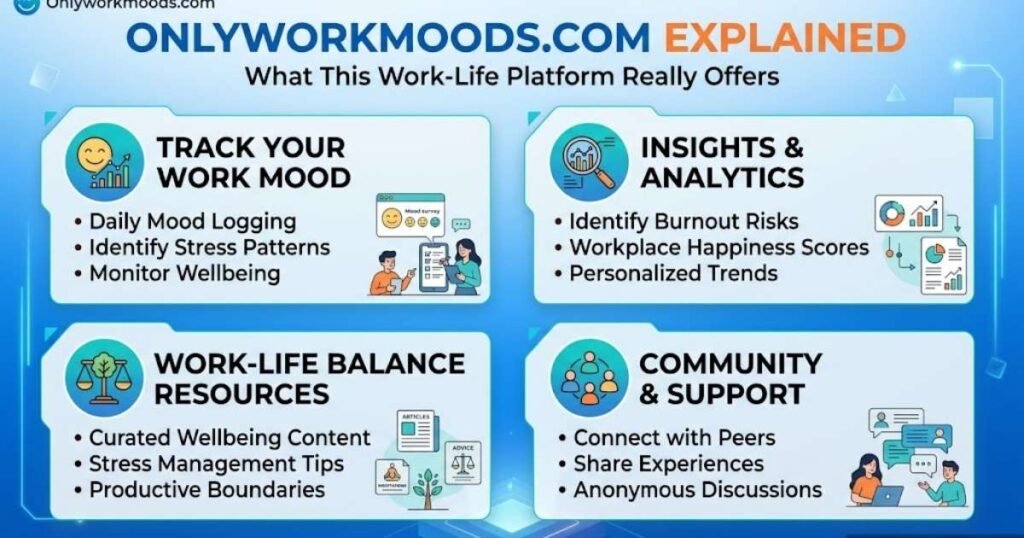
Onlyworkmoods.com has been showing up in search results for people looking into careers, workplace productivity, and general lifestyle topics. If you searched the name directly, you probably want a straight answer about what Onlyworkmoods.com actually is, not marketing language. This article breaks down what the site publishes, how it’s built, and whether it deserves a spot in your reading list.
What Is Onlyworkmoods.com, Actually?
Onlyworkmoods.com is a WordPress-based content publishing site that covers work, career development, business, finance, and a wide mix of lifestyle topics. It positions itself as a knowledge platform for professionals, job seekers, freelancers, and business owners.
In practice, it functions like a general-interest blog network rather than a specialized tool or software product. There’s no dashboard, no account system, and no interactive feature that tracks your mood, productivity, or work habits, despite what the name might suggest.
The site publishes regular articles across categories like Business, Finance, Education, Health, Automotive, Law, Home Improvement, and Technology. New posts appear on a near-daily basis, and each one follows a fairly standard blog format with a headline, an image, and body text organized under subheadings.
What the Site Is Not
Onlyworkmoods.com is not a mood-tracking app, a productivity software, or an HR platform. It doesn’t offer logins, dashboards, or any kind of personalized service.
It’s also not a niche publication limited to workplace psychology or emotional wellbeing, even though its name implies that focus. The actual content spans far beyond work moods into topics like legal services, home remodeling, and online gaming.
If you arrived expecting a structured tool for managing burnout or tracking productivity patterns, this site won’t deliver that. It’s a text-based content site, plain and simple.
What You’ll Actually Find on the Site
The homepage displays a rotating mix of recent posts grouped by category. Categories currently listed include Automotive, Business, Education, Fashion, Finance, Health, Lifestyle, Technology, and Travel, among others.
Article topics vary widely within a single browsing session. You might see a piece on talent acquisition trends next to an article about bathroom remodeling in a specific city, followed by a guide to online slots or a breakdown of disability discrimination attorneys.
This breadth is unusual for a site that markets itself around “workplace knowledge and career insights.” It suggests the platform functions more like a general content hub that accepts a wide variety of subject matter rather than a focused career resource.
Content Format
Articles typically run a few hundred to a thousand words, structured with H2 and H3 subheadings, short paragraphs, and occasional bullet points. Many posts include a “Key Takeaways” section near the top.
Author attribution across most posts is listed under a single byline, without detailed author bios, credentials, or professional background. This is a notable gap from a trust and expertise standpoint.
Images are used throughout, often stock-style graphics or AI-generated visuals rather than original photography. There’s no video content, no downloadable resources, and no interactive tools built into the articles.
Topic Range
Here’s a snapshot of the categories and the type of content found in each:
| Category | Example Topics |
| Business | Marketing agencies, business banking, business buildings for sale |
| Finance | Capital gains tax calculators, credit scores, debt management |
| Law | Traffic lawyers, disability discrimination attorneys, salary data |
| Education | Mock exams, school district calendars, spelling guides |
| Home Improvement | Bathroom remodeling by city |
| Automotive | Dealership operations, luxury vehicle technology |
| Health | General wellness and insurance-adjacent topics |
This table shows the range clearly. The content isn’t limited to “work moods” or workplace psychology at all. It reads more like a multi-niche affiliate and SEO content site.
Who’s Behind It
The site’s About page describes an editorial team committed to research, clarity, and reader-focused publishing. It references E-E-A-T principles (Experience, Expertise, Authoritativeness, Trustworthiness) directly, which suggests an awareness of Google’s quality guidelines.
However, there’s limited public information about specific writers, editors, or subject-matter experts behind the content. No named editorial staff, credentials, or professional backgrounds are easily visible on individual articles.
This gap matters. A site can state its commitment to editorial standards, but genuine E-E-A-T signals usually include named authors with verifiable expertise, which isn’t clearly present here.
Why So Many People Are Searching This Exact Phrase
People typically search “Onlyworkmoods.com” for one of three reasons. First, they landed on an article from the site through a search result and want to know if the source is legitimate before trusting the content.
Second, some visitors are curious after seeing the domain referenced in another article or backlink and want background before clicking through. Sites that publish across dozens of unrelated categories often draw this kind of scrutiny.
Third, a portion of searches come from people evaluating the site for guest posting, backlink purposes, or content partnerships. The broad topic spread and frequent posting schedule are typical markers of a site accepting contributed content, which naturally invites questions about its identity and reliability.
How the Site Is Structured
Onlyworkmoods.com runs on WordPress, using a standard blog theme with a top navigation bar, category menu, and a sidebar listing recent posts, archives, and categories. The layout is conventional and easy to navigate.
The site includes standard trust and legal pages: Privacy Policy, Terms and Conditions, Disclaimer, and a DMCA policy. These pages exist, which is a baseline trust signal, though their presence alone doesn’t confirm editorial quality.
Archives go back to mid-2023, with a noticeable increase in publishing frequency starting in early 2025. Posting volume by early-to-mid 2026 shows multiple articles per week across categories, which points to an active content production pipeline rather than a passive or abandoned project.
Here’s a quick structural summary:
- Homepage: Category-based post grid with a “Latest Posts” section
- Navigation: Automotive, Business, Education, Fashion, Finance, Health, Lifestyle, Technology, Travel
- Footer: Privacy Policy, DMCA, Terms and Conditions, Disclaimer, contact email
- Social presence: Linked X (Twitter) and LinkedIn company pages
Is It Actually Useful? Pros and Cons
Whether Onlyworkmoods.com is worth your time depends on what you’re looking for. It’s useful as a general information source but has clear limitations for anyone seeking depth, authority, or specialized workplace tools.
What It Does Reasonably Well
The site covers a genuinely wide range of everyday topics, which means you might stumble on something relevant even if you weren’t looking for it specifically. Its articles are written in accessible, plain language without heavy jargon.
Publishing frequency is consistent, so the content stays reasonably current. The site also maintains basic legal and trust pages, which is more than some low-quality content sites bother to include.
- Broad topic coverage across career, finance, business, and lifestyle
- Simple, scannable article structure with subheadings and takeaways
- Regular publishing schedule
- Standard legal and policy pages present
Where It Falls Short
The biggest issue is the mismatch between the site’s name and branding versus its actual content. A domain called “OnlyWorkMoods” implies a focused resource on workplace emotional wellbeing, but the real content spans law firms, bathroom renovations, and online slots.
Author credibility is thin. There are no visible bylines with professional credentials, no author bio pages with verifiable expertise, and no clear editorial oversight process described beyond general statements.
Depth is also limited. Most articles stay surface-level, offering general overviews rather than data-backed analysis, original research, or expert commentary you’d expect from an authoritative source on career or financial decisions.
- Content scope doesn’t match the site’s branding or name
- Minimal author transparency or credentials
- Limited depth on any single topic
- No interactive tools despite website copy suggesting a “platform”
- Mixed topic quality, ranging from genuinely useful to filler-style posts
The Mistake Most Visitors Make
The most common mistake people make with a site like Onlyworkmoods.com is assuming its broad, confident-sounding language about expertise and editorial standards automatically means the content is authoritative. Stated intentions and actual output are two different things.
Another common mistake is treating any single article as complete or final guidance, especially on topics involving money, legal matters, or health-adjacent decisions. Given the lack of named expert authorship, that’s a risky assumption.
Visitors also sometimes confuse the site’s name with an actual mood-tracking or workplace wellness tool. If you’re searching for software to monitor employee sentiment or personal productivity patterns, this site won’t meet that need at all.
How to Get Real Value From a Site Like This
General content sites aren’t automatically useless. They can still serve a purpose if you approach them with the right expectations and verify anything important before acting on it.
Read With a Specific Question in Mind
Go in looking for a specific answer rather than browsing aimlessly. General overview articles work best when you already have context and just need a quick refresher or a starting definition.
This approach also helps you judge quality faster. If the article answers your specific question clearly, it did its job. If it stays vague, move on.
Verify Any Practical Advice Elsewhere Before Acting On It
Any guidance touching finances, legal decisions, insurance, or health should be cross-checked against a primary source or licensed professional. This applies to Onlyworkmoods.com and to most general content sites without named subject-matter experts.
Cross-referencing takes a few extra minutes but protects you from acting on outdated or oversimplified information. Government sites, licensed professionals, and established industry publications are safer for anything with real financial or legal consequences.
Treat It as a Starting Point, Not a Destination
Use articles from sites like this as an entry point into a topic, not the final word. They can help you learn basic terminology or get oriented before diving into more authoritative resources.
This mindset keeps expectations realistic. You get value from the site’s breadth and accessibility without over-relying on content that lacks deep editorial vetting.
A Realistic Example of How Someone Might Use It
Picture someone searching for basic information about how credit scores affect lease approval. They land on an Onlyworkmoods.com article covering that exact topic.
The article gives a general explanation of what credit score ranges typically mean for leasing decisions. It’s readable and free of confusing jargon, so the reader walks away with a basic understanding.
Before signing any lease or making a financial decision, though, that same reader would still need to check with their specific leasing company or a financial advisor, since credit requirements vary by location, lender, and property type. The article served as a starting point, not the deciding factor.
This pattern applies across most of the site’s content. It’s reasonable for orientation and general awareness, but not a substitute for direct professional or official guidance on decisions that matter.
Bottom Line
Onlyworkmoods.com is a multi-category content publishing site, not a specialized work-life or mood-tracking platform despite its name. It covers career, business, finance, law, education, and several unrelated lifestyle topics through a standard WordPress blog format.
The site is reasonably active, easy to navigate, and includes the basic trust pages you’d expect from a legitimate publication. Its main weaknesses are thin author credibility, shallow topic depth, and a content scope that doesn’t match its branding.
Use it as a quick reference or starting point for general topics, and verify anything with real financial, legal, or health consequences through a more authoritative or professional source.
Frequently Asked Questions
Is Onlyworkmoods.com a legitimate website?
Yes, it’s an active, functioning content site with standard legal pages and regular publishing. Legitimacy as a working site doesn’t guarantee deep expertise on every topic covered.
Does Onlyworkmoods.com offer any tools or apps?
No, it’s a text-based blog publishing platform. There are no dashboards, trackers, or downloadable tools despite the “platform” language on its About page.
Who writes the content on Onlyworkmoods.com?
Most articles are attributed to a general byline without detailed author credentials listed publicly. This limits how much expertise can be verified for any single piece.
Can I trust the financial and legal advice on the site?
Treat it as general information only, not professional advice. Always verify financial, legal, or health-related content with a licensed expert or official source.
Why does the name suggest workplace moods but the content covers so much more?
The branding focuses on work and career themes, but the actual content library spans finance, law, automotive, and lifestyle topics. This mismatch is common among general SEO content sites that expand beyond their original niche.
Is Onlyworkmoods.com good for career advice specifically?
It offers general, surface-level career and workplace content that can work as a starting point. For in-depth or high-stakes career decisions, more specialized resources are better suited.
How often does Onlyworkmoods.com publish new content?
The site publishes multiple articles per week across its various categories, based on its visible post archive. Publishing frequency has increased noticeably since early 2025.
Conclusion
Onlyworkmoods.com is best understood as a general content publishing site rather than a specialized work-life or mood-management platform. It’s useful for quick, accessible overviews on a wide range of topics, but its lack of named expert authorship and shallow depth on individual subjects mean it shouldn’t be your only source for decisions involving money, legal matters, or professional strategy. Read it for orientation, verify anything important elsewhere, and you’ll get reasonable value out of it without over-relying on a site that promises more specialization than it actually delivers.

Daniel Wilson is the admin of Meaning Lexi, a website focused on the meanings of words, names, phrases, and symbols. He is dedicated to providing clear, accurate, and easy-to-understand content for readers.