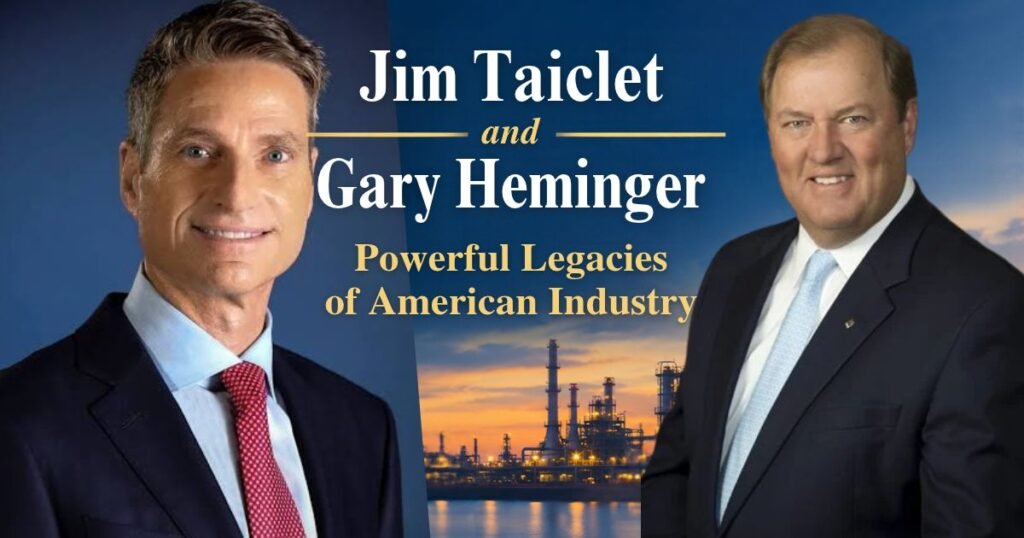
Two executives, two very different industries, and one shared trait: both made huge bets that reshaped their companies. Jim Taiclet and Gary Heminger rarely appear in the same sentence, yet their careers show how American industry is built, one acquisition, one strategy shift, and one hard decision at a time.
Taiclet is a former Air Force pilot who now runs the largest defense contractor in the United States. Heminger spent 45 years at one company and turned a regional refiner into a national giant. This guide compares Jim Taiclet and Gary Heminger side by side, with verified facts, current numbers, and the leadership lessons behind each story.
Quick answer:
Jim Taiclet is the chairman, president and CEO of Lockheed Martin. Gary Heminger is the retired chairman and CEO of Marathon Petroleum, which he led from 2011 to 2020. The two have no known business partnership. This article compares them because their careers show two contrasting paths to the top.
Who Is Jim Taiclet? The Pilot Turned Defense CEO
Jim Taiclet is the chairman, president and chief executive officer of Lockheed Martin, a role he has held as CEO since June 2020. He became chairman in March 2021 and has served on the company’s board since 2018.
His résumé crosses four worlds: the military, consulting, aerospace manufacturing, and telecommunications infrastructure. That mix is rare in a defense boardroom, and it explains much of his strategy.
From Air Force Pilot to Corporate Strategist
Taiclet’s career began in uniform. He started as a U.S. Air Force officer and pilot, logging more than 5,000 flying hours, mostly in the Lockheed C-141B StarLifter. He served as an aircraft commander, instructor pilot, and unit chief of standardization and evaluation.
His military service included real combat-zone work. During the Gulf War, he piloted one of the first transport aircraft to bring U.S. forces into Saudi Arabia for Operation Desert Shield.
His education supported the move into business:
- U.S. Air Force Academy: distinguished graduate with bachelor’s degrees in engineering and international relations
- Princeton University: master’s degree, with a fellowship at the Princeton School of Public and International Affairs
After the service, he built his corporate base in this order:
- McKinsey & Company: consultant focused on telecommunications and aerospace strategy
- Pratt & Whitney: vice president of engine services, overseeing military and commercial jet engine overhaul and repair
- Honeywell Aerospace Services (formerly AlliedSignal): president, per company announcements at the time of his Lockheed appointment
This path matters. He learned how jet engines are serviced, how global telecom networks scale, and how large organizations make decisions under pressure.
The American Tower Transformation
Many readers know Taiclet from Lockheed. Wall Street first knew him from American Tower.
He joined American Tower in 2001. His CEO tenure there began in 2003, and he became chairman, president and CEO in 2004. The company owns and operates wireless and broadcast communications towers.
The results are the heart of his reputation. Under his leadership, American Tower grew its market capitalization from roughly $2 billion to more than $100 billion and expanded to 19 countries.
What did that growth require?
- A shift from a mostly U.S. business to a global one
- Long-term contracts with wireless carriers
- Steady investment in infrastructure that customers rent rather than build
This experience shaped his later thinking. The tower business taught him that connectivity is a strategic asset, and he carried that belief straight into defense.
Leading Lockheed Martin into the 21st Century
In March 2020, Lockheed announced its succession plan. Taiclet officially became president and CEO on June 15, 2020, replacing Marillyn Hewson, who stayed on as executive chair. At the time, the company had a record backlog of $144 billion.
Taiclet then introduced his big idea, called 21st Century Security. The vision brings together the aerospace and defense industry, new entrants, and the tech and telecom sectors, using an open, standards-based architecture to deliver integrated solutions.
In plain terms, he wants weapons and sensors that connect and share data across branches, allies, and platforms. Think of it as moving from isolated machines to networked systems powered by AI, 5G, and advanced computing.
The numbers today (October 2026)
Lockheed released its third-quarter results today. The highlights, per the company’s SEC filing:
- Sales of $20.7 billion, up from $18.6 billion a year earlier
- Net earnings of $1.8 billion, or $7.97 per share
- A record backlog of $292.0 billion, including $52.5 billion tied to a multi-year award for PAC-3 MSE interceptors
- Dividend raised for the 24th year in a row
The backlog is the headline. It sits roughly double the level when Taiclet took over in 2020.
Key programs and priorities
- F-35 Lightning II: the flagship fighter. Lockheed had delivered a record 143 jets through Q3 2025.
- Missile defense: In June 2026 the Missile Defense Agency awarded a seven-year, $35 billion contract to quadruple THAAD interceptor production.
- Golden Dome: Lockheed was selected to develop space-based interceptor prototypes under this homeland missile defense effort.
- Munitions capacity: Taiclet credits bets made ahead of demand, such as expanding munitions production before contracts arrived.
- Acquisitions: Lockheed agreed to buy undersea-warfare firm Ultra Maritime for $3.45 billion.
A fair note for balance: defense programs carry execution risk. Lockheed reported $1.6 billion of program losses in Q2 2025, and large contracts face political and budget scrutiny. Taiclet’s record is strong on demand and growth, while delivery on complex programs remains the key test.
Beyond the Boardroom
Taiclet’s influence extends past Lockheed. He is a member of the Business Council, an associate fellow of the American Institute of Aeronautics and Astronautics, and a director of Mass General Brigham.
His public voice is consistent. He talks about serving “the frontline men and women” and giving them better technology than their adversaries have. His own flight experience gives that message weight.
Who Is Gary Heminger? The Architect of America’s Largest Refiner
Gary Heminger is the retired chairman and CEO of Marathon Petroleum Corporation. His story is different from Taiclet’s in almost every way. He did not hop between industries. He stayed, and he climbed.
A Marathon Man from the Start
Heminger joined Marathon in 1975. Chief Executive magazine described him as a “lifer” who took the long, steady road to the top of the Findlay, Ohio, company.
His education was practical and Midwestern. He attended Tiffin University and the University of Dayton, and completed the Wharton School Advanced Management Program.
His early career moved through the business side of oil:
- 1998: named vice president of business development when Marathon Ashland Petroleum was formed
- 2001: named executive vice president of supply, transportation and marketing, and then president of Marathon Petroleum Company LLC
- 2001 to 2011: served as executive vice president of downstream at Marathon Oil
That decade gave him deep knowledge of refining, logistics, and retail. He understood how crude oil becomes gasoline, how it moves, and how it sells.
Building Marathon Petroleum
In 2011, Marathon Oil split into two companies. Heminger became president and CEO of Marathon Petroleum with the June 2011 spin-off, and became chairman in 2016.
Under his watch, the company pushed into three areas at once:
- Refining: turning crude into fuels
- Retail: the Speedway convenience store chain
- Midstream: pipelines and logistics through MPLX
The company said he headed several transformative acquisitions, and Forbes named Marathon Petroleum a best employer in 2015.
His midstream strategy deserves attention. Midstream assets tend to produce steadier, fee-based income than refining margins, which swing with commodity prices. That balance became a signature of his approach.
The Andeavor Acquisition: A Defining Bet
The Andeavor deal is the centerpiece of Heminger’s legacy, and also the source of his most debated chapter.
The facts
- Announced: April 30, 2018
- Closed: October 1, 2018
- Value: total equity value of $23.3 billion and total enterprise value of $35.6 billion
- Result: the creation of the largest U.S. refiner and one of the five largest globally
Heminger framed the deal as a quest to build the best refining, marketing, and transportation company in the country. Andeavor added West Coast and Mountain West refineries and retail assets, which gave Marathon national reach.
The complication
The strategy faced investor headwinds. Activists including Elliott Management and D.E. Shaw argued that the share price lagged after the Andeavor acquisition and pushed for a shakeup.
The pressure produced three outcomes:
- In October 2019, Heminger announced his plan to retire after 45 years.
- Marathon announced it would separate Speedway into an independent public company.
- Michael Hennigan took over as CEO in mid-March 2020.
The Speedway ending
The retail plan changed again after Heminger left. In 2020, Marathon agreed to sell Speedway to 7-Eleven for $21 billion in cash, with after-tax proceeds of about $16.5 billion. The deal closed on May 14, 2021. The agreement also included a 15-year fuel supply arrangement.
So the Andeavor story has two sides. Supporters see a bold consolidation that built scale. Critics point to the investor backlash and the later breakup of pieces he had built. Both views have merit, and the full picture is more nuanced than either.
Recognition and Legacy
Heminger’s post-Marathon life stays active:
- PPG Industries: He has been a PPG director since 2017.
- The Ohio State University: He serves as a trustee, with a term running through May 2027.
- Compensation: Equilar reported he realized about $102.6 million in total compensation from 2011 to 2019.
His legacy rests on scale and endurance. He led through a major oil price downturn, completed one of the largest refining deals in U.S. history, and stayed on to help integrate the companies even after announcing his retirement. The board thanked him for agreeing to remain for extended service to ensure a successful integration.
Jim Taiclet vs. Gary Heminger: A Side-by-Side Comparison
Here is how the two leaders compare on the facts that matter most.
| Category | Jim Taiclet | Gary Heminger |
| Current status | Chairman, president and CEO, Lockheed Martin | Retired chairman and CEO, Marathon Petroleum |
| CEO tenure | June 2020 to present | 2011 to March 2020 |
| Industry | Aerospace and defense | Refining, retail, midstream energy |
| Career path | Air Force, McKinsey, Pratt & Whitney, Honeywell, American Tower, Lockheed | 45 years at Marathon |
| Education | U.S. Air Force Academy, Princeton | Tiffin University, University of Dayton, Wharton program |
| Signature move | 21st Century Security and record backlog growth | $23.3 billion Andeavor acquisition |
| Earlier big win | American Tower: $2 billion to $100 billion+ market cap | Building MPLX and midstream strength |
| Main challenge | Program execution and budget politics | Activist investors and share price pressure |
| Headquarters | Bethesda, Maryland | Findlay, Ohio |
| Other roles | Business Council, Mass General Brigham board | PPG board, Ohio State trustee |
Three clear differences
- Path: Taiclet moved across industries. Heminger stayed in one.
- Growth style: Taiclet leans on technology and partnerships. Heminger leaned on consolidation and scale.
- Exit: Taiclet remains in charge. Heminger left under investor pressure but with the board’s strong public support.
Two clear similarities
- Both made large strategic bets with multi-year payoffs.
- Both led companies where physical infrastructure, whether fighter jets or refineries, takes years to build and cannot be changed quickly.
Why These Two Leaders Matter Beyond Their Industries?
Their stories matter because defense and energy sit at the center of national security and the economy. When Lockheed delivers missile defense or Marathon refines fuel, the effects reach millions of people.
Here are practical lessons readers can take from both careers.
Lessons from Taiclet
- Cross-industry experience is an advantage. His telecom background shaped his defense strategy.
- Invest before the demand arrives. He credits early capacity bets for Lockheed’s recent surge.
- Build a clear, simple vision. “21st Century Security” gives employees and customers a single idea to rally around.
Lessons from Heminger
- Deep expertise builds trust. Forty-five years inside one company gave him unmatched operational knowledge.
- Big deals need big follow-through. A bold acquisition must be matched by a market narrative that investors believe.
- Stakeholders shape strategy. Activist pressure can change a leader’s timeline, even when the board stands behind him.
What this means for the industries?
Defense spending is rising and supply chains are being rebuilt. Energy companies keep balancing refining, retail, and pipelines. Both fields reward leaders who plan over decades but still answer to quarterly results. That tension defines modern American industry.
A note on trust: all figures here come from company filings, official bios, and established business outlets, and I recommend checking Lockheed’s investor relations page and Marathon’s SEC filings for the latest updates. Company numbers change every quarter.
Frequently Asked Questions
Who is Jim Taiclet?
Jim Taiclet is the chairman, president and CEO of Lockheed Martin, a former Air Force pilot, and the former CEO of American Tower.
Who is Gary Heminger?
Gary Heminger is the retired chairman and CEO of Marathon Petroleum, where he worked for 45 years and led the company from 2011 to 2020.
Are Jim Taiclet and Gary Heminger connected?
No public business partnership between them is known. This article compares them because they led major American companies in defense and energy.
When did Jim Taiclet become CEO of Lockheed Martin?
He became CEO on June 15, 2020, and added the chairman title in March 2021.
What did Jim Taiclet do before Lockheed Martin?
He led American Tower as CEO from 2003, after roles at Honeywell, Pratt & Whitney, and McKinsey, and after serving as an Air Force pilot.
What is Lockheed Martin’s backlog now?
Lockheed reported a record backlog of $292.0 billion in its Q3 2026 results, released October 22, 2026.
What is 21st Century Security?
It is Taiclet’s vision for connected, open-architecture defense systems that combine traditional aerospace with AI, 5G, and commercial technology.
When did Gary Heminger retire from Marathon Petroleum?
He retired in March 2020 after announcing his plans in October 2019.
Why did Gary Heminger leave Marathon Petroleum?
He stepped down after activist investors pushed for changes following the Andeavor deal, though the board praised his leadership.
How much was the Andeavor acquisition worth?
The deal had an equity value of $23.3 billion and an enterprise value of $35.6 billion.
What happened to Speedway?
Marathon sold Speedway to 7-Eleven for $21 billion, and the sale closed on May 14, 2021.
Who replaced Gary Heminger at Marathon Petroleum?
Michael Hennigan took over as CEO in March 2020.
What is Gary Heminger doing now?
He serves on the PPG Industries board and is an Ohio State University trustee.
Conclusion
The careers of Jim Taiclet and Gary Heminger show two proven routes to leading an American giant. Taiclet moved across industries, linking aviation, telecom, and defense into a growth story that now rests on a record $292 billion backlog. Heminger stayed in one company for decades, built scale through the $23.3 billion Andeavor deal, and left a legacy that is still debated.
The takeaway is simple. Strong leaders pair a clear vision with disciplined execution, and they accept that investors, customers, and history will judge both. If you follow defense or energy, keep watching how Lockheed turns its backlog into deliveries and how Marathon’s post-Heminger strategy evolves.

Daniel Wilson is the admin of Meaning Lexi, a website focused on the meanings of words, names, phrases, and symbols. He is dedicated to providing clear, accurate, and easy-to-understand content for readers.