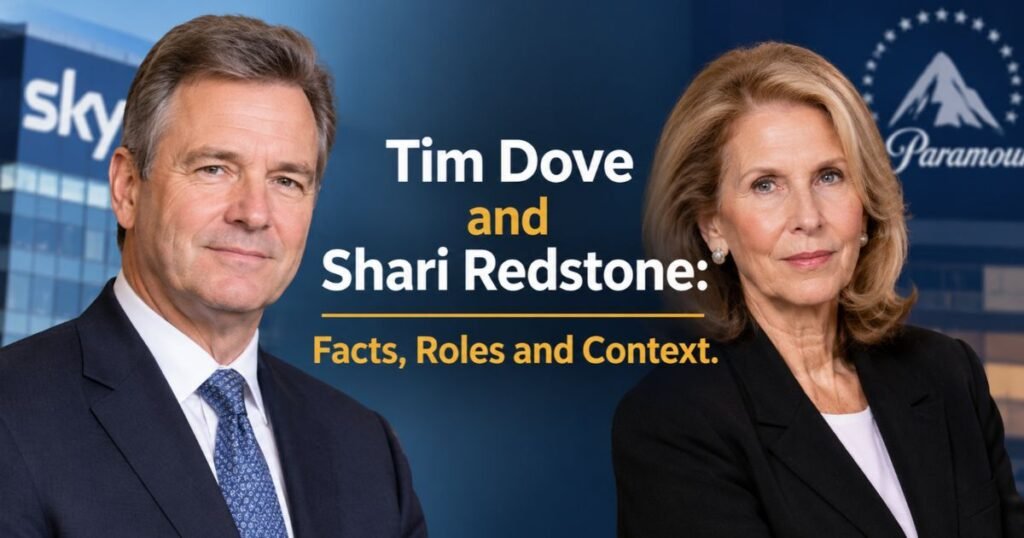
Search for Tim Dove and Shari Redstone and you will find pages that treat the two names like a package deal. They are not one. Shari Redstone is the media heir who spent years steering Paramount through mergers, boardroom fights and a final sale. Tim Dove is a retired oil and gas executive who ran Pioneer Natural Resources.
This guide separates what the public record confirms from what the internet implies. As of October 2026, no reliable source documents a business partnership between Tim Dove and Shari Redstone. Below you will find a clear bio for each person, the reasons their names get linked, and a simple method for checking any executive claim yourself.
Bio/Wiki
Here is a side-by-side snapshot built from SEC filings, company announcements and major business press. Use it as a quick reference, then read the sections below for context.
| Detail | Shari Redstone | Tim Dove |
| Full name | Shari Ellin Redstone | Timothy L. Dove |
| Born | April 14, 1954 | About 1956 or 1957 (estimate) |
| Industry | Media and entertainment | Oil and gas |
| Best known for | Controlling Paramount through National Amusements | Serving as CEO of Pioneer Natural Resources |
| Education | BS, Tufts University; JD and master’s in tax law, Boston University | BS in mechanical engineering, MIT (1979); MBA, University of Chicago (1981) |
| Key roles | President of National Amusements (2000); chair of Paramount Global | CFO (2000), President and COO (2004), CEO (2017) at Pioneer |
| Current status | Sold the family’s controlling stake to Skydance; left Paramount after the 2025 merger | Retired from Pioneer in February 2019 |
| Documented link to the other | None found | None found |
Who Is Shari Redstone?
Shari Redstone is an American media executive and the daughter of Sumner Redstone. She led National Amusements, the closely held company that controlled Paramount, until the family sold that control to Skydance Media.
Shari Redstone’s Early Life and Education
Shari Redstone was born on April 14, 1954, in Washington, D.C. Her grandfather, Michael Redstone, founded the theater business in 1936 that later became National Amusements. Her father, Sumner Redstone, grew that business into a media empire.
She earned a bachelor’s degree from Tufts University, then a law degree and a master’s in tax law from Boston University. From 1978 to 1993 she practiced law, handling corporate matters, estate planning and criminal cases. CBS’s own proxy statement later cited that legal experience as part of what she brought to its board.
From National Amusements to Paramount Global
Her path from lawyer to media power broker took about three decades. Here are the main steps:
- 1994: She became executive vice president of National Amusements and joined the Viacom board.
- 2000: She became president of National Amusements.
- 2006: She became non-executive vice chair of Viacom, and later held the same title at CBS.
- 2011: She co-founded Advancit Capital, an early-stage investment firm focused on media and technology.
- 2019: She became chair of ViacomCBS after the two companies reunited.
- 2020: Sumner Redstone died on August 11, and his holdings passed to a trust she led.
- 2022: ViacomCBS was renamed Paramount Global.
- 2024 to 2025: She negotiated and closed the sale to Skydance.
Why Shari Redstone Still Draws Attention
She remains a search favorite for good reasons:
- Time magazine named her one of the world’s 100 most influential people in 2020.
- She controlled a company that owned CBS, Paramount Pictures, Nickelodeon, MTV and Comedy Central.
- She forced out CEO Bob Bakish in April 2024 after clashes over the Skydance talks.
- She received about $1.75 billion in cash for the family’s stake in National Amusements.
- After the sale, she described to The New York Times why she backed a $16 million settlement with President Trump over a 60 Minutes lawsuit.
Whether you admire her decisions or not, her choices shaped what millions of people watch.
Who Is Tim Dove?
Timothy L. Dove is the former president and chief executive officer of Pioneer Natural Resources, a Texas-based oil and gas producer. He retired in February 2019 after a career that spanned engineering, finance and operations.
What We Know About Tim Dove
The verified details come mostly from SEC filings and company press releases:
- He graduated from the Jesuit College Preparatory School of Dallas in 1975.
- He earned a mechanical engineering degree from MIT in 1979 and an MBA from the University of Chicago in 1981.
- He worked at Diamond Shamrock and its successor, Maxus Energy, in exploration, marketing, refining and planning.
- He joined Parker & Parsley in 1994, and Pioneer was formed from that company in 1997.
- He became Pioneer’s chief financial officer in 2000 and president and chief operating officer in December 2004.
- He became CEO on January 1, 2017, succeeding Scott Sheffield, who later returned to the role after Dove retired.
- His former school named him a Distinguished Alumnus in 2018.
Pioneer itself was later acquired by ExxonMobil in 2024, years after Dove stepped away.
Why Information on Tim Dove Is Hard to Find
Dove is a private person who rarely made headlines outside energy circles. He is retired, so there is no steady flow of news. His name is also common, which means a casual search can mix him up with unrelated people called Tim Dove.
Wikipedia’s article about him even carries a notice questioning whether the topic meets its notability standard. That tells you something: the best information about him lives in regulatory filings, not in glossy profiles.
How to Verify a Name Online
Use this five-step check before trusting any biography:
- Search the full name with the company, such as “Timothy L. Dove Pioneer Natural Resources.”
- Open the SEC’s EDGAR database and look for proxy statements (DEF 14A) and annual reports (10-K).
- Compare the person’s job title, dates and education across at least two independent sources.
- Look for a primary source, such as a press release or filing, rather than a page that only repeats another page.
- Be cautious if a page makes claims about a relationship without naming where the information came from.
Why Are Their Names Mentioned Together?
Their names appear together mainly because of how people search, not because of a shared company or deal. Search engines suggest related phrases, and curious readers click them. Content writers then build pages around those suggestions.
Business Networks and Overlap
Executives at large public companies move in overlapping circles. They appear in SEC filings, speak at investor conferences, sit on charitable boards and meet the same bankers and lawyers. Shari Redstone, for example, attended the Allen & Co. Sun Valley conference in 2024, a yearly gathering of media and technology leaders.
Sharing a room is not the same as sharing a business. Two executives can be in the same industry network for years and never work together. In this case, the documented careers sit in separate sectors: energy for Dove, media for Redstone.
Why a Search Pairing Isn’t a Relationship
A pairing in search results is just a pattern of clicks. It does not prove a friendship, a partnership or a family tie. At least one page that ranks for this exact phrase reaches the same conclusion: corporate records document each career separately and do not show that the two worked together.
Think of it like a library shelf. Two books can sit side by side because of how they were filed, not because the authors know each other.
Spotting Low-Quality Claims
Watch for these warning signs:
- The page names no sources, or only links to other blogs.
- It uses vague phrases such as “reportedly close” or “sources say” without naming a publication.
- It mixes up the people, giving Dove a media career or Redstone an oil career.
- It lists no dates, filings or official titles.
- It still describes Shari Redstone as Paramount’s current chair even though the sale is complete.
If a page fails two or more of these tests, treat it as unverified.
Shari Redstone’s Role in the Media Industry
Redstone’s influence came from ownership structure more than from any single job title. Understanding that structure explains why one family could shape an entire company.
Family Control and Governance
National Amusements held about 77 percent of Paramount’s voting shares, even though it owned a much smaller portion of the total equity. That gap exists because Paramount used a dual-class share system. Class A shares carried votes, while Class B shares did not.
This is a classic controlled-company model. The controlling shareholder can steer major decisions, including mergers, board seats and leadership changes. Public investors may own most of the economic value yet have little say. That tension fueled several shareholder lawsuits during her tenure.
Case Study: The 2019 Viacom and CBS Reunion
The 2019 reunion is the clearest example of her influence.
- Background: Viacom and CBS had operated as separate companies since the mid-2000s, though National Amusements controlled both.
- The push: Redstone favored recombining them, arguing a larger company would compete better in a changing market. CBS’s board resisted, and the dispute turned into a turbulent 2018 that included the exit of CBS chief Les Moonves.
- The result: The merger was completed in December 2019, creating ViacomCBS with Redstone as chair.
- The aftermath: In January 2021, a Delaware judge allowed former CBS shareholders to sue her over claims that she pressured the company into the deal. The company became Paramount Global in 2022.
The lesson is simple. A controlling shareholder can reshape an industry, but the choice can bring legal and financial risk.
Shari Redstone’s Influence on U.S. Entertainment
Through Paramount, her family’s holdings touched film, broadcast television, cable and streaming. Paramount Pictures, CBS, Nickelodeon, MTV, BET and Showtime all sat under one umbrella. When the Skydance deal closed in 2025, Paramount+ reported 77.7 million subscribers.
Her influence also showed in people moves. She backed leadership changes, supported the 2024 “office of the CEO” structure after Bakish left, and ultimately chose a buyer in David Ellison. Those calls affected thousands of employees and the programming audiences see.
Corporate Leadership and Decision-Making
Big corporate decisions rarely come from one person, even in a controlled company. They come from a mix of ownership, boards and advisors.
Who Really Makes the Call?
At Paramount, four groups shaped major choices:
- The controlling shareholder: Redstone could approve or block a sale.
- The board of directors: It had a duty to all shareholders.
- A special committee: Independent directors reviewed the Skydance offers.
- The CEO and management team: They ran daily operations and strategy.
The Skydance story shows how this works. A special committee evaluated bids, while Redstone ended talks on June 11, 2024, and then returned weeks later to sign a deal on July 7. One person held a veto, but a process surrounded her.
Why Professional Networks Matter
Connections matter in corporate life because deals depend on trust and introductions. Bankers bring buyers. Lawyers shape structures. Directors vouch for each other.
Still, a network is only a map of who could meet, not proof of who did. That distinction is the heart of the confusion around this keyword pair. A name in a network is a lead worth checking, not a fact worth publishing.
The Changing Entertainment Business
The business Shari Redstone inherited looks very different from the one she left.
From Cable to Streaming
For decades, cable bundles paid networks like MTV and Comedy Central steady fees. Then viewers began canceling cable and moving to streaming. Netflix, Disney and others invested billions in digital platforms, and legacy media companies had to follow.
Paramount answered with Paramount+, built on its older CBS streaming service. It grew, but the old cable income kept shrinking faster than streaming could replace it.
Mergers, Restructuring, and Survival
The pressure showed in the numbers. Reports at the time of the Skydance agreement said Paramount had lost nearly $17 billion in value since late 2019. It also carried about $14.6 billion in long-term debt.
The Skydance deal was designed to answer those problems:
- $1.5 billion in new capital to pay down debt.
- A projected $2 billion in annual cost savings.
- New leadership under David Ellison as chair and CEO, with Jeff Shell as president.
- A shift toward a content-first strategy backed by Ellison family wealth.
Many legacy media groups now face the same choice: merge, restructure or shrink.
What Can Be Learned From Their Professional Context?
Even though their careers do not connect, the two executives offer practical lessons:
- Ownership shapes power. Redstone’s influence came from voting control. Dove’s came from climbing the ranks of a public company.
- Different paths reach the top. Dove moved through finance, business development and operations. Redstone moved from law to family business to the boardroom.
- Industry disruption changes everything. Energy and media both faced swings that tested leaders.
- Retirement and exit are part of the story. Dove stepped aside in 2019, and Redstone sold in 2025.
- Verification beats assumption. The most useful habit is to ask where a claim comes from.
Public Interest and Media Coverage
Interest in Redstone peaks around deals, lawsuits and leadership changes. Interest in Dove is quieter and tied to Pioneer’s history. When both names appear in one query, the coverage is usually thin.
Reliable Sources for Researching Tim Dove and Shari Redstone
Start with these:
- SEC EDGAR: Proxy statements, 10-K reports and merger filings list titles, dates and education.
- Company press releases: Pioneer Natural Resources and Paramount announced leadership changes directly.
- Established business outlets: Variety, The Hollywood Reporter, Reuters, Bloomberg, The Wall Street Journal and The New York Times covered the Paramount deal in depth.
- Alumni and institutional pages: Jesuit Dallas published a profile of Dove when it honored him in 2018.
Confirmed Facts vs. Online Speculation
| Confirmed by records | Speculation to avoid |
| Dove was CEO of Pioneer from 2017 to 2019 | That Dove held a role at Paramount or National Amusements |
| Redstone chaired Paramount and led National Amusements | That Redstone held a role in the oil and gas industry |
| Skydance bought National Amusements and merged with Paramount | That the two executives were business partners |
| Redstone received about $1.75 billion for the family stake | That any personal or family tie exists between them |
FAQ’s
Are Tim Dove and Shari Redstone business partners?
No reliable record shows a partnership. Their documented careers are in different industries.
Who is Tim Dove?
Tim Dove is the former president and CEO of Pioneer Natural Resources, an oil and gas company. He retired in February 2019.
Who is Shari Redstone?
Shari Redstone is a media executive who led National Amusements and chaired Paramount Global. She sold the family’s controlling stake to Skydance.
Is Shari Redstone still in charge of Paramount?
No. The Skydance merger closed in 2025, and David Ellison now serves as chair and CEO.
How much did Shari Redstone receive from the Skydance deal?
Reports say she received about $1.75 billion in cash for National Amusements.
Why do people search for Tim Dove and Shari Redstone together?
It is mostly a search pattern, often boosted by pages that pair names without evidence.
Where can I verify an executive’s background?
Use SEC EDGAR filings, company press releases and established news outlets.
Did Tim Dove ever work in media?
Public records show his career in energy and engineering, not entertainment.
Conclusion
The facts are straightforward once you separate them. Shari Redstone built her public profile in media, from National Amusements to the 2019 reunion of Viacom and CBS to the 2025 sale to Skydance. Tim Dove built his in energy, rising through Pioneer Natural Resources to the CEO role before retiring in 2019.
Nothing in the public record ties the two together. Their names sit near each other in search results because of how the internet works, not because of a shared deal.
Next time you see a claim that links two executives, check the filings, confirm the dates and look for named sources. That small habit protects you from repeating a rumor and gives you a far better picture of how corporate leadership actually works.

Daniel Wilson is the admin of Meaning Lexi, a website focused on the meanings of words, names, phrases, and symbols. He is dedicated to providing clear, accurate, and easy-to-understand content for readers.