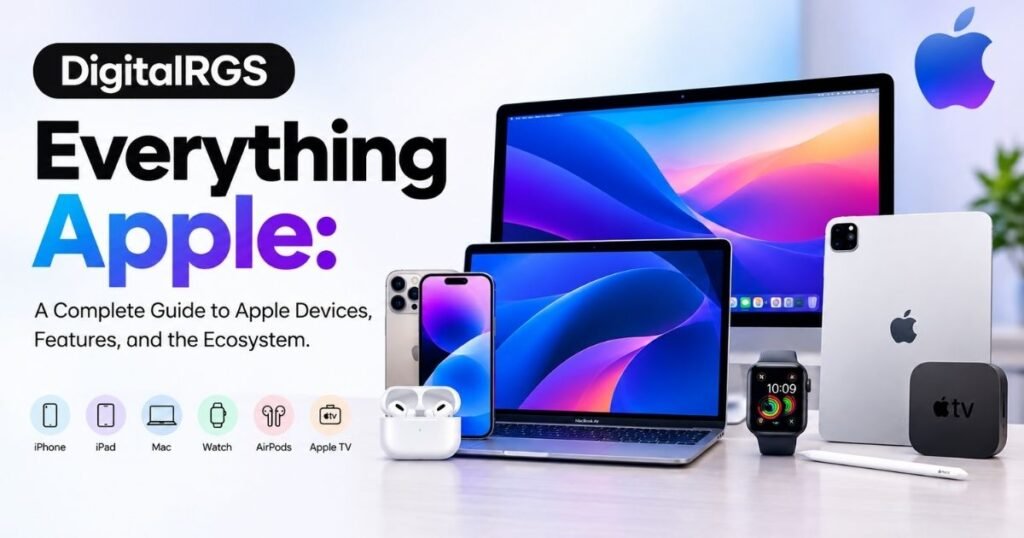
DigitalRGS Everything Apple is a topic for people who want one clear place to understand Apple products, services, and how they work together. Apple makes phones, computers, tablets, watches, and cloud services. Each one is useful alone, but the real value appears when they connect.
This guide explains that connection in plain language. Whether you are a first-time buyer or a long-time user, DigitalRGS Everything Apple as a subject covers what to buy, how to set it up, how to stay safe, and how to fix common problems. Every section is practical and easy to scan.
digitalrgs everything apple
The phrase “digitalrgs everything apple” points to a broad, all-in-one approach to Apple content. It covers hardware, software, services, buying decisions, and troubleshooting.
The main idea is simple. Apple products are designed as a system, so learning one device in isolation leaves gaps. Understanding how the iPhone, Mac, iPad, Apple Watch, and iCloud share data helps you get more from each purchase.
This article follows that approach. Each section below answers one clear question and gives you steps or facts you can use today.
What Does DigitalRGS Everything Apple Cover?
The topic covers the full Apple experience, from devices to daily habits. Here is what a complete Apple resource should include:
- Devices: iPhone, Mac, iPad, Apple Watch, AirPods, Apple TV, and HomePod.
- Software: iOS, iPadOS, macOS, watchOS, and their built-in apps.
- Services: iCloud, Apple Music, Apple TV, Apple Arcade, and Apple One bundles.
- Features: Continuity, AirDrop, Find My, Apple Pay, and Apple Intelligence.
- Practical help: buying advice, setup steps, privacy settings, and repairs.
Coverage matters because Apple users rarely have one device. Most own two or three. A guide that links them saves time and prevents common mistakes, such as running out of iCloud storage or missing a key setting.
How the Apple Ecosystem Works
The Apple ecosystem is a set of devices and services that share your Apple Account. Sign in once, and your data, purchases, and settings can follow you across products.
Several features make this work:
- Handoff: start an email on iPhone and finish it on your Mac.
- Universal Clipboard: copy text on one device and paste it on another.
- AirDrop: send files, photos, and links to nearby Apple devices.
- Continuity Camera: use your iPhone as a webcam or scanner for your Mac.
- Universal Control: use one keyboard and mouse across a Mac and an iPad.
- iPhone Mirroring: view and control your iPhone from a Mac.
These tools rely on Bluetooth, Wi-Fi, and the same Apple Account. Keep those turned on. Most “it stopped working” problems come from a device being signed out or having Wi-Fi or Bluetooth switched off.
iPhone: The Center of Many Apple Setups
For most people, the iPhone is the starting point. It handles calls, messages, photos, payments, maps, and health data. It is also required to set up an Apple Watch.
When choosing an iPhone, focus on four things:
- Camera needs: Pro models add extra lenses and stronger video tools.
- Storage: photos and video fill space fast, so pick a size you will not outgrow.
- Battery life: compare official battery figures across models.
- Software support: Apple typically supports iPhones with updates for many years.
Useful built-in features include Face ID, Apple Pay, Emergency SOS, Crash Detection on supported models, and the Action button on newer models. Turn on automatic updates so you get security fixes without effort.
One tip: back up your phone before any major update. Use iCloud Backup or a Mac connection.
Mac and MacBook: Productivity at the Core
Macs run macOS and use Apple silicon chips in current models. These chips are known for strong performance and good battery life, especially in MacBooks.
Here is a simple way to compare common choices:
| Mac Type | Best For | Key Strength |
| MacBook Air | Students, travel, everyday work | Light, quiet, long battery life |
| MacBook Pro | Video, code, design, heavy tasks | More power and better displays |
| iMac | Home and office desks | All-in-one design |
| Mac mini | Budget desktop setups | Small size, use your own display |
| Mac Studio and Mac Pro | Professional studios | Top-tier performance |
Before buying, check the RAM and storage. Both are usually fixed after purchase, so choose with your future needs in mind. For general work, moderate memory is enough. For video editing or development, aim higher.
Useful macOS tools include Spotlight search, Stage Manager, Time Machine backups, and Preview for quick edits to PDFs and images.
iPad and Apple Watch
The iPad sits between a phone and a laptop. It suits reading, note-taking, drawing, video, and light work. With a keyboard case, many people use it as a laptop replacement.
Quick iPad guide:
- iPad: the everyday choice for families and students.
- iPad mini: the portable pick for reading and travel.
- iPad Air: a balance of power and price.
- iPad Pro: the strongest option for creative and professional work.
Apple Pencil support varies by model, so check compatibility before buying accessories.
The Apple Watch is a health and convenience device. It tracks activity, heart rate, sleep, and workouts. Some models offer ECG readings, fall detection, and irregular rhythm notifications. It also shows messages, controls music, and pays with Apple Pay.
Remember that the Apple Watch needs an iPhone for setup. Treat its health data as helpful information, not a medical diagnosis. Talk to a doctor about any health concern.
iCloud and Apple Services
iCloud is Apple’s cloud service. It stores photos, files, contacts, calendars, notes, and device backups. It also powers Find My and helps your devices stay in sync.
Every Apple Account includes 5 GB of free storage. That fills up quickly, so many users pay for a larger plan. Paid tiers exist from 50 GB up to several terabytes, and pricing varies by country, so check the current rate in your Settings.
Key services to know:
- iCloud Drive: file storage that works across devices.
- iCloud Photos: keeps your full library available everywhere.
- iCloud Backup: saves your iPhone or iPad so you can restore it.
- Apple One: a bundle that can combine iCloud storage with Apple Music, Apple TV, and Arcade.
- Apple Pay and Wallet: cards, tickets, passes, and keys in one place.
To avoid storage problems, review what is taking space in Settings, then iCloud, then Manage Storage. Remove old backups and large videos you no longer need.
Apple Intelligence and AI Features
Apple Intelligence is Apple’s set of AI features built into its operating systems. It works on supported devices only, which generally means recent iPhones and iPads and Macs with Apple silicon. Check Apple’s official compatibility list before you buy.
Common features include:
- Writing Tools: proofread, rewrite, and summarize text in many apps.
- Notification summaries: short overviews of long message threads.
- Image tools: create images and emoji, and clean up photos.
- Visual Intelligence: learn about objects and places using your camera.
- Live Translation: support for translating conversations in supported languages.
- Siri improvements: better understanding and app integration.
Apple says many tasks run on the device itself. For heavier requests, it uses Private Cloud Compute, which is designed to protect user data. Feature availability changes by language, region, and software version, so check your device’s settings for what is currently offered.
Always review AI output. Summaries and rewrites can miss detail or tone.
Privacy and Security
Apple builds privacy tools into its products, and you should know how to use them. Small settings changes make a large difference.
Turn these on first:
- Two-factor authentication for your Apple Account.
- Face ID or Touch ID with a strong passcode.
- Find My so you can locate or lock a lost device.
- Automatic software updates for security patches.
- Passkeys and iCloud Keychain for safer sign-ins.
Other helpful protections include App Tracking Transparency, which lets you block apps from tracking you across other apps. Hide My Email creates random addresses for sign-ups. Mail Privacy Protection limits email tracking.
For extra safety, look at Advanced Data Protection. It adds end-to-end encryption to more iCloud data. Note that if you lose access, Apple cannot recover that data, so set up a recovery method first. Lockdown Mode exists for people at high risk of targeted attacks.
Never share your Apple Account password or verification codes. Apple does not ask for them by phone or text.
Buying Apple Products Without Overspending
Apple products hold their value well, but the upfront cost is high. These options can lower it:
| Option | How It Helps | Watch Out For |
| Apple Certified Refurbished | Lower price, tested, one-year warranty | Stock changes often |
| Education pricing | Discounts for students and staff | Proof of eligibility needed |
| Trade-in | Credit for your old device | Value depends on condition |
| Previous-generation models | Big savings for small feature loss | Shorter update runway |
| Authorized resellers | Sales and promotions | Verify the seller is authorized |
Follow these rules to spend wisely:
- Match the device to your real use, not the top spec.
- Buy enough storage the first time, since it usually cannot be upgraded.
- Consider AppleCare+ for devices you carry daily.
- Avoid unknown sellers offering prices far below market.
When buying used, check the device against your Apple Account. Make sure Activation Lock is off and the device is not reported lost or stolen.
Troubleshooting Common Apple Problems
Most Apple issues have simple fixes. Start with the easy steps before anything drastic.
General steps that solve many problems:
- Restart the device.
- Install the latest software update.
- Check Wi-Fi, Bluetooth, and your Apple Account sign-in.
- Free up storage if space is low.
- Remove and re-add the affected account or accessory.
Common issues and quick fixes:
| Problem | Try This |
| iPhone frozen | Force restart using the volume and side buttons |
| Fast battery drain | Check Battery settings for heavy apps, lower screen brightness |
| Mac running slow | Close heavy apps, check Activity Monitor, restart |
| AirDrop not working | Turn on Wi-Fi and Bluetooth, set visibility to Everyone for 10 Minutes |
| iCloud storage full | Delete old backups and large files, or upgrade the plan |
| Apple Watch not syncing | Restart both devices and keep them close |
If problems continue, run Apple Diagnostics on a Mac or contact Apple Support. Always keep a backup before you try a reset or restore.
Is DigitalRGS an Official Apple Source?
No. DigitalRGS is not Apple, and there is no sign that it is an official Apple resource. Treat it as an independent source of information about Apple products.
This matters for trust. Official facts, such as specifications, pricing, warranty terms, and supported features, come from Apple itself. Independent sites can explain, compare, and simplify, but they should not replace Apple’s own pages.
Use independent content for context and Apple’s official pages for final answers. That approach keeps your decisions accurate, especially for purchases, repairs, and security settings. Check that any site clearly states who runs it and does not claim a partnership it does not have.
How to Evaluate DigitalRGS Apple Information
Not all Apple content is equally reliable. Use this checklist on any article, including this one:
- Author and site transparency: is it clear who wrote it and who runs the site?
- Date: Apple changes software often, so old advice may be wrong.
- Sources: does it link to Apple support pages or official specifications?
- Balance: does it mention limits and downsides, not only praise?
- Consistency: do the details match Apple’s own documentation?
- Safety: does it avoid asking for passwords or risky downloads?
Be careful with any guide that suggests hidden tricks, unofficial tools, or removing security features. Apple’s own Support pages and Settings menus are the safest place to confirm a step.
When two sources disagree, trust Apple’s documentation. If a feature is not on your device, check region, language, and hardware requirements.
Why the Apple Ecosystem Matters
The ecosystem matters because it saves time and reduces friction. Your devices connect, your data syncs, and your security settings apply across products.
The main benefits are clear:
- Convenience: switch between devices without starting over.
- Consistency: the interface feels familiar on every product.
- Security: one account and one set of protections.
- Long-term support: devices tend to receive updates for years.
- Resale value: Apple products often keep more value than many rivals.
There are trade-offs. Products cost more, repairs can be pricey, and it can be hard to leave once you own several devices. Consider these before committing fully.
The best approach is to build gradually. Start with the device you need most, then add others as your needs grow.
FAQ’s
What is DigitalRGS Everything Apple?
It is a broad topic covering Apple devices, software, services, and tips in one place. It helps users understand products and get more from the ecosystem.
Is DigitalRGS owned by Apple?
No. DigitalRGS is not an official Apple site. Confirm specifications, prices, and support steps on Apple’s own website.
What is the Apple ecosystem?
It is the group of Apple devices and services that connect through one Apple Account. Features like AirDrop, Handoff, and iCloud let them share data smoothly.
How much iCloud storage do you get for free?
Every Apple Account includes 5 GB of free iCloud storage. You can upgrade to a paid plan if you need more space.
Which Apple devices support Apple Intelligence?
It runs on select recent iPhones and iPads, plus Macs with Apple silicon. Check Apple’s official compatibility list for your exact model.
Is it cheaper to buy refurbished Apple products?
Yes, Apple Certified Refurbished products cost less than new ones. They are tested and include a one-year warranty.
How can I keep my Apple devices secure?
Turn on two-factor authentication, Find My, and automatic updates. Use a strong passcode and never share verification codes.
Conclusion
DigitalRGS Everything Apple works best as a starting point for understanding how Apple products fit together. The iPhone, Mac, iPad, Apple Watch, and iCloud are strongest when used as a connected system.
Start with the device you need most, secure your Apple Account, and pick a storage plan that fits. Buy smart with refurbished or education options, and keep backups current. When you need final answers on specs, pricing, or repairs, confirm them with Apple’s official pages. Use independent guides like this one to learn, compare, and decide with confidence.

Daniel Wilson is the admin of Meaning Lexi, a website focused on the meanings of words, names, phrases, and symbols. He is dedicated to providing clear, accurate, and easy-to-understand content for readers.