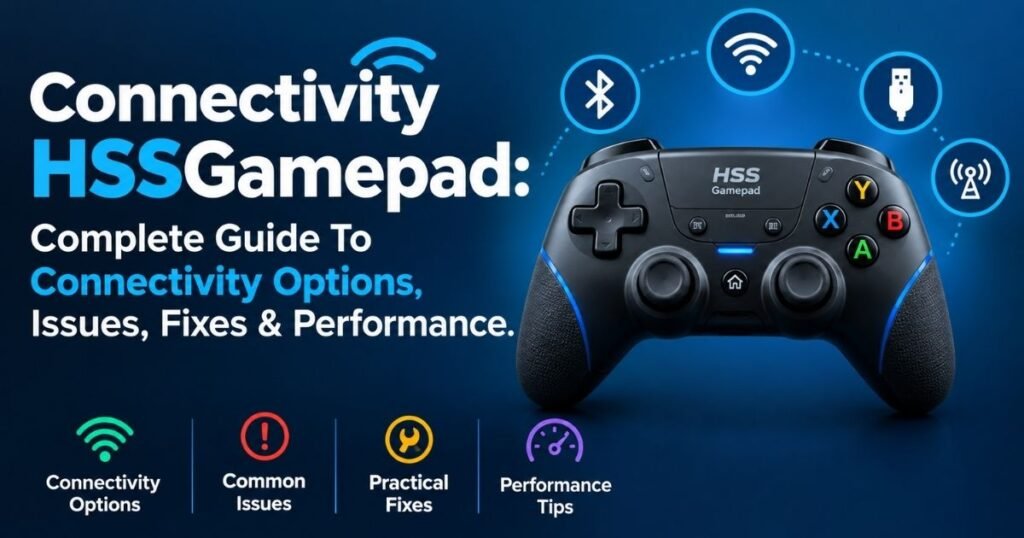
Connectivity HSSGamepad describes how your controller links to a PC, phone, tablet, smart TV or console. When that link is strong, every button press lands on time. When it is weak, you get lag, random drops and missed inputs.
This guide covers every connection option, how pairing works, why problems happen and how to fix them in the right order. You will also find platform-specific steps, a problem and fix table, a case study and clear signs it is time to replace the pad. Most connection faults come from simple causes, so you can usually solve them yourself in a few minutes.
HSSGamepad units vary by model and seller, and the brand has no single official support page. Treat the steps here as proven general methods for Bluetooth, USB and 2.4GHz controllers. Always check the manual that came with your unit for exact button combinations and light patterns.
What Is Connectivity HSSGamepad?
Connectivity HSSGamepad refers to every way the controller connects and communicates with a host device. This includes wireless pairing, wired cable use and the moment the host recognizes the pad as a game controller. It also covers how steady that link stays during play.
A connection has three jobs. It must carry your inputs quickly, stay stable for long sessions and be recognized by the game you are playing. If any one of these fails, the controller feels broken even when the hardware is fine.
Many players think of connectivity as “plug in and play”. In practice, it is a chain of parts. The controller radio, battery, cable, host Bluetooth chip, operating system driver and the game itself all play a role. A weak link anywhere in that chain causes symptoms that look the same on screen.
Understanding this chain is the fastest way to fix problems. Instead of guessing, you can test each part one by one and find the real cause.
HSSGamepad Connectivity Options
Most modern gamepads, including HSSGamepad models sold as multi-mode controllers, offer more than one way to connect. Each method has its own strengths. The right choice depends on your device, your game type and your setup.
The three common options are Bluetooth, wired USB and a 2.4GHz wireless dongle. Not every unit includes all three, so confirm your model before buying cables or adapters.
Bluetooth Connectivity
Bluetooth is the most popular wireless option. It needs no extra hardware because most phones, tablets, laptops and many TVs already have a Bluetooth radio. You put the controller in pairing mode, select it on the host and start playing.
The main benefit is convenience. You can connect to a phone, then to a PC, without carrying a receiver. Battery use is also modest on modern Bluetooth versions.
The trade-offs are latency and interference. Bluetooth adds a small delay compared with a cable, and it shares the 2.4GHz band with Wi-Fi routers, headsets and other gadgets. In a crowded room, the signal can stumble.
Bluetooth suits casual play, mobile gaming, strategy games and story titles. For competitive shooters or fighting games, many players prefer a lower latency mode.
Wired USB Connectivity
Wired USB is the simplest and most reliable option. You connect the controller to the host with a cable, and the host powers the pad. There is no pairing, no battery worry and no wireless interference.
A wired link normally gives the lowest and most consistent latency. It also charges the controller during play, which is useful for long sessions. This is why tournament players often stay wired.
The downsides are cable length and cable quality. A cheap or damaged cable can carry power but drop data, which causes a controller that powers on but is never detected. Use a data-capable cable, ideally the one supplied in the box.
Wired mode is also the best troubleshooting tool. If the pad works on a cable but fails wirelessly, you know the buttons and sticks are healthy and the problem sits in the wireless side.
2.4GHz Wireless Dongle Connectivity
A 2.4GHz dongle is a small USB receiver that talks directly to the controller on a dedicated radio link. It does not use the Bluetooth stack on your device. This usually means faster response and a steadier signal than standard Bluetooth.
Dongle mode is popular for PC gaming and some TV or console setups. You plug in the receiver, switch the controller to 2.4GHz mode and it links automatically, often within seconds.
The limits are simple. You need a free USB port, the receiver can be lost, and a replacement may be hard to find if the pad is sold without spares. Placing the dongle behind a PC case can also weaken the signal, so a short USB extension cable helps.
For players who want wireless freedom without much lag, this is often the best balance. It is common to see a mobile-friendly Bluetooth mode and a PC-friendly dongle mode on the same controller.
Multi-Device Connectivity and Switching
Some HSSGamepad models store more than one paired device. You can pair a phone, a tablet and a PC, then switch between them with a button combination or mode switch. Switching saves you from repeating the full pairing process each time.
Multi-device memory has limits. Controllers keep only a small number of saved links, and each Bluetooth profile can behave differently on each host. If the list fills up or an entry gets corrupted, the pad may refuse to connect.
To switch smoothly, follow this habit:
- Turn Bluetooth off on the device you are leaving.
- Select the correct mode on the controller before powering on.
- Wait for the light to settle before launching a game.
- Remove old devices you no longer use.
How HSSGamepad Connectivity Works
A gamepad connection is a two-way conversation. The controller sends button, stick and trigger data to the host many times per second. The host replies with small messages such as battery level or rumble commands.
Knowing the basics helps you read symptoms correctly. It also helps you choose the best mode for each game.
Pairing and Connection Process
Pairing is a one-time introduction between the controller and a host. The two devices swap security keys, and the host saves them. After that, reconnecting should take only a few seconds.
Here is the typical Bluetooth pairing flow:
- Turn the controller off.
- Hold the pairing button or button combination until the light flashes quickly.
- Open Bluetooth settings on the host and start a device search.
- Select the controller from the list.
- Wait for the light to become solid, which shows a successful link.
The exact combination varies by model. Common examples are holding a Home or Mode button with another key for three to five seconds. Your manual will confirm the right one.
Dongle mode works differently. The receiver and controller are usually pre-linked at the factory. If they lose the link, a short re-sync routine, often a button on the dongle plus a button on the pad, restores it.
Latency and Response Time
Latency is the delay between pressing a button and seeing the action on screen. It is measured in milliseconds. Lower is better, and consistency matters as much as the number itself.
The table below shows typical ranges for each connection type. Actual results depend on the model, host and settings.
| Connection Type | Typical Latency Range | Consistency | Best For |
| Wired USB | About 1 to 8 ms | Very high | Competitive play, streaming |
| 2.4GHz Dongle | About 2 to 10 ms | High | PC gaming, wireless play |
| Bluetooth | About 10 to 40 ms | Medium | Mobile, casual, travel |
Most players cannot feel a difference under about 20 ms in slower games. In fast shooters and fighting games, spikes matter more than the average. A link that jumps from 8 ms to 60 ms feels worse than a steady 25 ms.
Other factors add delay too. Game frame rate, screen refresh rate, TV game mode and background processes all stack on top of controller latency. That is why fixing the connection alone does not always remove lag.
Wireless Range and Signal Strength
Bluetooth controllers typically work up to about 10 meters (33 feet) in open space. Indoors, walls, furniture and people reduce that range. A safe working distance for stable play is often 3 to 5 meters.
Signal strength drops fast when something blocks the path. A body between the controller and a PC tower can be enough. Metal desks, PC cases and glass cabinets are common culprits.
2.4GHz dongles often offer similar or slightly better range, but placement is critical. A receiver plugged into the back of a PC is much weaker than one on a front port or an extension lead.
A simple rule works well. Keep a clear line of sight between the controller and the receiver or host, and keep the distance short.
Device Compatibility
HSSGamepad models are commonly used with Windows PCs, Android phones and tablets, and smart TVs. Some units also work with certain consoles or iOS devices, but support depends on how the controller identifies itself.
Controllers usually present themselves in one of a few ways. These include an XInput style device, a DirectInput style device or a generic Bluetooth HID gamepad. Each is handled differently by games and systems.
Use this quick guide to set expectations:
- Windows: Works with most games in XInput mode. Older games may need DirectInput.
- Android: Works with games that support controllers. Some titles need a button-mapping app.
- iPhone and iPad: Generally accepts only controllers that follow Apple’s supported standards.
- Consoles: Often need a licensed controller or a specific wired mode.
- Smart TVs: Depends on the TV’s Bluetooth HID support.
Always confirm compatibility for your exact model and device before assuming a fault.
Common HSSGamepad Connectivity Issues
Connection problems tend to fall into five patterns. Recognizing the pattern points you straight to the right fix. Each pattern below lists the symptom and the most likely direction to look.
HSSGamepad Won’t Connect to Bluetooth
This is the most common complaint. The controller does not appear in the device list, the pairing fails or the light keeps flashing without a solid link.
The usual causes are a controller not in pairing mode, an old saved pairing on the host, or a low battery. Sometimes the host Bluetooth radio is busy with other devices.
Try pairing from a clean state. Remove the controller from the host, restart both devices and put the pad into pairing mode again. If it still fails, test it on a second device. A pad that pairs elsewhere points to a host issue.
HSSGamepad Keeps Disconnecting
The controller connects, works for a few minutes, then drops. The light may go back to flashing, or the game may freeze until you press a button.
Common triggers include weak battery, interference, distance and power-saving features. On Windows and Android, the system can switch off the Bluetooth or USB radio to save power. That produces disconnections after idle periods or in the middle of a session.
Note when the drops happen. Drops during idle time suggest power settings. Drops when you move suggest range. Drops at certain times of day suggest interference from other devices.
HSSGamepad Has Input Lag or Delayed Response
You press a button and the action arrives late. The delay may be constant or may come in bursts.
Bluetooth congestion, a distant host, a busy PC and a low battery all add delay. Game or TV settings, such as a display without game mode, can create lag that looks like a controller fault.
To isolate the cause, test in wired mode. If the delay disappears, the wireless link is responsible. If lag remains, look at the game, the screen or the system load.
HSSGamepad Is Connected but Not Working in Games
The host shows the controller as connected, yet the game ignores it. This confuses many players because the connection looks perfect.
The cause is usually a mode or software mismatch. The game may expect an XInput device while the pad presents itself as DirectInput. A launcher such as Steam may also intercept the pad and remap it. On mobile, the game may simply not support external controllers.
Check whether the pad works in another game or in a controller test page. If it does, the fault sits with the game settings, not the connection.
HSSGamepad Connection Keeps Stuttering or Freezing
Inputs arrive in clumps. The character moves, stops, then jumps forward. Sometimes the whole controller freezes for a second or two.
This is a signal quality problem. It often comes from interference, a crowded Bluetooth environment or a receiver in a poor position. A failing battery can also cause brief power dips that interrupt the radio.
Move closer, switch modes and remove nearby wireless sources. If the stutter follows the controller to other rooms and devices, suspect the hardware.
Why HSSGamepad Connectivity Problems Happen
Every connection fault has a cause. Knowing the common causes lets you fix problems faster and avoid repeating them.
Low or Depleted Battery
A weak battery cannot power the radio at full strength. The controller may still turn on and light up, but the signal becomes unstable. This leads to drops, lag and pairing failures.
Batteries also age. An old pad may show a full charge and still fail under load. If problems appear only after a short time on a full charge, the battery is worn.
Wireless Interference
Bluetooth and 2.4GHz dongles share airspace with Wi-Fi routers, microwaves, wireless mice, headsets and other controllers. Too many devices on the same band cause packet loss.
Interference is worse in apartments and offices where many networks overlap. It shows up as stutter, sudden lag and random drops.
Incorrect Pairing Mode
Many controllers have separate modes for Bluetooth, dongle and wired use, and sometimes for different platforms. Starting the pad in the wrong mode means the host never sees it, or it connects with the wrong identity.
A pad in the wrong mode can also appear connected but send input the game does not understand.
Outdated Drivers or Firmware
Old drivers on a PC can fail to recognize the controller properly. Old controller firmware can contain known bugs that affect pairing or stability.
Operating system updates can also change how Bluetooth works, which is why a pad that worked last month may act up after an update.
Too Many Paired Devices
Both the controller and the host store pairing records. When either list grows large or holds stale entries, the pad may try to connect to the wrong device or fail to connect at all.
Controllers with multi-device memory are especially prone to this. Clearing old entries often fixes mysterious problems.
Conflicting Controller Software
Steam Input, mapping tools, emulators, vendor apps and virtual controller drivers can all grab the same device. When two programs compete, the game may see duplicate controllers, no controller or wrong button mapping.
This problem is common on PC and looks like a connection fault even though the link is healthy.
Distance and Physical Obstructions
Radio signals weaken with distance and are absorbed or reflected by objects. Walls, metal furniture, PC cases and even your own body can degrade the link.
Players often sit farther from the host than they realize, especially with a TV or a PC under a desk.
Hardware Damage or a Defective Controller
Sometimes the fault is physical. Worn USB ports, a damaged antenna, a failing battery or liquid damage can all break connectivity. A loose port often causes a cable to connect and disconnect with small movements.
If every software and environment fix fails, hardware becomes the most likely cause.
How to Fix HSSGamepad Connectivity Issues Step by Step
Follow these steps in order. They move from the simplest and most common fixes to the more technical ones. Test the controller after each step so you know what worked.
Step 1: Fully Charge the HSSGamepad
Plug the controller in and charge it to 100 percent. Use a known good cable and a reliable power source, such as a wall adapter or a powered USB port.
Avoid testing while the battery is nearly empty. Low power alone can explain pairing failures and drops. If the pad will not hold a charge, note this for the replacement section later.
Step 2: Restart the Controller and Connected Device
Turn the controller fully off, wait 10 seconds and turn it on. Restart the PC, phone, tablet or console as well.
This clears temporary glitches in the Bluetooth stack and frees stuck processes. It sounds basic, but it solves a large share of connection faults.
Step 3: Remove Old Pairings and Re-Pair the Controller
Open the Bluetooth settings on the host and remove the HSSGamepad entry. Then put the controller in pairing mode and add it again as a new device.
If your controller stores multiple pairings, clear its memory too, following the manual. A clean pairing on both sides removes corrupted keys and stale records.
Step 4: Check the Connection Distance and Environment
Move the controller within 2 to 3 meters of the host, with a clear line of sight. Turn off nearby wireless devices for a quick test.
If the problem vanishes, the cause is range or interference. You can then rearrange your setup instead of replacing hardware.
Step 5: Select the Correct HSSGamepad Connection Mode
Confirm that the controller is set to the mode you intend to use. Check the mode switch or button combination and the indicator light.
For a dongle, make sure the receiver is plugged in before powering on the pad. For Bluetooth, make sure the dongle is not stealing the link. If your model has separate PC and Android modes, pick the one that matches your host.
Step 6: Reset the HSSGamepad
Most controllers have a small reset button or a reset combination. Pressing it clears settings and pairings and returns the pad to factory behavior.
Reset when the pad behaves erratically, will not enter pairing mode or ignores commands. After a reset, pair it again from scratch and test in a simple game or a controller test tool.
Step 7: Update or Reinstall PC Drivers
On Windows, open Device Manager and look for the controller under Human Interface Devices, Xbox peripherals or Bluetooth. Uninstall the device, unplug or unpair it and restart the PC so Windows reinstalls the driver.
Also update the Bluetooth adapter driver from the PC or motherboard maker. An outdated Bluetooth driver is a frequent hidden cause of drops and lag.
Step 8: Disable Conflicting Controller Software
Close or disable other controller tools while testing. These include Steam Input, mapping apps, emulators and virtual gamepad drivers.
Then launch the game with only one controller layer active. If the pad works, re-enable your tools one at a time to find the conflict.
Step 9: Update HSSGamepad Firmware
If the seller or manufacturer offers a firmware tool, install the latest version. Firmware can improve pairing, battery reporting and stability.
Follow the instructions closely. Keep the controller charged, use a wired connection and do not unplug it during the update. If no official firmware exists for your model, skip this step and rely on the earlier fixes.
Platform-Specific HSSGamepad Connectivity Fixes
Each platform handles controllers differently. If general fixes fail, use the platform notes below.
HSSGamepad Connectivity on Windows 11
Windows 11 offers several places to fix controller problems. Start with the Bluetooth settings and remove the pad, then add it again.
Run the built-in troubleshooter for Bluetooth. Next, open Device Manager, expand the Bluetooth section and check the adapter’s Power Management tab. Turn off the option that lets the computer switch off the device to save power.
In Power Options, also disable USB selective suspend, which can cut power to USB ports and kill a wired or dongle link. If the game does not detect the pad, try wired XInput mode or test it in a game controller test page.
HSSGamepad Connectivity on Android
Android users should forget the controller in Bluetooth settings and pair it again. Confirm that your game supports external controllers, because many do not.
If Bluetooth acts strangely, clear the Bluetooth app cache in the system apps list and restart the phone. Turn off battery optimization for any controller mapping app so Android does not stop it in the background.
Some Android controllers work better through a USB-C OTG cable. This is a good test if wireless mode keeps failing.
HSSGamepad Connectivity on iPhone and iPad
Apple devices are stricter about controllers. They generally support controllers designed for Apple platforms and well-known console controllers. A generic pad may pair but not be recognized in games.
Check your model’s stated compatibility first. If it pairs, forget it in Bluetooth settings and try again. Keep iOS or iPadOS updated, because controller support can change with updates.
If the pad connects but no game responds, the controller is likely not supported on iOS. In that case, no setting will fix it.
HSSGamepad Connectivity on Nintendo Switch
Switch support depends heavily on the controller model and connection type. Many third-party pads work only through a wired USB link or a special adapter.
For wired play, connect the controller to the dock and turn on the wired controller communication option in the Switch controller settings. If your HSSGamepad is not designed for Switch, it may not connect at all. Confirm official Switch support before troubleshooting further.
How to Fix HSSGamepad Input Lag
Input lag has its own set of fixes. Work through the ones below, starting with the easiest.
Check Wireless Interference
Turn off nearby Bluetooth devices you are not using. Move the router away from your gaming area if possible.
If your router offers both 2.4GHz and 5GHz Wi-Fi, use the 5GHz band for your PC or console. That frees the 2.4GHz space for the controller.
Reduce Controller Distance
Sit closer to the host and keep the path clear. For a dongle, use a front USB port or a short extension so the receiver is in the open.
Even a one meter improvement can cut delay and drops in a crowded room.
Close Unnecessary Background Applications
A busy PC or phone processes input more slowly. Close browsers, downloads, streaming apps and overlays that you do not need.
On mobile, close background apps and turn on any game mode. Lower system load means faster response.
Update Drivers and Firmware
Update your Bluetooth driver, graphics driver and operating system. Install controller firmware if available.
Old drivers can add hidden delay and cause polling problems, especially on laptops with older Bluetooth chips.
Use Wired USB Mode for Lower Latency
If lag continues, switch to a cable. Wired mode removes radio delay and interference entirely.
This is the best option for competitive play and a strong test to confirm that the wireless link is the problem.
Advanced Ways to Improve HSSGamepad Connectivity
Once the basics work, these extra steps can raise stability and long-term reliability.
Clear Saved Bluetooth Pairings
Do a full cleanup every few months. Remove old controllers, headsets and other unused devices from your host list.
Then clear the controller’s own pairing memory and start fresh. This lowers the risk of pairing conflicts.
Optimize System Power Settings
On PC, choose a balanced or high-performance power plan and disable USB and Bluetooth power saving. On laptops, keep the device plugged in during gaming.
On phones, exclude your controller or mapping apps from battery saving. Power management is a hidden cause of random disconnects.
Check Bluetooth Version Compatibility
Newer Bluetooth versions offer better range, speed and stability. A controller with a modern Bluetooth chip paired to an old laptop adapter will only perform at the level of the weaker side.
If your host has old Bluetooth, a small USB Bluetooth adapter can be a cheap and effective upgrade. Choose a reputable brand and update its driver.
Improve Your Controller’s Physical Setup
Position the host or dongle where the signal has a clear path. Keep it away from large metal objects, monitors and USB 3.0 devices that can create radio noise.
A short USB extension cable often gives the biggest single boost for dongle users.
Reduce Nearby Wireless Device Interference
Limit how many active wireless devices sit around your gaming area. Wireless mice, keyboards, headsets and phones all add traffic.
Where possible, move some devices to wired versions. Fewer signals mean fewer collisions and steadier input.
HSSGamepad Connectivity: Common Problems, Causes and Fixes
Use this table as a fast reference when something goes wrong. Find your symptom, check the likely cause and try the fix.
| Problem | Likely Cause | Best Fix |
| Will not pair | Wrong mode or old pairing | Clear pairings, enter pairing mode again |
| Random disconnects | Low battery or power saving | Charge fully, disable power saving |
| Input lag | Interference or distance | Move closer, reduce devices, try wired |
| Connected but no input in game | Mode or software conflict | Switch input mode, close mapping tools |
| Stuttering or freezing | Weak signal or interference | Use a dongle extension, change position |
| Not detected on cable | Charge-only cable or dirty port | Use a data cable, clean the port |
| Works on one device only | Host Bluetooth or driver issue | Update drivers, try a USB adapter |
| Will not turn on | Depleted or failed battery | Charge for an hour, then test another cable |
How Stable HSSGamepad Connectivity Improves Gaming Performance
A stable connection changes how a game feels. Movement is smoother, aiming is more accurate and timing based actions land when you expect them to.
Consistent input matters most in games with tight timing. Fighting games, rhythm games and platformers reward exact responses. A single delayed press can cost a round, a combo or a jump.
Stability also protects your focus. When you do not fear a random drop, you play with more confidence. That reduces mistakes and frustration.
Better connectivity helps in other ways too:
- Longer battery life: A clean link avoids repeated reconnect attempts that drain power.
- Better accuracy: Steady polling gives smoother stick and trigger movement.
- Fewer interruptions: Streamers and long-session players avoid pauses and restarts.
- More flexibility: A reliable multi-device setup lets you switch platforms easily.
In short, connectivity is part of performance, not a separate topic.
Wired vs Wireless HSSGamepad Connectivity: Which Is Better?
Neither option wins in every case. The best choice depends on the game, the room and your priorities.
Wired gives the lowest latency and the fewest problems. Wireless gives freedom and a tidier setup. A dongle sits between the two, with near-wired speed and wireless comfort.
| Factor | Wired USB | 2.4GHz Dongle | Bluetooth |
| Latency | Lowest | Very low | Moderate |
| Stability | Excellent | Very good | Good, varies |
| Setup | Plug and play | Plug and play | Pairing needed |
| Battery use | None, charges pad | Moderate | Low to moderate |
| Portability | Low | Medium | High |
| Interference risk | None | Low to medium | Medium to high |
| Best use | Competitive play | PC gaming | Mobile and casual |
Choose wired for ranked matches, tournaments and troubleshooting. Choose a dongle for comfortable PC sessions. Choose Bluetooth for phones, tablets and travel.
If you own a multi-mode controller, you do not need to pick only one. Switch modes to match the moment.
How to Maintain Reliable HSSGamepad Connectivity
Good habits prevent most connection problems. A few minutes of care each month keeps the pad working like new.
Keep the Controller Charged
Charge the controller before long sessions and avoid running it to zero often. Deep discharge shortens battery life over time.
Use quality cables and chargers. Cheap chargers can deliver unstable power and harm the battery.
Keep Firmware and Drivers Updated
Check for controller firmware, Bluetooth driver and system updates every few months. Updates often fix stability bugs.
After a major system update, test the controller before an important match. That way you can fix problems in advance.
Avoid Excessive Wireless Interference
Keep the gaming area free from clutter of wireless devices. Place your router away from your gaming setup and use the 5GHz band when possible.
Turn off Bluetooth on devices you are not using so they do not compete for the same airspace.
Maintain a Clear Connection Range
Set up your seat and host so the path between them is open. Avoid placing the receiver behind a case or desk.
Use a USB extension for the dongle and keep the pad within a few meters of the host.
Regularly Clean Up Old Device Pairings
Remove old and unused Bluetooth entries from both the controller and your devices. A clean list means faster and more reliable reconnection.
Do this whenever you change hosts, sell a device or notice slow pairing.
Why Gamers Often Misdiagnose HSSGamepad Connectivity Problems
Many players blame the controller when the real cause is elsewhere. This wastes time and sometimes money on unnecessary replacements.
The first mistake is treating every delay as a controller fault. Display lag, low frame rates and a slow PC create similar symptoms. A TV without game mode can add more delay than the wireless link ever will.
The second mistake is trusting the connected light. A steady light only shows that a link exists. It does not prove the link is healthy, the mode is right or the game accepts the input.
A third mistake is skipping the simple tests. Players may reinstall drivers or buy a new pad before trying a different cable, a second device or wired mode. A five-minute test often reveals the answer.
Other common errors include:
- Assuming a charge-only cable carries data.
- Ignoring power saving settings.
- Leaving several controller apps running at once.
- Expecting a generic pad to work on a platform that restricts controllers.
- Forgetting that a recent system update changed behavior.
Test one variable at a time. Change the cable, then the mode, then the device. This method separates controller faults from environment and software problems.
Case Study: Fixing a Laggy HSSGamepad Connection
This is an illustrative scenario built from common troubleshooting patterns. It shows how a structured approach solves a typical lag complaint.
The Problem
A player used a Bluetooth HSSGamepad with a Windows laptop for fast action games. Over several weeks, inputs began to arrive late, and the controller dropped twice per session.
The player suspected a faulty pad and considered buying a new one.
The Investigation
The player first tested the pad in wired mode. Response was instant and stable, which showed the buttons, sticks and cable path were healthy.
Next, they checked the laptop. The Bluetooth driver was two years old. Windows power settings allowed the Bluetooth adapter to turn off to save energy. The router sat one meter from the laptop, and three other Bluetooth devices were active nearby.
The Fix
The player updated the Bluetooth driver and turned off the power saving option for the adapter. They removed old pairings, paired the controller again and switched off unused Bluetooth devices.
They also moved the router farther away and connected the laptop to the 5GHz Wi-Fi band. As a final step, they used a short USB extension for a 2.4GHz dongle to compare results.
The Result
Bluetooth lag dropped sharply, and disconnections stopped during normal sessions. The dongle mode delivered the most consistent response for fast games.
The player kept the original controller and saved the cost of a new one. The lesson is clear. Isolate the cause before replacing hardware.
When Should You Replace Your HSSGamepad?
Replacement is the last step, not the first. Try every fix above before you decide.
Consider replacing the controller when you see these signs:
- It fails to connect on more than one device, in every mode.
- The battery drains within minutes or will not hold a charge.
- The USB port is loose, bent or only works at certain angles.
- Buttons or sticks register wrong inputs even in wired mode.
- The pad disconnects after a reset, a clean pairing and a fresh cable.
- There is visible damage, swelling, liquid contamination or burning smell.
A swollen battery is a safety risk. Stop using the controller and dispose of it through proper electronics recycling.
Before you buy a new one, check the warranty. If the controller is still covered, contact the seller. Also compare models for the connection modes, battery size, compatibility list and firmware support you need. A pad with clear platform support and good documentation will save you trouble later.
Frequently Asked Questions
Why is my HSSGamepad not connecting?
The most common causes are a low battery, the wrong mode or an old pairing record. Charge the pad, clear saved pairings and pair it again in the correct mode.
How do I put my HSSGamepad in pairing mode?
Turn the controller off, then hold the pairing button or the model’s pairing combination until the light flashes fast. Check your manual because the exact buttons differ by model.
Why does my HSSGamepad keep disconnecting?
Weak battery, interference, long distance and power saving settings are the usual reasons. Charge the pad, move closer and turn off power saving for Bluetooth or USB.
Is wired or wireless better for HSSGamepad?
Wired offers the lowest latency and the most stable link, so it suits competitive play. Wireless gives more freedom and works well for casual and mobile gaming.
How do I reduce HSSGamepad input lag?
Reduce interference, sit closer to the host and close background apps. Update drivers and firmware, or switch to wired mode for the lowest delay.
Can I use HSSGamepad on Android, iPhone and Windows?
It commonly works on Windows and Android, but support depends on your exact model. iPhone and iPad accept only certain controller types, so confirm compatibility first.
How do I reset my HSSGamepad?
Press the small reset button, if your model has one, or use the reset combination in the manual. Then remove old pairings from the host and pair the controller again.
Final Thoughts
Reliable connectivity is the base of a good gaming experience. A great controller means little if the link is slow, unstable or misunderstood by the host device.
Most HSSGamepad connection problems have simple fixes. Charge the pad, restart devices, clear old pairings, choose the correct mode and reduce interference. If problems remain, update drivers and firmware and check for software conflicts.
Test one change at a time and use wired mode as your reference point. That method separates true hardware faults from environment and settings issues, and it saves time and money.
Keep the controller charged, keep your system updated and clean up old pairings from time to time. With these habits, you will enjoy stable, responsive play on every device you use.

Daniel Wilson is the admin of Meaning Lexi, a website focused on the meanings of words, names, phrases, and symbols. He is dedicated to providing clear, accurate, and easy-to-understand content for readers.