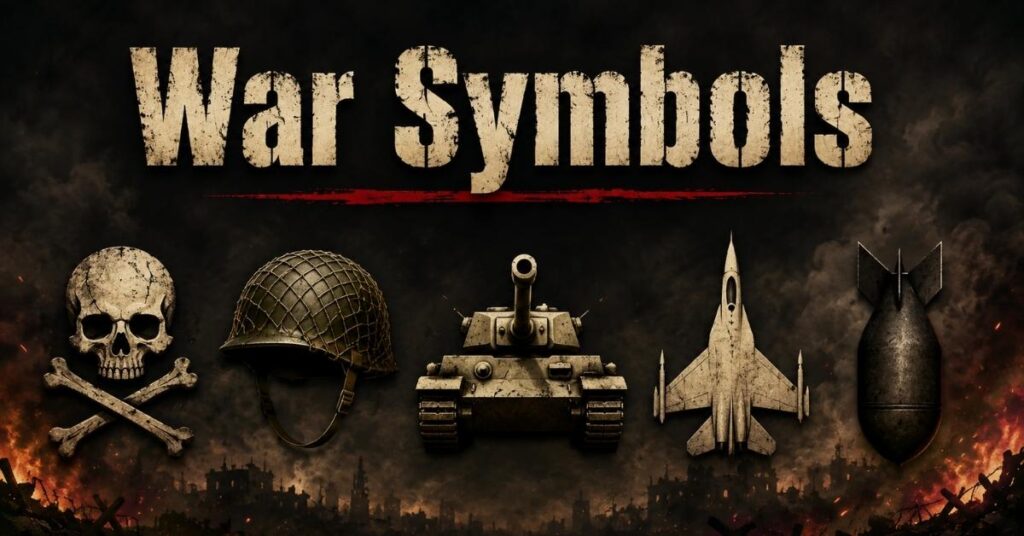
Long before written language connected civilizations, symbols already spoke for them. A painted shield, a carved eagle, or a single raised sword could announce loyalty, strike fear, or rally an exhausted army back onto the field. War symbols are humanity’s oldest visual language, and they remain just as powerful today, appearing in tattoos, flags, films, and even text messages.
This guide walks through the most iconic war symbols ever used by warriors and empires, what they truly mean, where they came from, and why they still resonate with people across cultures and generations. Whether you’re researching for a tattoo, a school project, or pure curiosity, you’ll find clear, accurate, and deeply explained answers here.
What Are War Symbols?
War symbols are visual signs, animals, objects, colors, or emblems associated with conflict, military strength, sacrifice, protection, or victory. They were used by armies, tribes, and empires to identify allies, intimidate enemies, and preserve the memory of battles fought.
Unlike ordinary decoration, war symbols carried real weight on the battlefield. A Roman legion would defend its eagle standard with its life. A Viking shield painted with a protective rune was believed to call on the gods themselves. These weren’t just images, they were tools of morale, identity, and spiritual protection.
Today, war symbols still surface everywhere, from national flags and military insignias to tattoo studios and pop culture. Understanding them gives insight into how different societies have processed conflict, courage, and loss throughout history.
Also Check This: 7+ Symbols of Virgo
Symbols Of War And Their Deep Meanings
War symbolism isn’t one-dimensional. The same image can represent bravery in one culture and tragedy in another. Below are the most searched angles people use when exploring this topic.
Symbols Of War

Common war symbols include swords, shields, eagles, skulls, dragons, arrows, spears, and military flags. Each one developed its meaning through centuries of use in actual combat, mythology, or royal ceremony, rather than being invented purely for decoration.
War Symbolism
War symbolism is the practice of using an image or object to represent abstract ideas connected to conflict, such as courage, loss, dominance, or unity. A clenched fist, a broken sword, or a black flag can each tell an entire story without a single word.
Symbols That Mean War
Some symbols directly signal war rather than just hinting at it. The color red, crossed swords, a drawn bow, a sounded horn, and a raised battle axe have historically meant one thing: conflict has begun or is about to.
War Symbols Copy And Paste
People searching for digital war symbols usually want quick-access characters for usernames, captions, or designs. Popular copy-paste options include:
- ⚔️ (crossed swords)
- 🛡️ (shield)
- 🏹 (bow and arrow)
- ☠️ (skull and crossbones)
- 🪓 (battle axe)
- 🔥 (fire, often used for destruction or battle intensity)
These symbols work well for social media bios, gaming usernames, and stylized text since they’re instantly recognizable without needing explanation.
War Symbols Tattoos
War symbol tattoos are extremely popular because they let people carry meaning permanently on their skin. A sword tattoo can represent personal strength, a shield can symbolize protection of loved ones, and a skull can mark survival through a difficult chapter of life. Many veterans choose war symbols specifically to honor service and remember fallen comrades.
Symbols For War
When people search “symbols for war,” they’re usually looking for ready-made imagery for art, design projects, or storytelling. Flags, crossed weapons, fire, and armored figures are the most commonly used visuals because they communicate conflict instantly, even without context.
Also Check This: Sanskrit Symbols
Famous Ancient And Historical War Symbols
History is layered with symbols that defined entire eras of conflict. Here’s a closer look at the most historically significant ones.
War Symbols Emoji

Modern emoji keyboards include several war-related icons used daily in casual conversation: ⚔️ for rivalry or competition, 🛡️ for protection, 💣 for explosive situations, and 🚩 for warning signs or red flags in relationships and arguments. These emojis borrow their emotional weight directly from centuries-old war symbolism.
War Symbols WW2
World War II introduced some of the most recognizable, and in some cases most painful, symbols in modern history.
- The swastika, originally an ancient symbol of good fortune across Hindu, Buddhist, and Jain traditions, was hijacked by the Nazi regime and turned into a symbol of hatred and genocide.
- Winston Churchill’s V-for-Victory hand gesture became a unifying symbol of resistance across occupied Europe.
- Mission symbols, small painted icons like bombs, planes, or ships on aircraft fuselages, recorded a crew’s combat achievements during bombing runs.
- The red-circle headband worn by Kamikaze pilots symbolized sacrifice and duty to the emperor.
These WW2 symbols are a reminder that war imagery can carry both heroism and horror within the same era.
War Symbols And Meanings
Most war symbols fall into a few core meaning categories: power and authority (eagles, crowns, scepters), protection and defense (shields, amulets, talismans), aggression and conquest (swords, spears, fire), and remembrance or sacrifice (poppies, medals, broken weapons). Recognizing which category a symbol falls into makes its deeper meaning much easier to understand.
Ancient War Symbols

Ancient civilizations relied heavily on symbolic imagery because literacy was limited and battlefield communication had to be instant. Egyptian pharaohs carried ceremonial daggers as symbols of royal power and protection, like the famous dagger found in Tutankhamun’s tomb. Mesopotamian armies used lion imagery to represent royal might, while early Chinese warlords used dragon banners to project unstoppable strength.
War Symbols Greek
Greek mythology and history are saturated with war imagery. The shield of Achilles, forged by the god Hephaestus, became a legendary symbol representing both the glory and the brutal cost of war. The spear and helmet of Athena, goddess of strategic warfare, represented wisdom combined with strength, distinguishing calculated battle tactics from the blind aggression associated with Ares, the god of chaotic war.
Symbols Of War In Mythology
Nearly every mythology has a deity or symbol tied to conflict. Norse mythology gives us Mjölnir, Thor’s hammer, both a divine blessing and a weapon of destruction. Māori mythology centers on Tūmatauenga, the god of war, hunting, and human struggle. Slavic mythology honors Svetovit, often depicted with four heads and a sword, symbolizing vigilance in every direction. These figures show that ancient cultures viewed war not just as a human act but as something cosmic, often tied to the eternal struggle between order and chaos.
Also Check This: Leadership Symbols
What Symbolizes War?
In the broadest sense, fire, blood-red colors, raised weapons, sounding horns, and predatory animals like eagles, wolves, and dragons symbolize war across nearly every culture on earth. These elements share one thing in common: they all signal danger, power, or an imminent clash.
Deep Symbolic Meaning of War Symbols
War symbols operate on more than just a historical level. They tap into something psychological and even spiritual within people.
Spiritual Meaning
Many cultures believed war symbols carried protective or divine power. Vikings painted runes onto shields believing the gods would shield them from harm. Warriors across Africa and the Americas wore amulets carved with battle symbols to invoke courage and survival. Spiritually, war symbols often represent an internal battle, a person’s struggle between fear and courage, weakness and strength.
Psychological Meaning
Psychologically, war symbols tap into humanity’s deepest survival instincts. They represent the fight-or-flight response embedded in the human brain. Seeing a sword or shield can subconsciously trigger feelings of empowerment, protection, or alertness, which is part of why these images remain so visually compelling even in peaceful, modern contexts.
Cultural Meaning
Culturally, war symbols preserve collective memory. A nation’s flag, a tribe’s painted crest, or a regiment’s emblem isn’t just decoration, it’s a record of identity, sacrifice, and shared history passed down through generations. Losing or dishonoring a culture’s war symbol was historically treated as one of the gravest insults imaginable.
Powerful Types of War Symbols and Their Meanings
Here is a closer breakdown of the most iconic war symbols in history, including how they looked, what they meant, and where they were used.
Eagle Symbol
Visual Description
A bird of prey, usually shown with outstretched wings, sharp talons, and a fierce, forward-facing gaze.
Meaning
The eagle represents dominance, far-sightedness, and supreme authority. Its ability to soar above all other creatures made it a natural symbol for empires claiming superiority over rivals.
Where It Appears
Roman legionary standards, the United States Great Seal, Napoleonic France’s imperial banners, and modern military insignias around the world.
Sword Symbol
Visual Description
A long bladed weapon, often shown upright, crossed with another sword, or sheathed in a scabbard.
Meaning
The sword represents honor, authority, courage, and martial discipline. Unsheathing or presenting a sword historically marked coronations, knighthood ceremonies, and formal declarations of war.
Where It Appears
Medieval knighthood rituals, samurai Bushido culture, King Arthur legends, modern military ceremonies, and tattoo art.
Skull and Crossbones
Visual Description
A human skull positioned above two crossed bones.
Meaning
Traditionally a symbol of mortality and danger, the skull and crossbones was adopted by pirates and later by elite military units as a warning sign meant to project fear and signal that death was always close at hand.
Where It Appears
Pirate flags, hazard warning labels, elite military unit patches, and biker and tattoo culture.
Red Poppy Symbol
Visual Description
A bright red flower with a dark center, typically worn as a pin or printed on memorial wreaths.
Meaning
The red poppy symbolizes remembrance, sacrifice, and the bloodshed of soldiers, inspired by the poppies that grew across the battlefields of Flanders after World War I.
Where It Appears
Remembrance Day and Veterans Day ceremonies, war memorials, and military tribute events across the Commonwealth nations.
Shield Symbol
Visual Description
A flat, often curved defensive panel, historically made of wood, metal, or leather, frequently decorated with crests or patterns.
Meaning
The shield represents defense, resilience, and protection, both physical and spiritual. Many cultures believed painted shields could deflect not just blades but bad fortune as well.
Where It Appears
Ancient Greek and Roman armor, Viking longships, African tribal warfare, and modern coats of arms and family crests.
Dragon Symbol
Visual Description
A massive, serpent-like mythological creature, often shown breathing fire or coiled in a battle-ready stance.
Meaning
The dragon represents unstoppable strength, fear, and untamed power. In Eastern cultures it also carries connotations of imperial authority and protection.
Where It Appears
Chinese warfare banners, Welsh national flags, medieval European folklore, and fantasy storytelling and gaming culture.
War Symbols Across Cultures
War symbolism shifts dramatically depending on the civilization that created it.
Ancient Roman Culture
Roman military identity revolved around the eagle standard, or aquila, carried by each legion. Losing this standard in battle was considered a catastrophic disgrace, and soldiers were known to risk death to recover it.
Viking Culture
Norse warriors painted symbols like the Valknut and the Helm of Awe onto shields, helmets, and ships, believing these marks invoked courage and supernatural protection from the gods during raids.
Japanese Samurai Culture
Samurai clans used family crests known as mon to identify loyalty on chaotic battlefields. Cherry blossoms also held deep symbolic weight, representing the brief, fragile nature of a warrior’s life, beautiful but fleeting.
Native American Cultures
Arrows held precise symbolic meaning depending on direction. An arrow pointing left warded off evil, one pointing right offered protection, and a downward arrow signaled peace. Two crossed arrows specifically represented war between opposing forces.
Medieval European Culture
Knights carried heraldic shields bearing unique colors and crests to identify their family and allegiance in battle. Tournaments and ceremonies reinforced these symbols as marks of honor, loyalty, and noble duty.
War Symbols in Art, Movies and Pop Culture
War imagery continues to shape modern storytelling and visual culture in powerful ways.
In Movies
Films use swords, flags, fire, and armor to instantly establish stakes and tension. A single raised banner in a battle scene can communicate unity or doom without a line of dialogue.
In Paintings
Classical war paintings often used dramatic lighting, broken weapons, and fallen soldiers to capture both the glory and tragedy of conflict, turning battlefield moments into timeless emotional statements.
In Books
Literature frequently uses war symbolism to represent inner conflict. A character’s sword, scar, or shield often mirrors their personal struggle, not just their physical battles.
In Tattoos
War symbols remain among the most requested tattoo designs worldwide, chosen to honor service members, mark personal resilience, or represent battles people have survived outside the battlefield.
In Fashion
Military-inspired patterns, camouflage, skull motifs, and eagle emblems regularly appear in streetwear and high fashion, borrowing the boldness and authority associated with war imagery.
Spiritual and Dream Meaning of War Symbols
War symbols often appear in dreams, and their meaning usually points inward rather than to actual conflict.
Seeing Swords in Dreams
Dreaming of a sword often reflects personal power, decisiveness, or the need to cut away something harmful in your waking life, such as a toxic relationship or a difficult decision you’ve been avoiding.
Seeing Flags or Banners
A flag or banner in a dream typically symbolizes identity, loyalty, or a need to take a stand on something important. It can also reflect a desire for recognition or belonging.
Seeing Battles or Armor
Dreaming of battle or wearing armor commonly represents emotional conflict, stress, or the feeling of needing to protect yourself from criticism, pressure, or a challenging life transition.
Positive vs Negative Meaning of War Symbols
War symbols carry a dual nature, capable of inspiring hope just as easily as they can represent destruction.
Positive Meanings
- Courage and resilience in the face of adversity
- Protection of loved ones, community, or homeland
- Honor, discipline, and personal growth
- Remembrance and respect for those who sacrificed
Negative Meanings
- Violence, destruction, and loss of life
- Fear, intimidation, and oppression
- Division between nations, tribes, or communities
- Trauma and lasting psychological scars
Why Humans Are Attracted to War Symbols
People are drawn to war symbols because they represent raw human emotion in its purest form: fear, courage, survival, and identity. These images bypass language entirely and speak directly to instinct. A sword doesn’t need translation to communicate strength, and a skull doesn’t need explanation to communicate danger.
War symbols also offer a sense of belonging and meaning. Wearing a symbol as a tattoo, displaying it as a flag, or using it in art connects a person to something larger than themselves, whether that’s a family legacy, a nation’s history, or a personal victory over hardship. Even in peaceful, modern life, the emotional intensity behind these ancient images continues to resonate.
FAQ’s
What is the most powerful war symbol in history?
The eagle is widely considered the most powerful war symbol because it was used by multiple empires, including Rome and the United States, to represent dominance and authority.
What does a sword tattoo symbolize?
A sword tattoo typically symbolizes strength, honor, protection, and personal battles a person has overcome in life.
Are war symbols always negative?
No, many war symbols represent courage, protection, and remembrance rather than violence itself.
What is the oldest known war symbol?
Arrows and spear imagery are considered among the oldest war symbols, dating back to prehistoric hunting and tribal conflict.
Why do soldiers use animal symbols like eagles and dragons?
Animal symbols represent traits soldiers wanted to embody, such as strength, fearlessness, and dominance over enemies.
What does seeing war symbols in a dream mean?
Dreaming of war symbols usually reflects inner emotional conflict, stress, or a personal struggle rather than literal violence.
Conclusion
War symbols are far more than marks of conflict. They are emotional records of courage, identity, protection, and sacrifice carried across thousands of years and countless civilizations. From the Roman eagle to the Viking shield, from the samurai crest to the modern emoji, these symbols continue to communicate something words often cannot.
Understanding their history and meaning doesn’t just satisfy curiosity, it connects us to the warriors, empires, and cultures that shaped the world we live in today. Whether you encounter them in a museum, a tattoo parlor, or a text message, war symbols remain one of humanity’s most enduring and powerful forms of expression.

Daniel Wilson is the admin of Meaning Lexi, a website focused on the meanings of words, names, phrases, and symbols. He is dedicated to providing clear, accurate, and easy-to-understand content for readers.