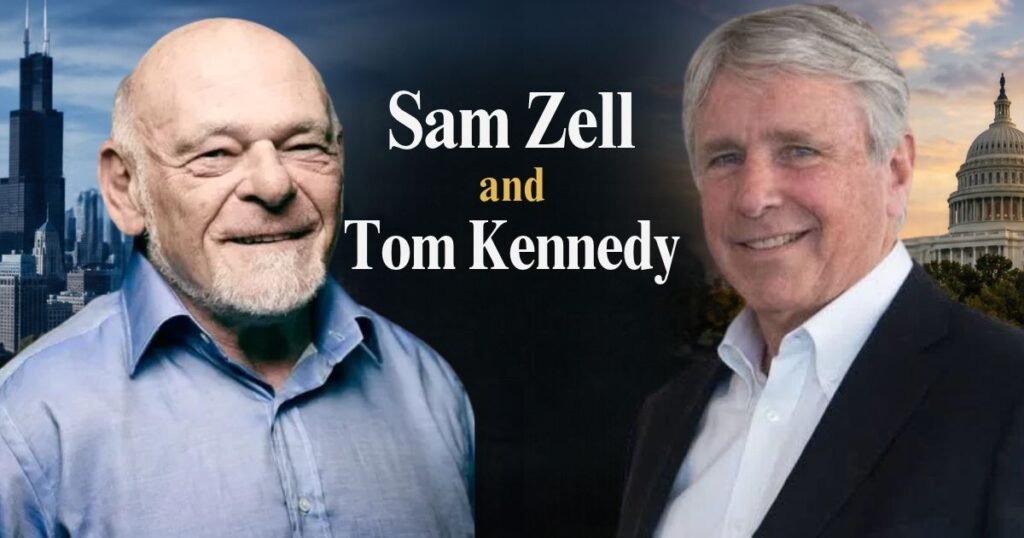
Search for Sam Zell and Tom Kennedy and you will land in two very different corners of American life. One is a Chicago real estate billionaire who built an empire on troubled properties and then stumbled on a newspaper deal. The other is a soft-spoken game show host who spent three decades making living rooms feel like studio audiences. The phrase Sam Zell and Tom Kennedy shows up in search bars more often than you might expect, and the people behind it usually want one clear answer: who is who, and what did each man actually do?
This guide gives you that answer. You will get verified dates, the real numbers behind the Tribune Company collapse, a full timeline of Tom Kennedy’s game shows, and a plain explanation of why the two names get mixed up. Every fact below was checked against obituaries, encyclopedias, and major news outlets.
Quick snapshot before we dive in:
| Sam Zell | Tom Kennedy | |
| Birth name | Shmuel Zielonka | James Edward Narz |
| Born | September 28, 1941, Chicago | February 26, 1927, Louisville, Kentucky |
| Died | May 18, 2023, age 81 | October 7, 2020, age 93 |
| Known for | Equity Group Investments, REITs, the Tribune buyout | You Don’t Say!, Name That Tune, Password Plus |
| Nickname | The Grave Dancer | Brother of host Jack Narz |
Who Were Sam Zell and Tom Kennedy?
Sam Zell was an American billionaire, lawyer, and investor. He founded Equity Group Investments in 1968 and became one of the best known names in commercial real estate. People called him “the Grave Dancer” because he bought distressed assets that others avoided.
Tom Kennedy was an American television host. Born James Edward Narz, he changed his professional name in the late 1950s and went on to host about 14 game shows between 1958 and 1989. He is best remembered for You Don’t Say!, Split Second, Name That Tune, and Password Plus.
What they have in common:
- Both were famous American figures who died in the last six years.
- Both built careers on reading people and situations quickly.
- Both changed or adjusted their names or reputations along the way. Zell’s family shortened Zielonka to Zell, and Narz became Kennedy.
- Both left a long paper trail of obituaries, interviews, and archival footage.
What they do not have in common: a documented business or personal relationship. Research for this article found no joint project, partnership, or recorded meeting between them. The pairing is a search habit, not a historical connection. We will return to that in a later section.
Sam Zell: The Grave Dancer Who Bet Big and Lost
Zell’s story is usually told as a rise followed by one spectacular fall. That version is mostly right, but it skips how many wins stacked up before the loss. His career ran for more than 60 years and touched apartments, offices, mobile home communities, energy, transportation, radio, and baseball.
From Humble Beginnings to Real Estate Empire
Zell’s story starts before he was born. His parents, Berek and Ruchla Zielonka, left Poland months before his birth to escape the Nazi invasion. Their route to safety ran through Russia and Japan, and accounts credit transit visas issued by diplomat Chiune Sugihara. The family settled in Chicago, where Zell was born in 1941.
His father worked as a wholesale jeweler and made smart real estate and stock market investments on the side. Young Sam picked up the hustle early. Biographical accounts say he sold photos at his own eighth grade event and resold magazines to classmates at a markup.
How the empire began, step by step:
- College landlord. While studying at the University of Michigan, Zell managed a small apartment building in exchange for room and board. He graduated in 1963 managing several properties.
- A partner for life. He teamed up with fraternity brother Robert Lurie. By the time Zell finished law school in 1966, the pair managed more than 4,000 apartments.
- Law was a short detour. He earned a law degree from Michigan, then reportedly practiced for about a week before returning to real estate.
- Equity Group Investments. Zell founded the predecessor of his flagship firm in 1968. Lurie joined him the following year.
- Buying the wreckage. During the 1973 to 1975 recession, lenders were desperate to avoid foreclosures. Zell took over troubled properties and gave lenders workable repayment plans.
That last move defined his reputation. When everyone ran left, he looked right. The line became one of his best known mantras.
He later described the philosophy in a Real Estate Review essay titled “The Grave Dancer.” Publication dates in news coverage vary, so treat the exact year with care. The memorable sentence from that piece stuck with him for life: “I was dancing on the skeletons of other people’s mistakes.”
Zell’s major business moves:
- Apartments. The apartment portfolio went public in 1993 and grew into what became Equity Residential.
- Offices. He built Equity Office Properties into the largest office landlord in the country. In 2007 Blackstone bought it for about $39 billion including debt, the largest leveraged buyout in history at that time.
- Manufactured housing. In 1984 he founded Equity LifeStyle Properties, which owns hundreds of mobile home communities.
- Industrial and distressed deals. Over the years his firms took stakes in Itel, Anixter, Covanta, Schwinn, Sealy, Jacor, and Midway Airlines.
Zell also helped shape the modern real estate investment trust, or REIT. Equity Group Investments credited him with a critical role in creating the structure behind a market worth more than $4 trillion today. That is arguably his most durable legacy.
Not every chapter earned praise. Journalists have examined resident complaints about some manufactured housing communities tied to his companies. A fair profile should hold both facts: he created enormous value for investors, and his business model drew real criticism from some tenants.
Outside business, Zell rode motorcycles hard and founded a group of fellow tycoons called Zell’s Angels. He gave generously to education. His name appears on programs at the University of Michigan, Northwestern’s Kellogg School, and the Wharton School. He also wrote a 2017 memoir called Am I Being Too Subtle?
The Tribune Disaster: A Case Study in Overconfidence
Then came 2007. Zell had just sold Equity Office at the top of the market. He looked unbeatable. Weeks later he agreed to take over Tribune Company, the media giant behind the Chicago Tribune, the Los Angeles Times, The Baltimore Sun, Newsday, the Hartford Courant, and the Chicago Cubs.
The deal in numbers:
- Price: about $8.2 billion
- Zell’s own money: $315 million, structured as debt
- Funding mechanism: an employee stock ownership plan, or ESOP, that carried much of the financing
- Closed: December 2007, when Zell became chairman and CEO
- Bankruptcy filing: December 2008, less than a year later
- Assets versus debt at filing: about $7.6 billion against about $13 billion
The company’s filing became the largest bankruptcy in the history of the American media industry. Zell later called the deal “the deal from hell.”
What went wrong, in plain terms:
- Too much debt. The buyout loaded the company with roughly $8 billion in new obligations just as newspaper revenue was falling.
- Terrible timing. The Great Recession arrived almost immediately and crushed advertising.
- Real estate thinking, media problem. Real estate assets keep their value through cycles. Newspapers were losing readers and ad dollars to the internet.
- Culture clash. Zell put radio veteran Randy Michaels in charge. Reporting from the period described a hostile workplace and sharp morale problems. Michaels resigned in October 2010.
- Painful cuts. About 4,200 jobs were lost during the ownership period.
In January 2009 the company moved to sell the Chicago Cubs, Wrigley Field, and a stake in Comcast SportsNet Chicago to the Ricketts family for roughly $900 million. Tribune emerged from bankruptcy on December 31, 2012, under creditor control, and Zell was out. In 2019, he and other former executives agreed to pay $200 million to settle claims tied to the buyout.
Zell died on May 18, 2023, at his home, from complications of a recent illness. He was 81. Even in tributes, the Tribune loss sits beside the wins. A Forbes columnist once summed up the irony by noting the “grave dancer” of real estate had become the “grave digger” of newspapers.
Tom Kennedy: The Game Show Host Who Never Stopped Smiling
If Zell’s life was about leverage and risk, Kennedy’s was about rhythm and reliability. Viewers knew what they would get when he walked onstage: good humor, a steady voice, and a clean pace. He did not need to shout to hold a room.
A Louisville Kid Who Followed His Brother
Tom Kennedy was born James Edward Narz on February 26, 1927, in Louisville, Kentucky. His older brother Jack Narz, born in 1922, became a well known game show host first. Their brother in law was another famous host, Bill Cullen.
Kennedy studied at the University of Missouri and the University of Kentucky and worked at radio stations along the way. After about a decade in radio, he followed his brother to Hollywood.
How Narz became Kennedy:
- Both brothers were announcers and hosts working in the same industry.
- Having two hosts with the same last name promoting competing products created confusion.
- After a lunch meeting with his agent, according to a family account, he emerged as Tom Kennedy.
- Sources date the change to 1957, with his first national hosting job coming in 1958.
The name stuck. It also created a modern mix up. Search engines now surface many people called Tom Kennedy, and that is part of why this keyword pairing exists at all.
His first hosting credit was The Big Game on NBC in 1958. He followed it with Dr. I.Q. in 1958 and 1959. Then came the break that changed his career.
The Golden Era of Game Shows
Kennedy’s breakthrough was NBC’s You Don’t Say! in 1963. The show asked contestants to give clues so a celebrity guest could guess a famous name. It ran six years and made him a household name.
Tom Kennedy’s key hosting credits:
| Show | Years | Notes |
| The Big Game | 1958 | First national hosting job |
| Dr. I.Q. | 1958 to 1959 | Early radio style quiz on TV |
| You Don’t Say! | 1963 to 1969, 1975 | NBC original, ABC revival |
| It’s Your Bet | 1971 to 1972 | Betting themed quiz |
| Split Second | 1972 to 1975 | Fast paced ABC quiz |
| Name That Tune | 1974 to 1981 | Nighttime run, daytime in 1977 |
| Break the Bank | 1976 | Daytime run |
| To Say the Least | 1977 to 1978 | NBC word game |
| Whew! | 1979 to 1980 | CBS game |
| Password Plus | 1980 to 1982 | Took over after Allen Ludden’s illness |
| Body Language | 1984 to 1986 | Charades style game |
| The Price Is Right (nighttime) | 1985 to 1986 | Syndicated edition |
| Wordplay | 1986 to 1987 | Late career credit |
He also hosted a talk show, The Real Tom Kennedy Show, in the early 1970s. He worked as a panelist on To Tell the Truth, Hollywood Squares, and Liar’s Club. Acting roles included guest spots on That Girl, The Ghost & Mrs. Muir, Cannon, and Hardcastle and McCormick.
He retired in 1989 after several pilots from his own production company failed to sell. In 2003 he returned for a Hollywood Squares appearance. In July 2005, he and Jack Narz shared the Game Show Congress’s Bill Cullen Award for Lifetime Achievement.
Kennedy was married to Betty Gevedon from 1952 until her death in 2011. They had four children. He died on October 7, 2020, at home in Oxnard, California, at age 93, after a period of ill health.
Why These Two Men Are Often Confused (And Who You’re Actually Looking For)
The short version: nobody has proven a link, so the confusion is mostly about search behavior and shared names. Here are the most likely reasons people type both names together. These are informed explanations, not documented facts.
- Search autocomplete. Popular names get paired by algorithms. If enough people search both within a short window, the suggestion sticks.
- A second Tom Kennedy in real estate. A different Tom Kennedy is a real estate executive who founded an advisory firm, TomKen Partners, and previously managed non traded REITs and large investment funds. A reader searching for “Tom Kennedy real estate” can easily end up near Sam Zell’s name, since Zell is the best known figure in the same industry. These are separate people.
- Obituary roundups. Both men were covered in “famous deaths” lists, which can place their names on the same page.
- Brand fame versus name fame. Zell is a famous surname in commerce. Kennedy is a famous surname everywhere. Both invite broad, overlapping searches.
How to figure out which person you need:
- Looking for a billionaire investor, Chicago, Tribune, REITs? You want Sam Zell.
- Looking for a game show host, Name That Tune, Password Plus? You want Tom Kennedy the television host, born James Edward Narz.
- Looking for a modern real estate advisor or fund manager? That is likely a different Tom Kennedy altogether.
- Looking for Jack Narz? He was Kennedy’s older brother and a host in his own right.
If you came here for a connection between them, the honest answer is that there is none on record. What you do get is two life stories that show how differently Americans can build fame.
Deep Dive: Why Sam Zell’s Tribune Bet Still Matters
Business schools and journalism programs still study the Tribune deal. The reason is simple: it contains several lessons that apply far beyond newspapers.
Lesson 1: Leverage multiplies both wins and losses. Debt worked beautifully in Zell’s real estate career, where assets held value and cash flow was predictable. In media, revenue was already shrinking. The same tool that built Equity Office helped sink Tribune.
Lesson 2: Expertise does not always transfer. Zell was brilliant at buying distressed property. Running a newsroom is a different craft. Critics argued he treated media like a building to flip rather than a public trust to manage.
Lesson 3: Financial structure shapes outcomes. The ESOP financing reduced Zell’s personal stake to $315 million, but it also put workers’ retirement futures at the center of the risk. When the company failed, employees paid a heavy price.
Lesson 4: Culture is not a footnote. Leadership choices, including the hiring of Randy Michaels, contributed to a toxic environment. Even a sound financial plan struggles when the workforce stops believing in management.
Lesson 5: Timing can break good strategy. The 2008 financial crisis was not Zell’s fault, and defenders say it was the main cause. Critics reply that a deal this fragile should never have been built to survive only good weather. Both views are worth holding.
What happened to the Tribune afterward:
- Creditors, led by hedge fund Oaktree Capital Management, took control in 2012.
- The company later split into broadcasting and publishing entities.
- The Cubs became a championship franchise under new ownership, a detail Chicago fans never let anyone forget.
For readers searching for a clear takeaway, here it is: Zell’s career shows that one bad bet can overshadow decades of success in public memory, even when the numbers across a full career tell a more balanced story. He won far more than he lost, but the lost bet involved real people’s jobs, so it lingers.
Deep Dive: Tom Kennedy’s Enduring Appeal in an Age of Cynicism
Kennedy’s career looks quiet beside Zell’s, but it holds its own kind of lesson. He never chased controversy. He rarely became the story. Yet he stayed employed in a hard business for about 30 years.
Why his style still works:
- Warmth without gimmicks. He kept contestants at ease and let the game carry the drama.
- Pace. Shows like Split Second and Name That Tune rewarded quick thinking, and Kennedy kept them moving.
- Reliability. Networks trusted him to step in. He took over Password Plus after Allen Ludden became ill, a high pressure assignment with a beloved franchise.
- Family connection. The Narz and Cullen link gave game show fans a sense of a tight knit community. That sense of family still draws nostalgia viewers to classic clips online.
Why classic game shows still find new audiences:
- Simple rules. You can understand a 1970s game in a few seconds.
- Low stakes, high joy. Wins are celebrated. Losses are gentle.
- Participation. Viewers play along at home, which feels very current in the age of trivia apps.
- Comfort. In a loud media world, an easygoing host feels like relief.
Name That Tune is a good example. The format has been revived by later networks, and its core idea, naming a song in the fewest notes, still works because it taps memory and a little ego. Kennedy’s nighttime run from 1974 to 1981 remains one of the best known versions.
His legacy is not about money or headlines. It is about being good at one thing for a long time, treating people kindly, and leaving behind a body of work that fans still enjoy.
Frequently Asked Questions
Who was Sam Zell?
Sam Zell was a Chicago billionaire investor and founder of Equity Group Investments, nicknamed “the Grave Dancer” for buying distressed assets. He died on May 18, 2023, at age 81.
Who was Tom Kennedy?
Tom Kennedy, born James Edward Narz, was an American game show host best known for You Don’t Say!, Name That Tune, and Password Plus. He died on October 7, 2020, at age 93.
Were Sam Zell and Tom Kennedy related or business partners?
No. No documented family, business, or personal connection between them was found. The pairing appears to come from search behavior and shared surnames in different fields.
Why was Sam Zell called the Grave Dancer?
He earned the nickname for buying troubled properties and companies at low prices, then reviving them. He used the phrase in an essay about the risky art of resurrecting dead properties.
How much did Sam Zell pay for the Tribune Company?
The buyout was valued at about $8.2 billion. Zell put in $315 million of his own money, structured as debt, while an employee stock ownership plan carried much of the financing.
When did Tribune Company go bankrupt?
It filed for Chapter 11 in December 2008, about a year after the buyout closed. It emerged from bankruptcy on December 31, 2012.
Did Sam Zell own the Chicago Cubs?
Yes. The Cubs came with the Tribune purchase in 2007. Zell’s side sold the team to the Ricketts family in 2009 for roughly $900 million.
What was Tom Kennedy’s real name?
His birth name was James Edward Narz. He adopted the name Tom Kennedy in the late 1950s so he would not be confused with his brother, host Jack Narz.
What game shows did Tom Kennedy host?
His best known shows were You Don’t Say!, Split Second, Name That Tune, and Password Plus. He also hosted Whew!, Body Language, and a nighttime The Price Is Right.
Was Tom Kennedy related to other game show hosts?
Yes. Jack Narz was his older brother, and Bill Cullen was his brother in law. Kennedy and Narz shared a Game Show Congress lifetime achievement award in 2005.
Where did Tom Kennedy die?
He died at his home in Oxnard, California, on October 7, 2020. He was 93.
Is the real estate executive Tom Kennedy the same person?
No. A real estate advisor named Tom Kennedy exists, but he is a different person from the game show host and has no documented link to Sam Zell.
Conclusion
Sam Zell and Tom Kennedy lived in different worlds, but both left a clear mark on American culture. Zell built a fortune by spotting value where others saw wreckage, helped shape the modern REIT, and then took a $8.2 billion gamble on the Tribune Company that ended in bankruptcy. Kennedy built something quieter: a three decade career as one of television’s most dependable game show hosts, with a catalog that still delights fans.

Daniel Wilson is the admin of Meaning Lexi, a website focused on the meanings of words, names, phrases, and symbols. He is dedicated to providing clear, accurate, and easy-to-understand content for readers.