Humans have always reached for symbols when words felt too small. Long before writing existed, people carved trees, spirals, suns and circles into stone to express something language could not capture: the mystery of being alive. These same shapes still show up in jewelry, tattoos and art today.
This guide walks through the most powerful life symbols and their meanings, where they come from, how different cultures interpret them, and why we are drawn to a single image that seems to say everything at once.
What Are Life Symbols?
Life symbols are images, shapes or objects that represent existence, growth and the connection between the physical and spiritual world. They can be ancient, like the Egyptian ankh, or modern, like a heartbeat line tattoo.
Life Symbols and Meanings
A few life symbols appear again and again across history:
- Tree of Life: growth, connection and family roots
- Ankh: eternal life and breath
- Infinity symbol: endlessness and unbroken continuity
- Lotus flower: rebirth and purity rising from mud
- Phoenix: renewal after hardship
- Circle: wholeness and the unbroken cycle of life
Each one offers a slightly different lens on the same idea: that life is both fragile and continuous.
Tree of Life Symbols
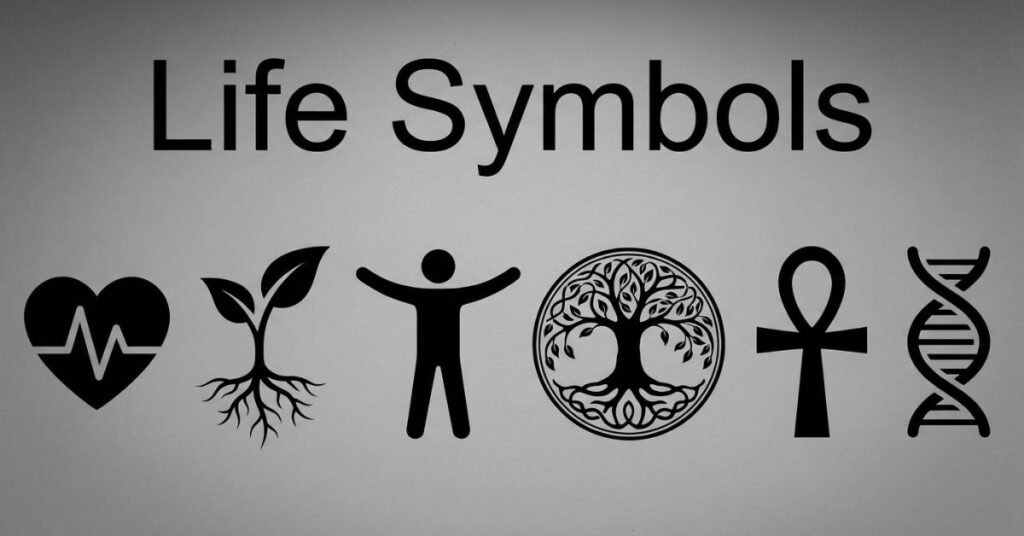
The Tree of Life shows up in Norse mythology as Yggdrasil, in the Kabbalah as a spiritual map, in Celtic art as Crann Bethadh, and in Christian scripture from Genesis through Revelation. Despite the different names, the core image stays consistent: a tree with roots reaching into the earth and branches stretching toward the sky.
Read More: 7+ Symbols of Virgo That Reveal Its True Personality And Hidden Power
Tree of Life Symbols and Meanings
The roots represent ancestry and stability, the trunk represents the present self, and the branches represent relationships and future potential. Because the tree loses its leaves and grows them back every year, it has also become a popular symbol of resilience and renewal, which is why it appears so often in necklaces and wall art today.
Eternal Life Symbols

Symbols tied to eternity and immortality include the ankh, the infinity symbol, the ouroboros (a snake eating its own tail), the unbroken circle and the phoenix. None of these have a clear beginning or end, which mirrors the idea of life continuing beyond what we can see.
Symbols of Life
Beyond mythology, everyday nature offers simple symbols of life: the sun, flowing water, a growing tree, a hatching egg and a butterfly leaving its cocoon. These feel universal because nearly every culture has watched the same natural cycles unfold.
What Symbolizes Life
In short, anything that grows, breathes, moves or renews itself can symbolize life, including water, sunlight, breath, seeds and the human heartbeat.
Symbol of Life
There is no single, universally agreed upon symbol of life. The Tree of Life and the ankh are the two most recognized, though a spiral or a heartbeat line can carry the same weight depending on the person using it.
Life Symbols and Meanings
Because meaning is partly personal, many people choose a symbol that fits their own story rather than the most historically popular one, such as an egg for a new parent or a phoenix for someone rebuilding after a hard chapter.
Symbols for Life

People use life symbols in practical ways: as tattoos, engraved jewelry, wall art and wedding rings. Choosing a symbol this way turns an abstract idea into something you can see every day.
Symbol for Change in Life
When life feels like it is shifting, three symbols come up again and again: the spiral, representing a winding but forward journey; the butterfly, representing transformation through struggle; and the phoenix, representing rebuilding after loss.
Read More: 89+ Popular Sanskrit Symbols That Can Transform Your Life in 2026
Symbols That Have Deep Meaning
A symbol earns “deep meaning” status when it connects to something every human experiences: birth, growth, loss or death, which is exactly why the Tree of Life, the ankh and the infinity symbol have lasted for thousands of years.
Things That Represent Life
Common things that represent life include water, sunlight, a heartbeat, a seed and a tree, each tied to survival and long term connection.
What Represents Life
If you need one quick answer, growth and continuation are what represent life most consistently across cultures. Anything that visibly moves, changes or renews itself tends to become a life symbol somewhere in the world.
Things That Symbolize Life
A candle flame, a flowing river, a newly hatched egg and a budding flower are everyday things that symbolize life, instantly understood without needing explanation.
Symbol of Life Meaning
The meaning shifts slightly by culture. In ancient Egypt, the ankh represented breath, water and sunlight. In Christianity, the tree and the cross represent eternal life through faith. In Celtic tradition, interwoven knots represent life without beginning or end.
Symbol for Life
In medicine and pop culture, the heartbeat or EKG line has become a modern symbol for life, often used in tattoos to mark survival or recovery from illness.
Symbols That Represent Life
Across art, religion and design, the symbols that consistently represent life are the Tree of Life, the ankh, the infinity symbol, the lotus flower, the circle and the phoenix.
What Symbol Represents Life
If a single answer is needed, the Tree of Life is generally considered the most universal symbol representing life, since some version of it appears in nearly every major culture and religion.
Powerful Symbols with Deep Meanings
Some of the most powerful symbols with deep meaning extend beyond life itself, including the heart for love, the dove for peace, and the anchor for hope, all of which overlap with life symbolism because love, peace and hope are things people associate with living fully.
Symbol That Represents Life
When narrowed to one image, most cultures point back to the tree, the circle or the ankh as the symbol that best represents life as an ongoing, connected process.
Symbols Representing Life
Across centuries of art, the symbols representing life have stayed surprisingly consistent. Cave paintings, religious manuscripts and modern tattoo flash sheets all return to the same handful of shapes: trees, circles, suns and spirals.
Objects That Represent Life
Physical objects that represent life include a seed, an egg, a flame and a sapling, objects that show life happening in real time rather than just symbolizing it abstractly.
Symbols Meaning Life
If you search specifically for symbols meaning life, the ankh and the Tree of Life appear in almost every reputable source, followed closely by the lotus flower and the infinity symbol.
Symbolism for Life
Symbolism for life works because it compresses a complicated idea into something the eye can take in instantly, carrying centuries of meaning without a single word of explanation.
What Symbolises Life
Using the British spelling does not change the answer. What symbolises life are growth, breath, continuity and renewal, expressed through trees, water, light and cyclical shapes like circles and spirals.
Symbolism of Life
The symbolism of life exists because humans have always needed a way to process parts of existence that feel too big for ordinary language: birth, death, love and time.
Thing That Represent Life
If only one thing had to be chosen, breath is often considered the simplest thing that represents life, which is exactly why the Egyptian ankh was nicknamed the “key of life.”
Greek Life Symbols

Ancient Greek culture contributed several lasting symbols connected to vitality and continuity, often through mythology and nature rather than direct religious doctrine.
The Ankh-Style Cross (Sometimes Confused)
The ankh itself is Egyptian, not Greek, but it is often mistakenly grouped with Greek symbols because of its later use in Mediterranean art that blended Egyptian and early Christian influences.
The Greek Key (Meander)
This continuous, looping pattern represents infinity, unity and the eternal flow of life, and it appears on pottery, architecture and jewelry throughout Greek history.
The Owl
Associated with the goddess Athena, the owl represents wisdom and the ability to see clearly even in darkness, a quality tied to navigating life’s uncertainty.
The Olive Branch
The olive branch represents peace, victory and abundance. According to Greek myth, Athena gifted the olive tree to Athens, making it a lasting symbol of a sustained, peaceful way of life.
Spiritual Life Symbols and Meanings
Spiritual traditions around the world rely heavily on a small set of recurring symbols.
Lotus Flower
The lotus grows up through muddy water to bloom untouched on the surface, representing purity, enlightenment and rebirth in Egyptian and Buddhist traditions alike.
Tree of Life
As covered earlier, the tree represents growth and the balance between earth and sky, appearing in nearly every major spiritual system.
Infinity Symbol
Shaped like a sideways figure eight and introduced by mathematician John Wallis in 1655, the infinity symbol has come to represent everlasting love and a life that continues beyond physical limits.
Spiral
The spiral represents the winding, non-linear journey of personal growth, closely tied in Celtic spirituality to the cycles of nature and the soul.
New Life Symbols
Some symbols are specifically tied to beginnings rather than continuity.
Butterfly
The butterfly’s transformation from caterpillar to winged creature makes it a near universal symbol of personal change.
Sunrise
A sunrise represents fresh starts and the daily renewal of opportunity, common in recovery journeys and personal milestones.
Egg
The egg represents pure potential, appearing in spring celebrations across many cultures as a symbol of fertility and new beginnings.
Phoenix
In Greek mythology, the phoenix burns to ash and rises again, making it one of the strongest symbols of starting over.
Base 12 Eternal Life Symbols
The number twelve functions as a symbol of completeness and eternal cycles in several traditions, from the twelve months that repeat every year to the twelve hours that circle a clock face endlessly. Because it divides so cleanly and repeats so consistently, twelve has long been linked to cosmic order and the idea of time renewing itself rather than running out.
Egyptian Life Symbols

Ancient Egypt produced some of the most recognizable life symbols in history.
The Ankh
Known as the key of life, the ankh has a loop on top of a T-shaped cross. It represented breath, water, sunlight and eternal life, and Egyptian gods were often shown offering it to pharaohs.
The Scarab Beetle
The scarab was linked to the sun god Khepri, believed to roll the sun across the sky each day, making the scarab a symbol of rebirth and daily renewal.
The Djed Pillar
Shaped like a stacked column, the djed pillar represented stability and endurance, closely associated with the god Osiris and placed in tombs to support continued existence.
The Eye of Horus
Representing protection, healing and royal power, the Eye of Horus was used as a protective amulet meant to guard the living and the dead from harm.
Life Symbols With Meaning
A life symbol only carries weight when paired with meaning. The shape itself is simple. The story behind it, mythological, religious or deeply personal, is what gives it lasting power.
Life Symbols Casket Corners
In the funeral industry, decorative medallions known as “LifeSymbols” are sometimes added to the corners of a casket to personalize it around the deceased’s faith, hobbies or military service. Common choices include crosses, doves, flowers and anchors, offering one last quiet expression of a person’s life.
Life Life Symbols and Meanings
Whichever way the phrase is searched, the underlying question stays the same: which images best capture the experience of being alive. The tree, the circle, the ankh and the infinity symbol remain the most consistent answers across cultures.
Everyday Life Symbols

Not every life symbol is ancient or religious. Keys, anchors, compasses and candles have taken on symbolic meaning in modern life, representing direction, hope and the small light that keeps moving forward.
Real Life Symbols
Real life symbols are the ones people choose for themselves rather than ones assigned by tradition, like a tattoo chosen after surviving a hard season or a ring worn to mark a personal milestone.
Meaning of Life Symbols
These symbols do not answer the philosophical question “what is the meaning of life.” Instead, they give people a visual anchor for the meaning they have already found through their own experiences.
Real Life Symbols of Rebellion
Some symbols represent life by representing resistance against forces that threaten it. The raised fist has long stood for solidarity and the fight for human rights. The broken chain represents freedom from oppression. The semicolon, popularized by the mental health awareness movement, represents a sentence the author could have ended but chose not to, symbolizing the choice to keep living.
Deep Symbolic Meaning of Life Symbols
Spiritual Meaning
Spiritually, life symbols often represent a connection between the physical body and something larger, whether described as the soul, the divine, or the universe.
Psychological Meaning
Psychologically, these symbols function as anchors for identity. Carl Jung described many of these shapes as archetypes, recurring images the mind reaches for instinctively when processing growth and change.
Cultural Meaning
Culturally, life symbols carry shared history. Wearing or displaying one can connect a person to generations of ancestors who used the same image to express the same hopes.
Types and Variations of Life Symbols
1. The Tree of Life
Represents growth, family and connection between earth and sky.
2. The Ankh
Represents breath, eternal life and protection.
3. The Infinity Symbol
Represents endlessness, faith and unconditional love.
4. The Spiral
Represents the winding journey of personal growth.
5. The Lotus Flower
Represents purity, enlightenment and rebirth.
6. The Phoenix
Represents renewal after destruction.
7. The Circle
Represents wholeness, unity and unbroken cycles.
Life Symbols Across Cultures
Ancient Egypt
Egypt gave the world the ankh, the scarab and the lotus, all tied closely to breath, rebirth and the afterlife.
Celtic Culture
Celtic art favors the Tree of Life, known as Crann Bethadh, along with spirals and interwoven knotwork representing eternity.
Eastern Cultures
In Buddhism and Hinduism, the lotus represents enlightenment, while the yin yang symbol represents the balance between opposing life forces.
Greek Mythology
Greek culture offers the olive branch, the owl and the phoenix myth, each tied to peace, wisdom and renewal.
Native American Culture
Many Native American traditions use the circle, often called the medicine wheel, along with the eagle feather and the turtle, a recurring symbol of the earth and enduring life.
Life Symbols in Art, Movies and Pop Culture
Movies
Films often lean on life symbols to express big themes visually, from sacred trees representing connection to nature, to circular imagery used to express the ongoing cycle of life.
Paintings
Gustav Klimt’s famous “Tree of Life” reimagined the ancient symbol with swirling gold branches, helping introduce it to a modern art audience.
Tattoos
Among symbolic tattoos, the ankh, the infinity symbol, the Tree of Life and the semicolon are some of the most requested designs, each marking survival, faith or personal transformation.
Fashion and Jewelry
Infinity rings, ankh pendants and Tree of Life necklaces remain popular gifts because they let someone wear a meaningful idea rather than just an accessory.
Spiritual and Dream Meaning of Life Symbols
In many dream interpretation traditions, seeing a tree points to personal growth, while water often points to emotional renewal. An egg is frequently linked to untapped potential, and sunrise imagery is generally read as a sign of new beginnings. These interpretations are folk traditions rather than clinical findings, best treated as food for reflection.
Positive and Negative Meaning of Life Symbols
Positive Meaning
Most life symbols carry hopeful meanings: growth, resilience, renewal, protection and connection to something larger than oneself.
Negative Meaning
A few ancient life symbols have unfortunately been misused throughout history. The most well known example is the swastika, which began as a symbol of good fortune in Hindu, Buddhist and Jain traditions long before it was tragically co-opted in the twentieth century, a reminder that symbols carry the weight of how they are used.
Why Humans Are Attracted to Life Symbols
People are drawn to life symbols because the mind naturally looks for patterns and meaning, especially around topics as big as mortality. A symbol turns an overwhelming idea like death, growth or eternity into something small enough to hold, wear or look at every day. That sense of comfort is part of why these same shapes have survived for thousands of years across cultures that never had contact with one another.
FAQ’s
What is the universal symbol of life?
The Tree of Life is the closest thing to a universal symbol of life, appearing in some form across Egyptian, Norse, Celtic, Christian and Kabbalistic traditions.
What does the ankh symbol mean?
The ankh is an ancient Egyptian symbol meaning life and breath, often shown being offered to pharaohs by the gods.
What flower symbolizes life?
The lotus flower symbolizes life because it rises clean and beautiful from muddy water, representing purity and rebirth.
What animal symbolizes life?
The phoenix and the butterfly are the animals most associated with life, both representing renewal and transformation.
What color symbolizes life?
Green is the color most associated with life, since it is tied to growth, nature and renewal in most cultures.
Is the Tree of Life a religious symbol?
Yes, the Tree of Life appears in Christianity, Judaism, Norse mythology and Celtic spirituality, though it is also used in non-religious art and jewelry today.
What is the symbol for new life?
The egg, the butterfly and the sunrise are the most common symbols for new life and fresh beginnings.
Conclusion
Life symbols have survived for thousands of years because they answer a need that never goes away: the desire to make sense of being alive. Whether it is the Egyptian ankh, the Celtic Tree of Life, a simple sunrise, or a symbol you choose for entirely personal reasons, what matters most is the meaning you attach to it. The right symbol does not just decorate your life. It reflects it back to you.

Daniel Wilson is the admin of Meaning Lexi, a website focused on the meanings of words, names, phrases, and symbols. He is dedicated to providing clear, accurate, and easy-to-understand content for readers.