Have you ever looked at a Filipino tattoo or artifact and felt there was a deeper story behind every curve and line? You were right. Filipino symbols carry centuries of history, spiritual wisdom, and cultural pride compressed into visual form. From the soaring Philippine Eagle to the intricate strokes of Baybayin, each symbol tells a story that no textbook fully captures.
This guide covers 60+ Filipino symbols and their meanings, organized by type, origin, and significance. Whether you are researching cultural heritage, planning a meaningful tattoo, or simply curious about Southeast Asian history, this article gives you everything you need to know.
What Are Filipino Symbols?
Filipino symbols are visual or written marks that represent the values, beliefs, history, and identity of the Filipino people. They include national emblems, ancient scripts, indigenous tribal patterns, mythological creatures, and everyday icons embedded in art and life.
These symbols did not appear overnight. They evolved across pre-colonial indigenous cultures, survived Spanish colonization, absorbed Chinese and Malay influences, and continue to shape modern Filipino identity. A single symbol can hold meaning on multiple levels: spiritual, political, cultural, and personal.
Filipino Cultural Symbols And Their Meanings
Filipino Symbols and Meanings
Filipino symbols broadly fall into several categories: national symbols officially recognized by law, pre-colonial indigenous marks, tribal tattoo patterns, mythological figures, and natural emblems. Together, they form a layered identity that stretches back more than a thousand years.
Filipino Flag
The Philippine flag is arguably the most powerful of all Filipino symbols. Adopted on June 12, 1898, it features a horizontal bicolor design with blue on top representing peace, truth, and justice, and red below representing patriotism and valor. A white equilateral triangle sits on the left side, containing a golden sun with eight rays and three golden stars.
Each element carries specific meaning: the eight sun rays represent the first provinces that revolted against Spanish rule, the three stars stand for the three major island groups of Luzon, Visayas, and Mindanao, and the white triangle symbolizes equality and fraternity. There is also one rarely discussed detail: when the red stripe is placed on top, it officially signals that the country is at a state of war.
Read More: FW Meaning in Text (2026 Update): Slang, Email, and Social Media Contexts
Filipino Symbols Tattoos

Tattoos in Filipino culture are among the most personal forms of symbolic expression. Ancient Filipino warriors wore tattoos called “batok” to mark their achievements in battle. The more tattoos a warrior had, the more respected they were in the community.
Traditional Filipino tattoo symbols draw from nature: waves for resilience, sun patterns for guidance, spear motifs for protection, and geometric shapes connected to ancestral spirits. These designs were not decorative. They were sacred markers of identity, rank, and spiritual alignment.
Today, Filipino symbols tattoos have a global following. People from all backgrounds choose these ancient patterns to honor Filipino ancestry or simply because the designs carry a depth that modern art rarely matches.
Filipino Symbols Letters
When people refer to Filipino symbol letters, they are usually talking about Baybayin, the indigenous pre-colonial script of the Philippines. This elegant writing system used curved and angular characters to represent syllables. It was written from left to right and consisted of 17 basic characters: 14 consonants and 3 vowels.
The word Baybayin itself comes from the Tagalog root word “baybay,” meaning “to spell.” Unlike the modern Latin-based Filipino alphabet, Baybayin captured a distinctly Southeast Asian phonetic structure tied to indigenous identity.
Philippines Symbols and Meanings
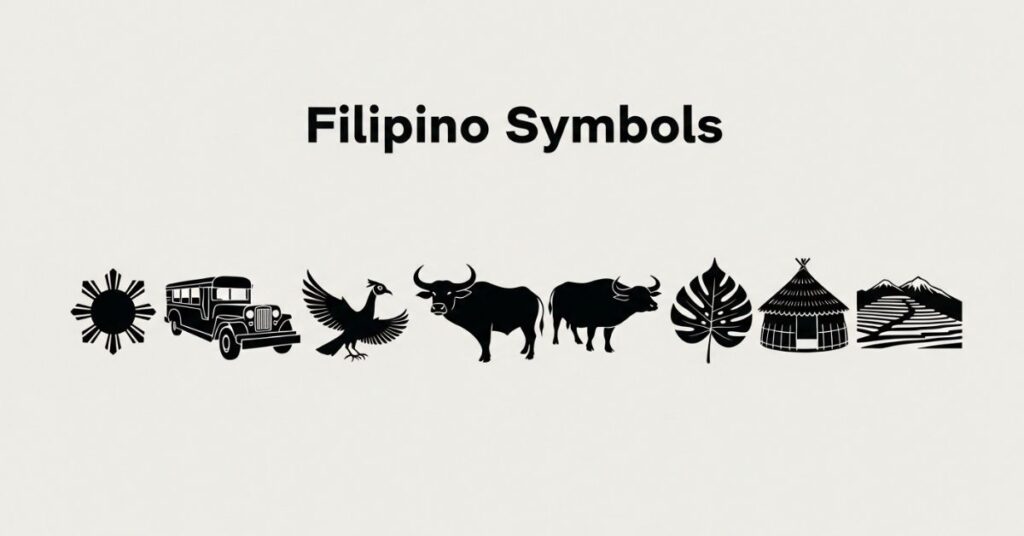
Beyond the national symbols recognized by law, the Philippines is rich with unofficial cultural symbols: the bamboo representing resilience and adaptability, the sampaguita flower representing purity, the jeepney representing Filipino ingenuity, and the carabao representing hardworking spirit and strength.
National Symbols Of The Philippines
What Are the 10 National Symbols of the Philippines
The Philippines has twelve officially recognized national symbols passed through law. These include the Philippine Flag, Filipino language, Coat of Arms, Sampaguita (national flower), Narra (national tree), Philippine Eagle (national bird), Philippine Pearl (national gem), Arnis (national martial art and sport), Filipino Sign Language, and the national anthem Lupang Hinirang.
Some widely circulated lists include the carabao as national animal, milkfish as national fish, and mango as national fruit. However, the National Commission for Culture and the Arts (NCCA) clarifies that many of these lack official legal basis and should be treated as popular but unofficial symbols.
Philippine National Symbols PDF
Official documentation for Philippine national symbols is maintained by the NCCA and DepEd. Teachers and students can access reference PDFs through DepEd Tambayan and the NCCA official website, which provide legally verified descriptions and proclamation numbers for each symbol.
Philippines National Bird
The Philippine Eagle was officially declared the national bird in 1995 through Proclamation No. 615 signed by President Fidel V. Ramos. It is one of the largest, most powerful birds of prey in the world and is found exclusively in the Philippine archipelago. It represents strength, freedom, and the Filipino people’s fierce drive to protect their sovereignty and natural environment.
Philippine National Symbols with Pictures and Description
Each official symbol comes with a legally defined description. The Sampaguita, declared national flower in 1934, represents purity and simplicity. The Narra tree, declared national tree in the same year, symbolizes strength and resilience. The South Sea Pearl, declared national gem in 1996, represents the Philippines’ unique natural wealth. Together, these symbols paint a portrait of a nation rooted in nature and proud of its heritage.
National Tree of the Philippines
The Narra tree (Pterocarpus indicus) holds the distinction of being the national tree. It is a hardwood tree celebrated for its durability, its pleasant rose-like scent, and its practical uses in woodcarving and furniture making. Beyond its material value, the Narra symbolizes the indomitable spirit of the Filipino people: strong, rooted, and useful under any conditions.
Ancient And Traditional Filipino Symbols
Ancient Filipino Symbols

Long before Spanish colonizers arrived, Filipino communities had a rich visual language rooted in animist beliefs, nature worship, and tribal identity. Ancient Filipino symbols were carved into wood, woven into textiles, etched onto gold, and inked onto skin.
These marks connected the living to the spiritual world. They honored anitos, the ancestral spirits believed to guide and protect communities. They marked transitions like birth, adulthood, marriage, and death. They were never mere decoration.
Filipino Symbolism
Filipino symbolism is deeply tied to the natural world. Water represents life, change, and spiritual cleansing. Mountains symbolize strength and the home of deities. The sun is a universal symbol of divine power, guidance, and the cycle of life. Birds, particularly the mythological Sarimanok, carry messages between the human and spirit worlds.
This reverence for nature as a living, interactive universe is a cornerstone of pre-colonial Filipino spirituality and continues to surface in modern Filipino art, literature, and design.
Traditional Filipino Symbols
Traditional Filipino symbols vary significantly by region and ethnic group. The Maranao people of Mindanao are famous for their Okir patterns: flowing, interlocking geometric and floral designs that appear on boats, furniture, and cloth. The T’boli people of South Cotabato expressed their cosmology through T’nalak woven textiles, using only red, black, and white thread to encode sacred symbols.
The Cordillera peoples of northern Luzon used geometric tattoo patterns to mark life milestones, while the Visayans developed their own tattoo tradition so extensive that early Spanish colonizers called them “Los Pintados,” meaning “the painted ones.”
Filipino Good Luck Symbols
Several Filipino symbols are associated with good fortune. The Sarimanok, the colorful mythological bird of the Maranao people, is a prime example. It is traditionally placed atop ceremonial umbrellas of royalty and is said to bring good luck to whoever encounters it. The sampaguita flower worn in garlands is also considered an auspicious symbol of blessing and welcome.
Filipino Ancient Symbols for Strength
Ancient strength symbols include the sun, a recurring motif across multiple Filipino cultures representing both physical and spiritual power. Warrior tattoos featuring spear patterns, crocodile scales, and geometric zigzags also carried meanings of courage and invincibility in battle.
Filipino Indigenous Symbols
Indigenous Filipino symbols reflect the worldview of more than 100 distinct ethnic groups. These include the Ifugao people’s rice terraces as a symbol of harmony with nature, the Mangyan script of Mindoro as a form of spiritual communication, and the Tausug weaving patterns of the Sulu archipelago as expressions of royal identity and protection.
Filipino Protection Symbols
Many ancient Filipino symbols served a protective function. Tattoos were believed to ward off evil spirits. Geometric patterns woven into clothing were thought to shield the wearer from harm. Anito figures, small wooden or gold carvings representing ancestral spirits, were kept in homes as guardians of the family.
Filipino Symbols Of Identity, Culture And Strength
Family Filipino Symbols and Meanings
Family is the foundation of Filipino society, and this is reflected in its symbols. The Bahay Kubo (nipa hut) represents the value of bayanihan, the Filipino spirit of collective unity and communal support. The image of multiple hands working together is a recurring motif in traditional Filipino weaving and folk art, symbolizing the interdependence of family members.
Filipino Symbols for Strength

The most widely recognized Filipino strength symbols include the carabao (representing patient endurance), the Philippine Eagle (representing fierce independence), and the bamboo plant (representing the ability to bend under pressure without breaking). In tattooing traditions, the sun and geometric diamond patterns are also powerful markers of inner strength.
Symbols That Represent Filipino Culture
Key cultural symbols include Baybayin script (representing pre-colonial literacy and pride), the Sarimanok (representing artistry and mythology), the T’nalak textile (representing indigenous weaving traditions), Arnis sticks (representing martial heritage), and the sampaguita garland (representing hospitality and warmth).
Indigenous Filipino Symbols
Indigenous Filipino symbols are among the richest and most underexplored areas of Philippine cultural heritage. They span scripts, tattoos, woven codes, carved patterns, and ceremonial objects, all encoding complex beliefs about the universe, community, and the spiritual world.
Symbols of Filipino Identity
Filipino identity symbols often appear at the intersection of pre-colonial heritage and modern nationalism: the Baybayin character appearing on the cover of Philippine passports, the Philippine Eagle on official seals, and the three stars and sun motif reproduced across everything from government documents to pop culture merchandise.
More Ancient And Cultural Filipino Symbols
Ancient Filipino Symbols and Meanings
Ancient Filipino symbols encoded meaning into every visual choice: the number of zigzags in a weaving, the position of a sun on a tattoo, the direction of curves in a script character. These were not arbitrary choices. They were a language.
Filipino Cultural Symbols
Filipino cultural symbols today are a blend of indigenous, colonial, and modern influences. The jeepney, colorfully decorated and uniquely Filipino, has become a cultural symbol of creativity under constraint. The Barong Tagalog, the embroidered men’s national dress, represents elegance, dignity, and cultural pride.
Ancient Filipino Symbols for Strength
Warriors among the Kalinga people of the Cordillera wore tattoos that became more elaborate with every act of courage. The sun with radiating lines was considered the most powerful strength symbol, appearing across multiple tribal traditions as a mark of spiritual and physical dominance.
Filipino Symbols for Family

Symbols representing family include the Bahay Kubo, the carabao as the family’s working partner, and community weaving patterns that visually represent interconnected lives. In many indigenous communities, family lineage was literally woven into textile patterns passed down through generations.
Traditional Filipino Symbols and Meanings
Traditional symbols carry layered meanings that combine the visible and the spiritual. A crocodile motif in Maranao art represents both earthly power and ancestral authority. A serpent pattern in Visayan tattooing represents both danger and protection depending on its placement on the body.
Old Filipino Symbols for Strength
Pre-colonial Philippine gold jewelry, many pieces of which survive in museum collections, featured sun discs, bird figures, and geometric patterns that served as talismans of strength and status. The Laguna Copperplate Inscription, the oldest written document found in the Philippines (dated 900 CE), proves that symbolic literacy in the archipelago stretches back more than a thousand years.
Tagalog Family Filipino Symbols and Meanings
Tagalog traditions include using sampaguita garlands as symbols of family love and welcome. The bayanihan concept, visually represented by neighbors carrying a house together, is a distinctly Tagalog-rooted symbol that has become a national emblem of cooperative spirit.
Common Filipino Symbols
The most commonly recognized Filipino symbols across all demographics include the Philippine Flag, the Sarimanok, Baybayin script, sampaguita flower, carabao, Philippine Eagle, Bahay Kubo, and the sun motif.
Filipino Symbols and Practices
Filipino symbols are not merely visual. They are embedded in practice. The raising of the flag is a ritual of patriotism. The wearing of Barong Tagalog at formal events carries cultural weight. The act of getting a traditional batok tattoo is a spiritual ceremony, not just a cosmetic procedure.
Warrior Filipino Symbols
Warrior symbols in the Philippines are diverse and powerful. Among the Visayans, tattoos covered nearly the entire body of accomplished fighters. Among the Maranao, the kris (a wavy-bladed sword) is both a weapon and a status symbol. Among the Cordillera peoples, headhunting-related tattoos marked a warrior’s most important achievements.
Ilocano Ancient Filipino Symbols and Meanings
The Ilocano people used Baybayin script to record their language and cultural traditions before colonization. Their textile traditions, particularly the abel weaving of Vigan, encode geometric symbols representing natural elements and community values. Ilocano warrior culture also had its own tattoo traditions connected to courage and spiritual power.
Deep Symbolic Meaning of Filipino Symbols
Spiritual Level
On a spiritual level, Filipino symbols served as bridges between the visible and invisible worlds. Anito figures invited ancestor spirits to protect the living. Tattoos carried magical protective power. The Sarimanok delivered messages from gods to humans. Every symbol held a sacred charge that went beyond its visual form.
Psychological Level
Psychologically, Filipino symbols serve as anchors of identity in a diaspora that spans the globe. For millions of Filipinos living abroad, a Baybayin tattoo or a Philippine Eagle necklace is a daily reminder of who they are and where they come from. These symbols provide belonging, pride, and emotional grounding.
Cultural Level
Culturally, Filipino symbols function as shared language across more than 170 dialects and 7,000 islands. They create a sense of nationhood that transcends regional and linguistic differences, binding people together under common imagery of sun, eagle, bamboo, and flag.
Types and Variations of Filipino Symbols
Sarimanok
The Sarimanok is a mythological bird of the Maranao people of Mindanao. It is depicted as a brilliantly colored rooster or hen holding a fish in its beak or talons. The word combines “sari” (assorted) and “manok” (bird/chicken). It appears in boat prows, royal umbrellas, sculptures, and modern art as a symbol of good fortune, beauty, and divine connection.
Sun and Stars of the Philippine Flag
The eight-rayed sun is one of the most reproduced symbols in the Philippines. Each ray represents one of the eight provinces that first rebelled against Spanish rule: Batangas, Bulacan, Cavite, Laguna, Manila, Nueva Ecija, Pampanga, and Tarlac. The three stars represent Luzon, Visayas, and Mindanao.
Anito Figures
Anito are carved wooden or metal figures representing ancestral spirits in pre-colonial Filipino belief systems. They were placed in homes and community spaces as guardians and intermediaries with the spirit world. Today, antique anito figures are prized cultural artifacts preserved in museums across the Philippines and the world.
Okir Patterns
Okir is the decorative art tradition of the Maranao and Maguindanao peoples of Mindanao. These flowing, interlocking designs feature stylized plants, animals, and geometric forms. Okir appears on the prows of traditional boats called “lanong,” on royal furniture called “torogan,” and in fabric designs. It represents the sophisticated artistic heritage of Muslim Mindanao.
Baybayin Script
Baybayin is an alphasyllabary, meaning each character represents a consonant-vowel syllable. It consists of 17 basic characters written from left to right. The script likely derived from the Kawi script of Java and Bali, reflecting the Philippines’ deep historical connections with the broader Southeast Asian world. Today, Baybayin appears on Philippine passports, official documents, and in the revival movement of pre-colonial culture among young Filipinos.
Filipino Symbols Across Cultures
Filipino symbols did not develop in isolation. They reflect centuries of trade and exchange with Chinese, Malay, Indian, Arab, and later Spanish and American cultures. The Baybayin script shows Indian Brahmic script influence. Okir patterns share visual DNA with Islamic geometric art. Spanish colonial architecture became a symbol of the Philippines itself. This cultural layering is what gives Filipino symbolism its extraordinary richness and complexity.
Filipino Symbols in Art, Movies and Pop Culture
Filipino symbols have gained significant visibility in global pop culture. The Sarimanok appears in international art exhibitions and Filipino-American murals. Baybayin script tattoos are popular in Filipino communities across the United States, Canada, and Australia. Filipino filmmakers like Lav Diaz and John Ford Coley weave indigenous symbols into visual storytelling. Marvel’s introduction of Filipino hero characters has also sparked renewed interest in Filipino mythological symbols and pre-colonial iconography among younger audiences worldwide.
Spiritual and Dream Meaning of Filipino Symbols
In Filipino folk belief, dreaming of the Philippine Eagle is an omen of incoming strength and good news. Dreaming of the sampaguita flower signals purity of heart and upcoming blessings. Seeing the Sarimanok in a vision or dream is considered a message from ancestral spirits. Water imagery in dreams is tied to emotional and spiritual cleansing, rooted in animist traditions that predate colonization by centuries.
Positive vs Negative Meaning
Most Filipino symbols carry primarily positive meanings: strength, protection, unity, and spiritual connection. However, some symbols have dual meanings depending on context. A crocodile motif in traditional art can represent both power and danger. The kris sword symbolizes honor in peace but vengeance in conflict. Inverted positioning of the Philippine Flag transforms it from a symbol of peace to a declaration of war. This duality reflects the sophisticated symbolic thinking embedded in Filipino cultural traditions.
Why Humans Are Attracted to Filipino Symbols
People are drawn to Filipino symbols for several deeply human reasons. First, they carry visual beauty: the curves of Baybayin, the colors of the Sarimanok, and the geometric perfection of Okir patterns satisfy an aesthetic desire for artistry with meaning. Second, they offer identity anchoring in an increasingly fragmented world. Third, they connect individuals to something larger than themselves: a community, a history, and a spiritual tradition that has survived centuries of colonial disruption. In a world hungry for authentic meaning, Filipino symbols deliver exactly that.
FAQ’s
What is the most important Filipino symbol?
The Philippine Flag is the most important official Filipino symbol, representing independence, unity, and sovereignty of the nation.
What does the sun in the Philippine Flag mean?
The eight-rayed golden sun represents the first eight provinces that rebelled against Spanish colonial rule, symbolizing freedom and the dawn of independence.
What is Baybayin?
Baybayin is an ancient pre-colonial Filipino writing system consisting of 17 syllabic characters, used before the Spanish introduced the Latin alphabet in the 16th century.
What does the Sarimanok represent?
The Sarimanok is a mythological colorful bird from Maranao culture representing good fortune, divine connection, and the artistic richness of southern Philippine traditions.
What are Filipino protection symbols?
Traditional Filipino protection symbols include tattoo patterns worn by warriors, anito (ancestor spirit) figures kept in homes, and geometric designs woven into clothing and textiles.
Is the carabao an official national symbol?
The carabao is widely recognized as a cultural symbol of Filipino hardwork and strength, but it lacks official legal status as a national symbol under Philippine law.
What does the narra tree symbolize?
The narra tree, the national tree of the Philippines, symbolizes resilience, strength, and the enduring spirit of the Filipino people.
What is the national bird of the Philippines?
The Philippine Eagle, declared national bird in 1995 through Proclamation No. 615, is one of the world’s largest birds of prey and a symbol of Filipino freedom and power.
Conclusion
Filipino symbols are far more than decorative images. They are a living archive of one of Asia’s most complex and resilient cultures. From the ancient strokes of Baybayin to the radiating rays of the sun on the national flag, every symbol carries the weight of centuries of history, survival, and pride.
Whether you are a Filipino reconnecting with your roots, a cultural enthusiast exploring Southeast Asian heritage, or someone looking for meaningful tattoo inspiration, these symbols offer a window into a world where beauty and meaning are always inseparable.
The real power of Filipino symbols lies in what they demand from you: to look closer, learn deeper, and carry the story forward.

Daniel Wilson is the admin of Meaning Lexi, a website focused on the meanings of words, names, phrases, and symbols. He is dedicated to providing clear, accurate, and easy-to-understand content for readers.