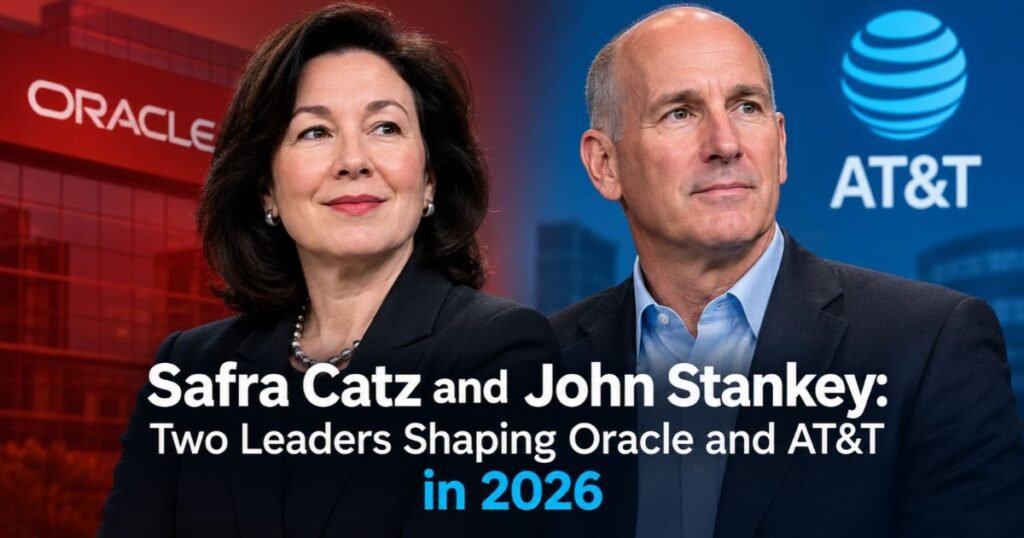
Safra Catz and John Stankey sit at the top of two very different American giants. One helped turn a database company into a cloud and AI powerhouse. The other reshaped a telecom and media conglomerate into a focused fiber and 5G business. Both stories matter to anyone who follows enterprise technology, telecom, or corporate leadership.
This guide explains who Safra Catz and John Stankey are, how they climbed to the top, and what their roles look like in 2026. It uses public filings, company announcements, and recent earnings reports. You will also find a side by side comparison and a short FAQ built for quick answers.
Quick answer:
In 2026, Safra Catz is Executive Vice Chair of Oracle’s board, a role she took in September 2025 after serving as CEO since 2014. John Stankey is Chairman and CEO of AT&T, leading the company since July 2020 and adding the chairman title in 2025.
Who Is Safra Catz?
Safra Catz is an Israeli-American business executive and one of the longest serving leaders in enterprise software. She joined Oracle in April 1999 and became a board member in 2001. She later served as chief financial officer, co-CEO, and sole CEO.
Catz is known for tight financial discipline, fast integration of acquired companies, and a low public profile. She rarely chases headlines. Her results, not her media presence, built her reputation.
Key facts at a glance:
- Born in December 1961 in Holon, Israel
- Education: University of Pennsylvania (undergraduate and law degrees)
- Joined Oracle: April 1999
- Oracle CEO: 2014 to September 2025 (co-CEO until 2019)
- Current title: Executive Vice Chair of the Oracle board
- Other roles: In-Q-Tel trustee, Paramount Skydance board member, Chair of the Oracle Education Foundation
Safra Catz’s Early Career and Finance Background
Catz started in investment banking in 1986 at Donaldson, Lufkin & Jenrette (DLJ). She rose to senior vice president in 1994 and managing director in 1997. Her work covered technology clients, which put her in regular contact with Oracle.
That relationship changed her path. Larry Ellison recruited her, and she moved to Oracle in 1999. She has said in past coverage that she wanted less travel, but the bigger story is fit. A deal maker with a strong grip on numbers was exactly what a fast growing software company needed.
This background explains her later style. She reads a balance sheet like a strategist, and she treats every acquisition as a math problem first.
How Safra Catz Built Her Career at Oracle
Catz became a senior vice president at Oracle in 1999 and an executive vice president within months. Over the next decade she gained responsibility for finance, operations, and mergers. In April 2011 she became co-president and CFO, reporting to Ellison.
In 2014, Ellison moved to chief technology officer and executive chairman. Catz and Mark Hurd became co-CEOs. In September 2019, Catz became sole CEO after Hurd stepped away for health reasons.
Oracle Acquisitions and Business Strategy
Catz is closely tied to Oracle’s buying spree. Her playbook was simple: buy proven products, cut overlap, and fold customers into Oracle’s ecosystem.
The major deals most often linked to her tenure include:
- PeopleSoft (2005): Expanded Oracle’s enterprise applications business.
- Sun Microsystems (2010): Brought Java and server hardware under the Oracle umbrella.
- NetSuite (2016): Gave Oracle a strong cloud ERP option for mid sized companies.
- Cerner (2022): A roughly $28 billion purchase that pushed Oracle deep into healthcare technology, now rebuilt as Oracle Health.
Beyond acquisitions, Catz backed the shift toward Oracle Cloud Infrastructure (OCI). That bet matured as AI training and inference demand surged. Oracle also joined the $500 billion Stargate Project with OpenAI and SoftBank to build AI data center capacity in the United States.
One analyst summary credited Catz with a 586 percent rise in Oracle’s stock during her years as CEO. Treat that as a headline figure, since stock performance depends on the measurement dates used.
From Oracle CEO to Executive Vice Chair
On September 22, 2025, Oracle announced that Clay Magouyrk and Mike Sicilia would become co-CEOs. Catz moved into the Executive Vice Chair role. Magouyrk had led OCI, and Sicilia had led Oracle Industries.
Catz described the timing as a moment of strength. In her words, it was the right time to pass the CEO role to the next generation of capable executives. The move was a planned succession, not an exit.
Who Is John Stankey?
John Stankey is the Chairman and CEO of AT&T. He is a classic company insider who spent nearly four decades moving through finance, strategy, technology, and operations roles before taking the top job.
Key facts at a glance:
- Joined AT&T (then part of the Southwestern Bell family) in January 1985
- Education: Loyola Marymount University (finance) and UCLA (MBA)
- President and COO: October 2019
- CEO: July 1, 2020
- Chairman: February 2025
- Outside roles: UPS board member and member of the National Security Telecommunications Advisory Committee
John Stankey’s Long Career Across AT&T
Stankey’s resume reads like a tour of the whole telecom industry. Company announcements list roles in corporate strategy and M&A, media and entertainment, operations, IT and technology, consumer mobility and broadband, and enterprise business.
He has served as chief strategy officer, chief technology officer, CEO of AT&T Operations, CEO of AT&T Business Solutions, CEO of the AT&T Entertainment Group, and CEO of WarnerMedia. That range gives him a rare view of both the network and the customer.
John Stankey’s Climb Through AT&T
Stankey did not arrive at the top through a single department. He earned trust by taking on hard assignments, including some that later became controversial.
From Technology Executive to AT&T CEO
AT&T’s board began succession planning in 2017. In September 2019, the company named Stankey president and COO while he continued to lead WarnerMedia. Randall Stephenson, who had led AT&T for 13 years, announced his retirement in 2020, and the board’s choice of Stankey was reported as unanimous.
Stankey became CEO on July 1, 2020. In February 2025, he also became board chair, succeeding William Kennard, who moved to lead independent director.
AT&T and the Shift Away From DirecTV
The media era at AT&T was short. The company bought DirecTV in 2015 and Time Warner in 2018. Stankey ran WarnerMedia after that deal. By 2021, AT&T had spun off DirecTV into a separate entity with TPG buying 30 percent, and WarnerMedia was combined with Discovery in 2022.
In 2024, AT&T agreed to sell its remaining 70 percent DirecTV stake to TPG for about $7.6 billion. Stankey summed up the logic by saying AT&T was repositioned around its connectivity strengths and aimed to lead in converged 5G and fiber services.
The lesson for readers: Stankey simplified the company. Less media, more network.
What Stankey Changed Inside AT&T
The biggest change is focus. AT&T now describes itself as a fiber and wireless connectivity company, and nearly every major decision supports that goal.
Key moves include:
- Selling the DirecTV stake to fund network investment
- Buying Lumen’s consumer fiber business for $5.75 billion, which closed in early 2026
- Agreeing to buy mid band spectrum from EchoStar in a roughly $23 billion deal
- Targeting more than 50 million fiber locations by the end of 2029
- Retiring legacy copper service, including FCC approval in 2026 for about 60 percent of California wire centers
A Customer-Focused Business Strategy
Stankey’s core idea is convergence. A household that buys home internet and mobile service from the same provider tends to stay longer and spend more. He has said converged customers show lower churn, stronger brand affinity, and higher lifetime value.
The numbers back the strategy. In the second quarter of 2026, AT&T reported:
- Revenue of $31.6 billion, up 2.3 percent
- Adjusted EBITDA of $12.3 billion, up 5.2 percent
- A best ever second quarter for fiber net additions
- A convergence rate of 42.5 percent among advanced home internet customers (45 percent excluding the acquired Lumen footprint)
- About $10 billion in planned 2026 share repurchases
His simple summary during the call was “where we have fiber, we win.”
Not everything is smooth. Management also noted that fiber ARPU fell about 1.3 percent year over year, mostly because Lumen customers pay less on average, and that construction can be bumpy in some regions.
AI and Technology at AT&T
Stankey frames AI as a connectivity story. As AI inference moves closer to users and businesses, networks need low latency and high bandwidth. He argues that fiber, combined with wireless, puts AT&T in a strong position for that demand.
AT&T also says it is using AI internally to lower costs. Management reported more than $1 billion in cost savings in 2025 and plans more efficiency gains through AI and digital transactions.
The contrast with Oracle is useful. Oracle sells the AI compute and applications. AT&T sells the network that carries AI traffic.
Safra Catz and John Stankey: A Side-by-Side Look
These two leaders do not compete. Still, comparing them shows how senior leadership works across industries.
| Factor | Safra Catz | John Stankey |
| Company | Oracle | AT&T |
| Current title | Executive Vice Chair | Chairman and CEO |
| Joined | 1999 | 1985 |
| Time as CEO | 2014 to 2025 | 2020 to present |
| Background | Investment banking, finance | Strategy, technology, operations |
| Signature theme | Cloud, AI, acquisitions | Fiber, 5G, convergence |
Different Industries, Similar Corporate Responsibilities
Both leaders manage the same core tasks: allocate capital, protect margins, and keep investors confident during a major technology shift. Both also deal with large debt or investment cycles tied to infrastructure. Oracle spends heavily on data centers. AT&T spends heavily on fiber and spectrum.
Two Different Paths to Corporate Leadership
Catz came from outside, joining Oracle after a decade in banking. She rose through finance and deal making. Stankey came up inside one company for almost 40 years, moving across technology, media, and operations.
One path shows how a financial mind can lead a tech company. The other shows how deep institutional knowledge can guide a complex turnaround.
Safra Catz and John Stankey in 2026
In 2026, both are still central figures, but in different seats. Catz advises and guides strategy from the board. Stankey runs daily strategy and carries both the CEO and chairman titles.
Where Each Leader Stands in 2026
Titles change, so here is the current picture based on filings and company reports available as of October 2026.
Safra Catz’s Current Role at Oracle
Oracle’s fiscal 2026 proxy statement lists Catz as Executive Vice Chair and a director since 2001. Day to day operations sit with co-CEOs Clay Magouyrk and Mike Sicilia. Larry Ellison remains chairman and chief technology officer.
Catz stays involved in the board’s strategic direction, which matters while Oracle scales AI infrastructure.
John Stankey’s Current Role at AT&T
Stankey is Chairman of the Board, CEO, and President. His 2026 agenda centers on:
- Integrating the Lumen fiber assets
- Deploying EchoStar mid band spectrum
- Growing converged fiber and wireless customers
- Returning cash to shareholders while reducing leverage toward the 2.5x range over time
He has also acknowledged that some investors have rotated toward AI stocks, and he expects AT&T’s valuation to reflect its network strengths over time.
What Their 2026 Positions Show
Three takeaways stand out:
- Planned succession works. Oracle handed power to insiders while keeping Catz’s experience on the board.
- Focus beats sprawl. AT&T became stronger by narrowing its mission.
- AI touches every sector. Oracle builds the compute. AT&T builds the pipes.
If you are researching either company, check the latest SEC filings and earnings calls, since leadership and figures can change.
Frequently Asked Questions
Is Safra Catz still the CEO of Oracle?
No. Catz stepped down as CEO in September 2025 and is now Executive Vice Chair, while Clay Magouyrk and Mike Sicilia serve as co-CEOs.
How long was Safra Catz CEO of Oracle?
She served as CEO from 2014 to 2025, first as co-CEO and then as sole CEO from 2019.
Who is the CEO of AT&T in 2026?
John Stankey is AT&T’s CEO and has held the role since July 1, 2020. He also became board chair in 2025.
When did John Stankey join AT&T?
He joined in January 1985 and has spent nearly four decades with the company.
Why did AT&T sell DirecTV?
AT&T sold its stake to focus on 5G and fiber and to fund network investment. The remaining 70 percent stake went to TPG for about $7.6 billion.
What is AT&T’s convergence strategy?
It means selling home internet (mainly fiber) and mobile service together to improve loyalty and lifetime customer value.
What major acquisitions are linked to Safra Catz?
PeopleSoft, Sun Microsystems, NetSuite, and Cerner are the best known Oracle deals from her time in senior leadership.
Do Safra Catz and John Stankey work together?
No. They lead separate companies, Oracle and AT&T, and there is no known business partnership between them.
Conclusion
Safra Catz and John Stankey show two proven ways to lead a large public company. Catz used financial discipline and smart acquisitions to help Oracle become a major force in cloud and AI. Now, as Executive Vice Chair, she supports a new generation of leaders. Stankey used decades of inside knowledge to simplify AT&T, exit satellite TV, and double down on fiber and wireless.
For readers in 2026, the practical lesson is clear. Strong leaders pick a lane, back it with capital, and plan succession early. To stay current, follow Oracle and AT&T investor pages and quarterly earnings releases, because both stories are still unfolding.

Daniel Wilson is the admin of Meaning Lexi, a website focused on the meanings of words, names, phrases, and symbols. He is dedicated to providing clear, accurate, and easy-to-understand content for readers.