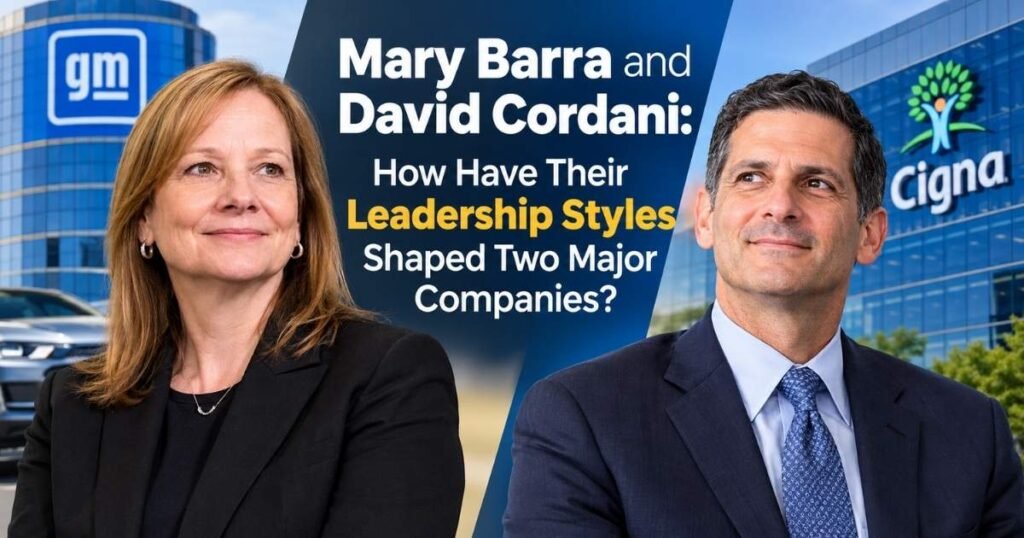
Few executive pairings get compared as often as Mary Barra and David Cordani, even though they run companies in completely different industries. Mary Barra and David Cordani are frequently mentioned together because both spent decades climbing internal corporate ladders before reaching the top job, and both used that experience to steer massive organizations through periods of disruption.
Barra took General Motors from a recall crisis to a company betting its future on electric vehicles and software. Cordani spent nearly 17 years turning Cigna from a traditional insurer into a $275 billion global health services company before becoming executive chair in July 2026. Their paths rarely crossed, yet both careers show how patience and long-term thinking reshape organizations.
This article breaks down how each leader rose to power, what makes their leadership styles distinct, and what lessons other executives and young professionals can take from their careers.
Understanding Mary Barra and David Cordani
Mary Barra is Chair and CEO of General Motors, a role she has held since January 2014. She is the first woman to lead a major global automaker, and her tenure has centered on electrification, software-defined vehicles, and renewed profitability.
David Cordani led The Cigna Group as CEO from 2009 until July 2026, when he became executive chair. Under him, Cigna grew from an $18 billion insurer serving 46 million customers into a global health platform generating roughly $275 billion in annual revenue and 185 million customer relationships. Brian Evanko, Cigna’s former president and COO, succeeded him as CEO.
Both leaders share a trait that matters more than industry: they built credibility from the inside, not by parachuting in from outside.
Mary Barra’s Journey to the Top
Mary Barra’s story is essentially a case study in internal mobility. She joined General Motors in 1980 as an 18-year-old co-op student inspecting fender panels at a Pontiac plant, while studying electrical engineering at what is now Kettering University.
Over the following three decades, she moved through plant management, vehicle engineering, global product development, human resources, and global purchasing. That breadth is unusual for a CEO; most executives specialize early. Barra instead built a 360 degree view of the automaker, which later shaped decisions touching manufacturing quality, labor relations, and product strategy.
She became CEO in January 2014, just weeks before GM’s ignition switch recall crisis became public. Rather than deflecting responsibility, Barra took ownership publicly, testified before Congress, and rebuilt trust through transparency, a moment that became the foundation of her leadership identity.
How Did Mary Barra Transform General Motors?
Barra’s transformation of GM has unfolded across several fronts rather than one dramatic pivot.
- Crisis response and cultural reset. After the recall crisis, Barra pushed a “speak up” culture, encouraging employees to flag safety concerns without fear of retaliation.
- Portfolio discipline. She exited unprofitable markets, including selling GM’s European operations, to concentrate capital on stronger businesses.
- Electrification strategy. GM committed billions to EV development and battery manufacturing, while staying flexible on timing as consumer demand shifted more slowly than expected.
- Software and recurring revenue. Barra has positioned OnStar and Super Cruise as higher margin, subscription style businesses rather than one time vehicle sales.
- Autonomous technology recalibration. After GM’s Cruise robotaxi unit faced safety setbacks, Barra redirected that technology toward personal autonomy features in consumer vehicles instead of a taxi fleet business.
These moves show a leader willing to change course publicly when the data demands it, rather than defending a strategy for the sake of consistency.
A Leadership Style Built Around Transformation
Analysts most often describe Mary Barra’s leadership style as transformational, with strong elements of collaborative and servant leadership layered on top.
- Empowerment over micromanagement. Barra famously shrank GM’s lengthy dress code policy down to two words, “dress appropriately,” trusting employees to use judgment.
- Accountability paired with trust. She holds teams to clear performance expectations while giving them room to make decisions.
- Communication skills forged early. During a 1998 GM labor strike, Barra helped bridge communication gaps between union workers and executives, sharpening her ability to listen across organizational layers.
- Values driven decision making. She has been vocal on diversity, workplace safety, and ethics, tying culture directly to business performance.
This combination lets Barra drive large scale strategic shifts, like the EV transition, without alienating the workforce that has to execute them.
David Cordani’s Rise in the Healthcare Industry
David Cordani joined Cigna in 1991 after beginning his career elsewhere in financial and insurance work. Like Barra, he spent decades in internal roles before becoming CEO in 2009, giving him a granular understanding of insurance, pharmacy benefits, and care delivery.
His tenure coincided with sweeping change in American healthcare, including the Affordable Care Act and rising drug costs. Rather than treating Cigna as a pure insurer, he pushed it toward becoming a broader health services organization. Key milestones include:
- Acquiring Express Scripts, a major pharmacy benefit manager
- Building out Evernorth Health Services, covering specialty pharmacy, virtual care, and benefits management
- Growing revenue from $18 billion to roughly $275 billion, and customer relationships from 46 million to more than 185 million
- Overseeing total shareholder return growth of more than 750 percent during his tenure
In March 2026, Cigna announced Cordani would retire as CEO effective July 1, 2026, moving into the executive chair role, with Brian Evanko taking over as chief executive.
What Makes David Cordani’s Leadership Approach Different?
Where Barra’s leadership narrative is framed around crisis and transformation, Cordani’s is framed around steady, deliberate expansion.
Customer centered strategy
Cordani repeatedly emphasized that growth only matters if it improves the customer experience, framing decisions around affordability and outcomes rather than pure margin expansion.
Long, disciplined succession planning
Cordani described his own exit as a “relay,” working with incoming CEO Brian Evanko for more than a year before the handoff rather than a sudden transition.
Diversification without losing focus
Instead of chasing unrelated acquisitions, Cordani concentrated Cigna’s expansion around health services adjacent to its core insurance business, reducing integration risk.
Financial discipline
Even while expanding aggressively, he maintained a reputation for meeting or exceeding financial guidance, sustaining investor confidence for nearly two decades.
The Importance of Long-Term Thinking
Both executives show why long-term thinking outperforms short-term reactivity in complex industries.
Barra’s EV strategy has faced criticism during slower than expected adoption periods, yet she has consistently reaffirmed GM’s 2035 target for an all electric lineup while adjusting pace based on real demand. Cordani’s decision to build Evernorth over multiple years, rather than seeking a quick acquisition and exit, let Cigna compound growth across connected businesses instead of a single product line.
The lesson for business leaders is simple: sustainable transformation rarely happens in a single fiscal year. Both leaders accepted short-term scrutiny in exchange for structural advantages that played out over a decade or more.
Mary Barra and the Future of Mobility
Barra continues to frame GM’s future around three connected priorities: electrification, personal autonomy, and software driven revenue.
On electrification, GM has scaled back rigid production targets while keeping its all electric ambition intact. On autonomy, Barra redirected Cruise related technology toward consumer features like hands-free highway driving in the Cadillac Escalade IQ rather than a robotaxi business. On software, GM is using AI design tools that let engineers estimate aerodynamics in minutes instead of weeks. It reflects her broader instinct: commit to a long-term vision, stay flexible on execution.
David Cordani and the Future of Healthcare
Even from the executive chair seat, Cordani’s influence on Cigna’s direction is expected to continue, particularly around long-term priorities like mergers, capital allocation, and dividend policy, while Evanko manages day to day operations.
The broader strategy Cordani built, connecting insurance, pharmacy benefits, and care delivery under one roof, positions Cigna to keep investing in data driven personalization and AI enabled care coordination. His emphasis on affordability and outcomes is likely to remain a defining theme of Cigna’s culture well beyond his time as CEO.
How Do Mary Barra and David Cordani Compare as CEOs?
| Leadership Area | Mary Barra | David Cordani |
| Industry | Automotive manufacturing | Health insurance and services |
| Tenure as CEO | Since January 2014 | 2009 to July 2026 |
| Career path | Entirely at General Motors since 1980 | Joined Cigna in 1991 after starting elsewhere |
| Defining strategy | Electrification and software transformation | Diversification into integrated health services |
| Signature trait | Crisis accountability and empowerment | Customer centered, disciplined growth |
| Recent milestone | Continues as Chair and CEO in 2026 | Moved to executive chair, succeeded by Brian Evanko |
The core similarity is clear: both are internal promotions who spent decades learning their organizations before leading them, and both prioritized long-term structural change over short-term optics.
Why Does Industry Experience Matter in Leadership?
Leadership research increasingly suggests that deep, sector specific experience often outperforms generalist executive hopping, especially in capital intensive or highly regulated industries like automotive manufacturing and healthcare.
Barra’s decades inside GM meant she understood plant operations and dealer networks before setting strategy at the top. Cordani’s decades in health services meant he understood regulatory complexity and pharmacy economics well enough to expand safely. For industries with long product cycles or heavy regulation, this earned expertise tends to reduce costly strategic mistakes.
What Leadership Lessons Can Businesses Learn From Mary Barra and David Cordani?
- Own your mistakes publicly. Barra’s handling of the 2014 recall crisis shows transparency builds more long-term trust than deflection.
- Plan succession years in advance. Cordani’s multi year handoff to Evanko reduced organizational risk and protected investor confidence.
- Stay flexible on tactics, firm on vision. Both leaders adjusted timelines while keeping their long-term direction intact.
- Build expertise from the ground up. Frontline and cross functional experience gives leaders credibility during high pressure decisions.
- Tie growth to customer value. Cordani’s insistence that growth must translate into better outcomes kept diversification strategically coherent.
The Role of Technology in Their Leadership
Technology sits at the center of both leaders’ strategies, though it shows up differently.
At GM, Barra has pushed AI into product design, alongside software like Super Cruise that generates recurring revenue. At Cigna, technology under Cordani focused on data analytics and AI enabled personalization to improve care coordination and cut costs across Evernorth. Both approaches reflect a shared belief: technology should serve a clear business outcome, not exist as an experiment.
How Have Their Leadership Styles Influenced Corporate Culture?
Barra’s empowerment focused style has pushed GM toward a flatter, more accountable culture, where employees are expected to use judgment and speak up rather than wait for top down instructions. Cordani’s customer centered style shaped Cigna’s culture around measurable outcomes, pushing insurance, pharmacy, and care teams to coordinate rather than operate in silos.
In both cases, culture became a deliberate extension of strategy rather than an afterthought, a distinguishing trait of effective modern leadership.
The Challenges Behind Executive Leadership
Leading a company the size of GM or Cigna comes with real friction that rarely appears in headline summaries.
Barra has had to manage slower than projected EV adoption, a scaled back robotaxi bet through Cruise, and shifting fuel economy regulations. Cordani navigated healthcare policy changes, rising drug costs, and the complexity of integrating a major pharmacy benefit manager. Neither avoided setbacks; what distinguishes their leadership is how publicly they addressed problems while holding their long-term direction.
What Can Young Professionals Learn From Their Careers?
For early career professionals, Barra and Cordani offer a counterpoint to the idea that fast promotions and job hopping are the only route to executive leadership.
- Both spent over a decade in operational, non glamorous roles before reaching senior leadership.
- Both used cross functional exposure, engineering and manufacturing for Barra, finance and healthcare operations for Cordani, to build a wider strategic toolkit.
- Both treated difficult assignments, like labor relations or regulatory complexity, as leadership development rather than obstacles to avoid.
Depth of experience, not just speed of promotion, shaped their credibility once they reached the top.
The Broader Meaning of Their Leadership
Mary Barra and David Cordani represent a leadership model built on patience, accountability, and long-term structural thinking rather than headline chasing. In industries facing massive disruption, automotive electrification and healthcare cost pressure among them, internally developed, deeply experienced leadership navigates uncertainty more effectively. Barra’s crisis driven transformation and Cordani’s steady diversification both point to the same principle: leadership credibility is built over years, not quarters.
FAQ’s
Who is Mary Barra?
Mary Barra is the Chair and CEO of General Motors, a role she has held since January 2014, and the first woman to lead a major global automaker.
Who is David Cordani?
David Cordani led The Cigna Group as CEO from 2009 to July 2026, when he became executive chair of Cigna’s board, succeeded as CEO by Brian Evanko.
Are Mary Barra and David Cordani related?
No. There is no public evidence of a family or personal relationship between them; their connection is purely professional, as two long tenured Fortune 500 CEOs.
What leadership style is Mary Barra known for?
Barra is most often described as a transformational and servant style leader who emphasizes empowerment, accountability, and direct communication.
What leadership style is David Cordani known for?
Cordani is known for customer centered, financially disciplined leadership focused on long-term diversification into integrated health services.
Why did David Cordani step down as Cigna CEO?
Cordani’s transition was part of a planned, multi year succession process, not a forced departure, and he remains involved as executive chair of the board.
What industries do Mary Barra and David Cordani lead?
Barra leads General Motors in automotive manufacturing, while Cordani led The Cigna Group in health insurance and health services.
Final Thoughts
Comparing Mary Barra and David Cordani reveals two distinct but equally effective leadership philosophies. Barra’s willingness to confront crisis head on and steer GM through a historic electrification shift shows the power of transformational, accountability driven leadership. Cordani’s steady, customer focused expansion of Cigna into a global health platform shows how disciplined, long-term diversification compounds value over nearly two decades.
Neither leader relied on shortcuts. Both built their authority through years of internal experience, and both continue to shape their industries: Barra as an active CEO steering GM through an uncertain automotive future, and Cordani as executive chair guiding Cigna’s next chapter alongside Brian Evanko. For any business leader or young professional studying modern executive leadership, their careers offer a clear reminder that patience, expertise, and long-term vision still matter more than speed.

Daniel Wilson is the admin of Meaning Lexi, a website focused on the meanings of words, names, phrases, and symbols. He is dedicated to providing clear, accurate, and easy-to-understand content for readers.